News briefing from Britain and Ireland


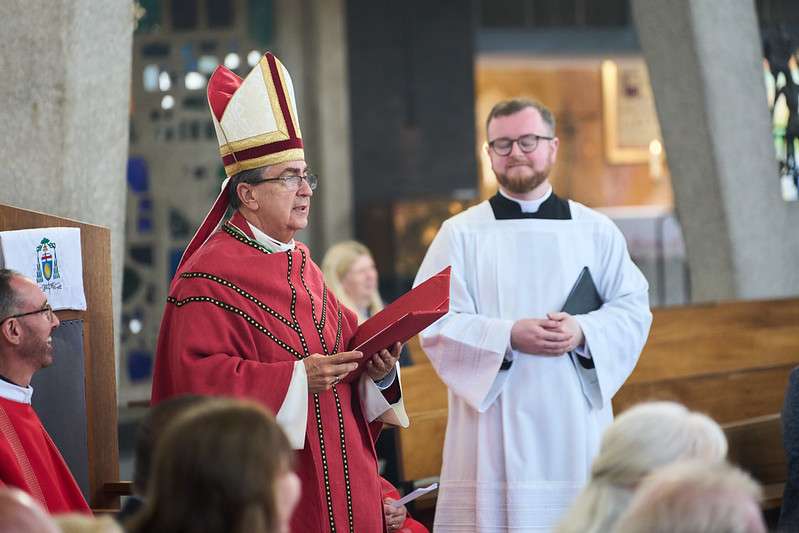
The Nuncio celebrates Mass at St Mary’s Leyland
© Mazur/cbcew.org.uk
The Apostolic Nuncio to Great Britain, Archbishop Miguel Maury Buendía, has spent five days on his first formal pastoral visit to the Archdiocese of Liverpool since May last year, meeting clergy, religious, Catholic educators, hundreds of school children and parish communities.
He also met civil and religious leaders at Liverpool Cathedral, celebrated Mass at St Oswald’s Church, Old Swan to mark the 175th anniversary of the Sisters of Mercy at the parish and presided at evening prayer at the Metropolitan Cathedral of Christ the King for the archdiocese, marking 175 years of the Chapter of Canons. There was also “A Concert for the Nuncio” on Saturday evening at St Francis de Sales Church. Archbishop of Liverpool John Sherrington said, “I would like to thank Archbishop Buendía for spending time with us here in the Archdiocese of Liverpool. It has been a great pleasure to welcome him and to share with him the life and mission of the archdiocese.” The Prison Advice and Care Trust has produced a report urging the Welsh government to help an estimated 5,000 Welsh children affected by having at least one parent in prison. Identifying and Supporting Children of Prisoners in Wales: A Rights-Based Case for Legislative and Policy Reform, written in partnership with the Children’s Legal Centre Wales, calls for Wales to introduce a statutory duty to identify children affected by parental imprisonment. It also asks the government to develop a national school-based model of identification and to support and create formal pathways of notification between justice agencies, schools and health services.
St Francis of Assisi parish in Handsworth, Birmingham is marking the 800th anniversary of the death of St Francis by holding a series of events from 21 September to 4 October. These include talks on the life of St Francis, an outreach collection for the local poor, a day of acts of charity and parish fellowship celebrating the Franciscan spirit of service and fraternity, school events and a special Mass. For further information, please email: stfrancis.bham@rcaob.org.uk.
A Gerard Manley Hopkins Study Day is being held by the Hopkins Society at the Birmingham Oratory from 10 am – 5pm on Saturday, 3 October. The Jesuit poet lived and work at the Birmingham Oratory School from 1867-68. The day includes a guided tour of the Oratory Church. Dr Andrew Hodgson of Birmingham University will give a talk on Hopkins as critic. Kasia Stefanowicz and Elaine Marshall will give a talk titled “How Newman helped Hopkins into Catholic Ways” while Chris Robson and Jill Martin will give the day’s final talk on “Hopkins and Colour: A playful interactive exploration”.
The Friends of Arundel Cathedral are undertaking a three-mile walking pilgrimage on Saturday, 26 September in honour of Our Lady and St Philip Howard. This begins with 10am Mass in Arundel Cathedral followed by a short period of adoration. The pilgrimage is free but please bring a packed lunch. The walk begins outside the main Cathedral door at 10.50pm and will end with tea and cake in the Cathedral Centre.
Professor Francis Davis of St Mary’s University, Twickenham said that a report from the Gather Movement indicating that all of Britain’s churches engaged in 250,000 social action projects had underestimated the true figure. At a seminar of the Fowley Island Institute, held jointly with Lincoln Bishop University and St Mary’s University, Davis said the work of the English Benedictine Congregation should be included for its vital contribution to rural life, while Caritas Social Action Network and UK Catholic schools reach more than a million people each year. Davis appealed for “deeper commitment to inter-disciplinary empirical political theology” to help lay people identify social needs.
The recently published Catholic Generosity report has been presented to Pope Leo XIV in Rome by Catholics in Fundraising. John Green, chair of the charity, noted the report’s emphasis the Church’s teaching on wealth, stewardship, philanthropy, ethical investment and estate planning. The report estimates that Catholic households hold around £1.2 trillion in wealth and contribute nearly £3 billion annually to charitable causes. It argues that Catholic Social Teaching provides a coherent framework uniting philanthropy, investment, wealth management and legacy giving as expressions of Christian stewardship.
Archbishop of Westminster Richard Moth has warned that violence “continues to engulf the Holy Land, pushing people apart while undermining hopes for peaceful co-existence in a two-state solution”. Archbishop Moth, president of the Catholic bishops’ conference of England and Wales, said in a statement that the two-state solution for Palestine and Israel must “remain the goal of all people of good will”, referencing Pope Leo XIV urgent appeal to the international community to work towards it.
Bishop of Leeds Marcus Stock has issued a pastoral letter setting out the progress that has been made since his appointment as Apostolic Administrator of the Diocese of Middlesbrough last December and as Apostolic Administrator of the Diocese of Hallam in March this year. Pope Leo asked him to initiate, among the clergy, religious and lay faithful, “a phase of study and discussion” with a view to their “possible future union”. In his pastoral letter he says, “The guiding principle which has underpinned our consultation has been not about how diocesan structures might change, but how those structures can better support the Church’s mission today and in the future.” A report is to be sent to Pope Leo and then published before the end of next month.
Bishop John Arnold, lead Catholic bishop for the environment in England and Wales, has urged Catholics to respond to the Season of Creation, which runs until 4 October, by caring for the natural environment as “co-workers with God so that the earth can provide a home in which all can flourish”. Drawing on Pope Leo XIV’s appeal to strive for an “end to the cycle of violence that destroys our common home”, Bishop Arnold said, “You might ask ‘What can I do in the face of such violent destruction of people and nature, often many thousands of miles away?’”. He said never to assume that changing our own hearts and our own behaviour will have no impact, and urged people in the West to consider how their own behaviour might contribute to these problems, whether it be through the abuse of drugs or the purchase of timber products from unethical sources. He also echoed Pope Leo’s call to promote peace and to disarm in every context, including where there is tension or conflict within our own communities within England and Wales.
The Scottish Bishops have concluded their annual meeting at the Royal Scots College in Salamanca. Items on the agenda included continuing discussion of the possible reconstruction of Scottish diocesan boundaries, making use of feedback from individual dioceses, a proposal to set up a National Evangelisation Commission and support for Aberdeen parents who are calling for a new Catholic secondary school in the city. There was renewed discussion of the need for accessible archives and a Scottish Catholic museum. In addition to daily Masses the Bishops made a day of retreat, led by the Scots College Rector, Fr John Carroll. The meeting coincided with the Nativity of the Blessed Virgin Mary, Salamanca’s patronal feast and focus of a week of celebrations.
Five cousins from [the island of] Barra have been cited in the BBC Radio nan Gaidheal Duaisean Dèan Diofar (Make A Difference) awards for their fundraising on behalf of Sciaf. Despite blustery conditions, during Lent 2026, Lewis Irving and Scott Campbell cycled 50km in an hour, marking the six decades the international trade charity has been operating. Ross Irving and Robbie Campbell, having abandoned plans to swim shore to shore at Castlebay, completed 5.4 km in the community pool in the same time. Rowan Campbell ran 12.5 km, completing her run in appalling weather at Barra airstrip. Mairi Campbell, mother of Rowan, Robbie and Scott spoke of the family’s pride and said “True to form, they are already working on a challenge for next year and I would expect bigger and better”.
Synodality is sometimes “misunderstood” as just another programme, a succession of meetings or even a kind of ecclesiastical parliament. “It is none of those things,” Bishop Michael Router said at his installation Mass as Bishop of Derry. Addressing bishops, priests, religious and civic leaders and the people of the diocese in St Eugene’s Cathedral, he said synodality helps us appreciate that the Church does not belong to any individual or political ideology. “Our task is not to reshape teaching according to our preferences, but to listen together to what the Holy Spirit is saying for the common good of all.”
The number of those in training for diocesan priesthood continues to rise, Bishop Phonsie Cullinan, chair of the Council for Vocations of the Bishops’ Conference, has said. “While the increase is modest, it is very encouraging,” he said, after it was announced that 15 students are beginning their training this year. The number is up from 13 in 2025 but down from 21 in 2024. There are now 74 seminarians in formation for diocesan priesthood, 51 are studying in St Patrick’s College, Maynooth and Redemptoris Mater Seminary in Dundalk; while another eight are based in seminaries on the continent.
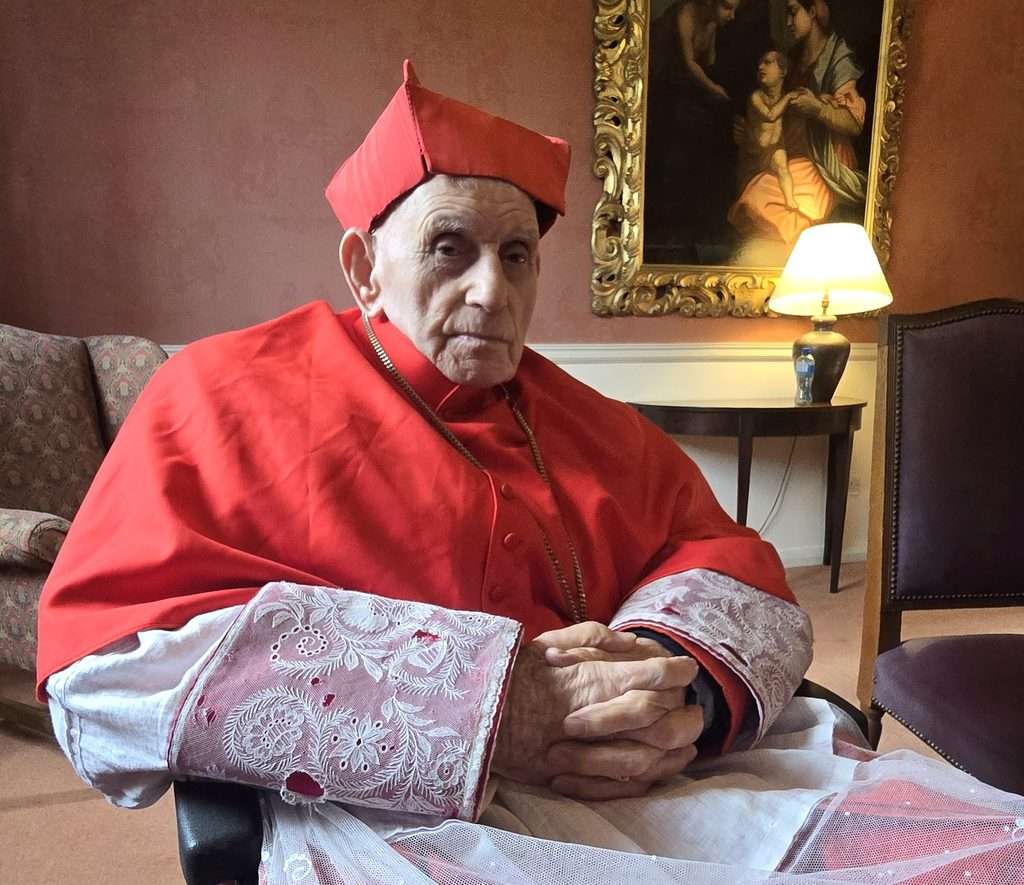
Priesthood is “the most joyous” profession there can be and there is “nothing more fulfilling than to be Jesus’ mouthpiece,” 97-year-old Cardinal Ernest Simoni of Albania, pictured above by Sarah Mac Donald, has said. Speaking to The Tablet at Ireland’s national seminary in Maynooth, the cardinal, who survived nearly three decades of imprisonment, torture, and forced hard labour under the communist Hoxha regime in Albania, said: “I feel Ireland is the shield of Catholicism in Europe and throughout the world and I hope they can keep that flame going.” He was in Ireland as a guest of Aid to the Church in Need Ireland.
Tributes have been paid to Ludmila Javorová who was secretly ordained a Catholic priest in 1970 by Czechoslovakia’s underground church. She was 94. Dublin-based Soline Humbert, who first experienced a call to the priesthood in the 1970s, described her as “one of the most unique, courageous, and controversial figures of twentieth century European Catholicism”. She was “a woman who remained faithful under totalitarianism, who betrayed no one, who stood with those whom the regime sought to render invisible, and who remained in the Church even when the Church asked her to renounce the ministry to which she knew she was called”.
“I think there is a fear of religious tourism,” Northern Ireland politician Deborah Girvan of the Alliance Party has told The Tablet. Speaking after she gave the keynote address at the conference “Pilgrim, Heritage and Regenerative Tourism” at the headquarters of the Missionary Society of St Columban, she said the situation was “tricky in Ireland” because religion was “divisive” in the past. The Columban Way, a pilgrim route which runs through Ireland, the UK and Continental Europe along trails connected with the sixth century monk St Columbanus was, she said, “an opportunity to resolve that and connect communities and diverse cultures”.
Stay updated — add us as a preferred news source on Google:


Help us keep The Tablet’s voice independent, clear and far-reaching.
Founded in 1840, The Tablet is the leading independent English-language Catholic weekly, celebrated for great writing, astute analysis, brilliant arts and books reviews and trustworthy reporting from correspondents in Britain, Ireland, Rome and across the world.
Independent, high-quality journalism is at the heart of what we do. The Tablet does not have deep pockets and we are not funded by rich donors. If you appreciate our work please consider supporting The Tablet’s Development Fund. It only takes a moment and you can cancel at any time.
- Support with £5 per month
- Support with £10 per month
- Support with other amount.

MOST READ ARTICLES
-
1
Pope returns to Vatican after hospital discharge
-
2
Diverse schools that are 100 per cent Catholic
-
3
Under endless skies
-
4
Battling confession fatigue
-
5
Nigerian bishop scorns suggestion of running in presidential election
-
6
Schismatic Spanish nuns strip contents of convent before eviction
FROM THE EDITOR'S DESK


