View from Rome


A question that looms in the afterglow of the Synod on Synodality is, what will be remembered of synodality when the Jubilee ends on 6 January 2026? How much of the final document of the three-year global listening process that has just concluded will have borne fruit?
It has been described as the most significant event in the life of the Church since the Second Vatican Council. Even the Council didn’t involve as broad-based a grassroots consultation process, or engage women and lay people to anything like the same extent. Some have styled it “a revolution that has gone unnoticed”. Will the revolution take flight or fizzle out? It will all come down to whether we, ordinary Catholics around the world, decide to get on board.
Episcopalis Communio, Pope Francis’ apostolic constitution written in 2018 on the Synod of Bishops, states that “the Synod assembly must be followed by the implementation phase, so as to initiate the reception of
the Synod’s conclusions in all the local churches, once they have been accepted by the Roman Pontiff in the manner he judges most appropriate”.
Since the Council the Pope has always followed up the Synod’s final document with his own post-synodal apostolic exhortation, de facto eclipsing what the Synod itself had to say. In this case, Francis, true to form, opted to do something that took everyone by
surprise. At the last sitting of the Synod he declared that what the Synod had produced already contains “very concrete indications that can guide the mission of the Church in different continents and diverse contexts”, and that he did not intend to add his own text.
Thus, the Pope sought to recognise “the value of the synodal journey”, which he entrusts back to the entire People of God, which, as Episcopalis Communio attests, is the “point of departure” but also the “point of arrival” of Synods.
I’m struck by two things. First, the Pope has elevated the entire process and its final document to a new level of importance and authority. No longer is the Synod an echo chamber for disseminating pontifical marching orders. Rather, it is a circular movement of the entire People of God, originating and culminating at the local level. This makes it clear that Rome will not be responsible for spoon-feeding the implementation of synodality in every bishops’ conference, diocese and parish. The Vatican will not act as a global watchdog enforcing synodality.
Second, from the get-go, there is an appreciation that the Synod’s indications require proper inculturation, in “different continents and diverse contexts”. Episcopalis Communio recognises that “cultures are quite diverse, and every general principle … needs to be inculturated, if it is to be respected and applied”. What, then, in the light of this appreciation, is the scope of the inculturation of ecclesial decision-making?
As the varied reactions to Fiducia Supplicans demonstrated earlier this year, dioceses and episcopal conferences can see the same matter quite differently depending on their sociocultural, political, and pastoral context. Towards the beginning of his pontificate, Francis called for a “sound decentralisation”, so that instead of referring to the Pope on everything, genuine discernment would occur at the various levels of the Church.
We’ve already seen this in the way, for example, the permanent diaconate was restored after Vatican II, but not all dioceses or episcopal conferences have decided to implement it. Could a similarly diversified approach be taken with the female diaconate or the ordination of married permanent deacons to the priesthood when the pastoral situation warrants it, as requested at the Synod on the Amazon?
Rather than fracturing church unity this would avoid splintering and schism. It would help us to rediscover the true sources of the unity of the Church, and allow for legitimate diversity in the way it lives out the mission that all Catholics share without imposing a one-size-fits-all model that only foments polarisation.
If there is to be a conversion to a more synodal Church there must be a focus on what is most urgent and relevant in each given context. Perhaps, though, there should be one non-negotiable across the board, something so far conspicuous by its absence: the protagonism of younger generations. Whereas the 2018 Synod focused on young people, all too few of them were represented in last month’s assembly.
The future of synodality will depend on those who give life to the conversion of the Church that it calls for between the Jubilee that begins on Christmas Eve and those that
follow.
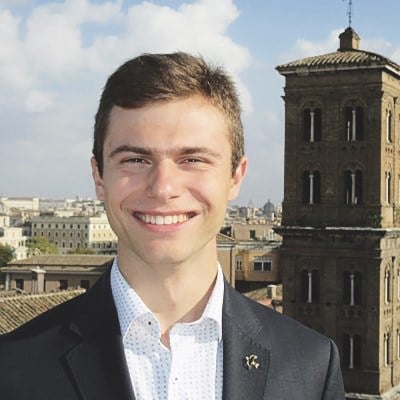
Julian Paparella is a doctoral student in theology from Canada studying at the John Paul II Institute for Marriage and Family in Rome, and the Coordinator of Intellectual Formation at the Venerable English College.
Login
Please login to comment
0 Comments
Oldest

Help us keep The Tablet’s voice independent, clear and far-reaching.
Founded in 1840, The Tablet is the leading independent English-language Catholic weekly, celebrated for great writing, astute analysis, brilliant arts and books reviews and trustworthy reporting from correspondents in Britain, Ireland, Rome and across the world.
Independent, high-quality journalism is at the heart of what we do. The Tablet does not have deep pockets and we are not funded by rich donors. If you appreciate our work please consider supporting The Tablet’s Development Fund. It only takes a moment and you can cancel at any time.
- Support with £5 per month
- Support with £10 per month
- Support with other amount.

MOST READ ARTICLES
-
1
Archbishop of Cardiff-Menevia meets with other worldwide Catholic Church leaders to discuss liturgy
-
2
Let there be light
-
3
World Humanitarian Day: aid workers face a ‘crisis of protection’
-
4
Ruling allows French private hospitals limited exemption from assisted suicide
-
5
A tract for our times
-
6
The wisdom of the saints
FROM THE EDITOR'S DESK