Sundays in July, August, September 2026


Sunday 5 July 2026
Fourteenth Sunday in Ordinary Time
Zechariah 9.9–10
Psalm 144(145).1–2,8–11,13b–14
Romans 8.9,11–13
Matthew 11.25–30
Over the next few weeks, the Gospels will focus on the parables, and today’s readings prepare us to understand the questions that we will be confronted by. Jesus teaches us the attitude that we should adopt when seeking the love of the Father: ‘I bless you, Father, Lord of heaven and of earth, for hiding these things from the learned and the clever and revealing them to mere children.’ Thus, Jesus reminds us not to approach his teachings or message with preconceived notions but rather to listen with minds open to the establishment of the Kingdom of God. This is an invitation to change, to challenge the system that we find ourselves in, and to advocate for the teachings of Christ.
But being a Christian with such an attitude is not easy. It never has been. It requires a public profession of faith and a willingness to stand in opposition to anything that runs counter to the gospel. In today’s second reading and Gospel, we are presented with stark reminders of this fact. In the letter from Paul to the Romans, we see a community struggling to be countercultural who are told ‘there is no necessity for us to obey our unspiritual selves or to live unspiritual lives.’ Rather they are reminded of the power of the Holy Spirit and its ability to bring new life. Similarly, in the Gospel, Jesus invites all of those who are suffering to come and rest in him. This rest will not magically solve our problems but rather give us to the strength to learn of his will for us.
Sunday 12 July 2026
Fifteenth Sunday in Ordinary Time
Isaiah 55.10–11
Psalm 64(65).10–14
Romans 8.18–23
Matthew 13.1–23 or Matthew 13.1–9
Today Jesus is asked ‘Why do you talk to them in parables?’ In his answer, we are drawn back to last week’s readings where Jesus teaches us that we must adopt a childlike posture of wonder and belief when coming to terms with God’s love and plans for us. He tells us in this week’s Gospel that ‘many prophets and holy men longed to see what you see, and never saw it; to hear what you hear, and never heard it’. Jesus often taught in parables. In The Parables of the Kingdom, C. H. Dodd defines parables as ‘a metaphor or simile drawn from nature or common life, arresting the hearer by its vividness or strangeness, and leaving the mind in sufficient doubt about its precise application to tease it into active thought’. The parables then are explanations of spiritual concepts that we are unable to grasp fully. By using them Jesus appeals to our imagination helping us to encounter God with our whole beings. They help to reach the deepest, most inaccessible, places within ourselves, the places that are characterised by longing, pain, and hurt. He uses parables both to help us understand complex issues and to help us heal.
Through the use of parables, Jesus is inviting us to be part of the new Kingdom that he is establishing. But they also display Jesus’ profound love of reality, of understanding the context in which he was preaching. Today’s Parable of the Sower would have been more easily accessible to his audience than it is to us. But it shows us how God is embedded within our world and that we are called to nourish it with both our faith and our action. As the Compendium of Social Justice teaches us, we are ‘called to render justice to the poor, releasing the oppressed, consoling the afflicted, actively seeking a new social order in which adequate solutions to material poverty are offered and in which the forces thwarting the attempts of the weakest to free themselves from conditions of misery and slavery are more effectively controlled. When this happens, the Kingdom of God is already present on this earth, although it is not of the earth. It is in this Kingdom that the promises of the Prophets find final fulfilment.’ (§325)
Sunday 19 July 2026
Sixteenth Sunday in Ordinary Time
Wisdom 12.13,16–19
Psalm 85(86).5–6,9–10,15–16
Romans 8.26–27
Matthew 13.24–43 or Matthew 13.24–30
This Sunday we continue to hear Jesus preaching in parables. Matthew even makes the point that ‘he said nothing to them without a parable’. The parable was clearly central to the pedagogy of Jesus. Kenneth E. Bailey (Jesus though Middle Eastern Eyes, SPCK, 2008) describes Jesus as a ‘metaphorical theologian’. His primary method of creating meaning was through metaphor, simile (‘the kingdom of heaven is like…’) and dramatic action. Not so much through ideas held together by logic. That’s what we’re more used to in the western theological tradition. He created meaning like a dramatist and a poet, rather than a philosopher. Metaphor communicates in ways that rational arguments cannot. They touch the heart, they stir the imagination, they work on us. It is not a delivery system for an idea, but a mode of theological discourse, or to use an image, a house to take up residence in and view the world from a new perspective. Storytelling has deep roots in the human psyche. It’s how culture is transmitted, and revolutionised. Jesus was a master storyteller.
Today’s parable tells the story of a man who sowed good seed in his field. This is God’s initiative in the human race, which always comes first. John Shea (Matthew Year A: On Earth As It Is In Heaven, Liturgical Press, 2004) points out that Jesus is not the only one sowing in the field. When people are asleep – that is, unresponsive to divine revelation – an enemy sows the weeds. Evil can never be attributed to divine initiative. When a response is called for, human beings respond well and badly. Both seeds are interwoven. We are all a mixed blessing, a mixture of good and an inclination to evil, and that should keep us humble, but also hopeful. There is no sense in which we’re invited just to accept this. It is clear that the working of God’s grace is relentless, if often hidden in plain sight. The yeast – the catalytic agent – works away in the mix, ‘until all of it was leavened’. The yeast works in the dark to raise the dough, just as the parables work in our hearts for our conversion and transformation.
Sunday 26 July 2026
Seventeenth Sunday in Ordinary Time
1 Kings 3.5,7–12
Psalm 118(119).57,72,76–77,127–130
Romans 8.28–30
Matthew 13.44–52 or Matthew 13.44–46
This Sunday we have our last look at parables in Matthew’s Gospel for a while. We have three short parables about what the Kingdom of God is ‘like’. Jesus uses similes to paint pictures of this new reality in human history, the kingdom of God. He doesn’t deliver a manifesto or lists of ideas. He gives us images: treasure in a field, a pearl of great value, a net thrown into the sea. A simile to some extent resists definitive interpretation. There was a period when an allegorical reading of parables was popular, in other words each element in the parable corresponded to one thing, for example the two coins handed over by the Good Samaritan (Christ) to the innkeeper for the care of the wounded man (fallen humanity) represented the Old and New Testaments, or in some readings, the sacraments. The allegorical approach is somewhat limiting and not the approach taken by Pope Francis in his extensive reading of the Good Samaritan in Fratelli Tutti. Nor does the Church encourage any interpretations which take our fancy. Church teaching will be our guide if we are going off the rails.
John Shea makes the point that the treasure is ‘hidden’ in a field. It is the one, true treasure, which will make life worthwhile, but it’s not to be found on the surface of life but buried in the field of ourselves. When we come upon this spiritual depth, this kingdom of God within us (Lk 17.21), we are surprised and delighted, but given the tangle of good wheat and weeds that we are, we can also forget this great discovery. There is more to be done to ensure entry into this kingdom. We need to sell all that we have and buy the field. Likewise, the merchant, ‘sold all that he had’ and bought the pearl of great value. This life-giving discovery – our encounter with the living God and his kingdom – requires a process of purification. As Shea says, ‘ridding ourselves of everything that would block the love of God from working in our lives’. We are buying into God, so to speak.
Sunday 2 August 2026
Eighteenth Sunday in Ordinary Time
Isaiah 55.1–3
Psalm 144(145).8–9,15–18
Romans 8.35,37–39
Matthew 14.13–21
In this Sunday’s Gospel we see the contrast between two meals. Herod’s birthday party, in the previous passage, ends with the gruesome dish of the head of John the Baptist served on a platter, compared to the life-giving meal Jesus hosts for the tired and hungry crowd. Jesus had just heard the news of the execution of his cousin John. His response was to withdraw by himself, to grieve this terrible loss. The crowds follow him, not out of curiosity, but need. The response of Jesus is so moving. Rather than insist on his own needs, the need to be alone, he turns to the crowds with compassion (a key word in the Gospel to describe the visceral reaction of God in Jesus faced with human suffering). This compassion is not just pity, a kind of remote feeling sorry for people. It is close and brings healing, a desire to lift people out of misery.
Pope Francis, in his reflections on this Gospel (Pope Francis, Reflections on the Sunday Gospel, Year A, Hodder, 2022), identified, as he often did, three messages. When considering the compassion of Jesus he notes that ‘Jesus teaches us to place the needs of the poor before our own needs. Our needs, even if legitimate, are not as urgent as those of the poor, who lack the basic necessities of life.’ The second message is sharing. He contrasts the reaction of Jesus and the disciples to the situation. The disciples react with worldly logic, when each person thinks about themselves. They want to dismiss the crowds, so they can look out for themselves. Jesus reasons with God’s logic, which is sharing. The feeding of the multitude – attested in all four Gospels – is not magic, but as Pope Francis pointed out, ‘a sign that calls for faith in God, provident Father, who does not let us go without our “daily bread” if we know how to share it as brothers [and sisters]’.
The third message is the foreshadowing of the Eucharist. The gestures of Jesus are the same as at the Last Supper, when he took the bread, blessed and broke it and gave it to his disciples (26.26). Jesus does not just give bread to feed hungry people in the desert (like the manna), he is the bread of eternal life. He is blessed, broken and given for us. Pope Francis warns us that we must go to the Eucharist with the same sentiments of Jesus, which are compassion and the will to share: ‘One who goes to the Eucharist without having compassion for the needy and without sharing is not at ease with Jesus.’
Sunday 9 August 2026
Nineteenth Sunday in Ordinary Time
1 Kings 19.9,11–13
Psalm 84(85).9–14
Romans 9.1–5
Matthew 14.22–33
Today’s Gospel presents one of the most iconic scenes from Jesus’ ministry when he walks on water to reach his disciples. Pope Francis described the scene and its meaning for us thus: ‘All the disciples are on the boat, united in the experience of weakness, of doubt, of fear and of “little faith”. But when Jesus climbs into that boat again, the weather suddenly changes: they all feel united in their faith in Him. All the little and frightened ones become great at the moment in which they fall on their knees and recognize the Son of God in their Teacher. How many times the same thing happens to us! Without Jesus, far from Jesus, we feel frightened and inadequate to the point of thinking we cannot succeed. Faith is lacking! But Jesus is always with us, hidden perhaps, but present and ready to support us.’ (Angelus, 10 August 2014). If we are to play our part in the creation of the Kingdom of God, we must display both faith and fearlessness. But such things do not come naturally or automatically to us. No matter how many times Jesus tells us not to be afraid, the fear returns. This is a result of his absence in our lives. We are only safe as long as we are with Jesus, and that safety in the absence of the risen Christ, can only be achieved through prayer – our most powerful tool in the creation of the Kingdom.
But what does this mean for our relationships with one another and with the world beyond the Church? This Gospel is highly symbolic – the boat not only represents our individual lives, but also the life of the church community. It reminds us that our faith is not private but also relies on the community we surround ourselves with. If we are to create a society worthy of Christ’s reign, we must expect hazards and opposition. But these can be overcome if we remain committed to a life of prayer which sustains our witness to the gospel.
Sunday 16 August 2026
The Assumption of the Blessed Virgin Mary
Apocalypse 11.19; 12.1–6,10
Psalm 44(45).10–12,16
1 Corinthians 15.20–26
Luke 1.39–56
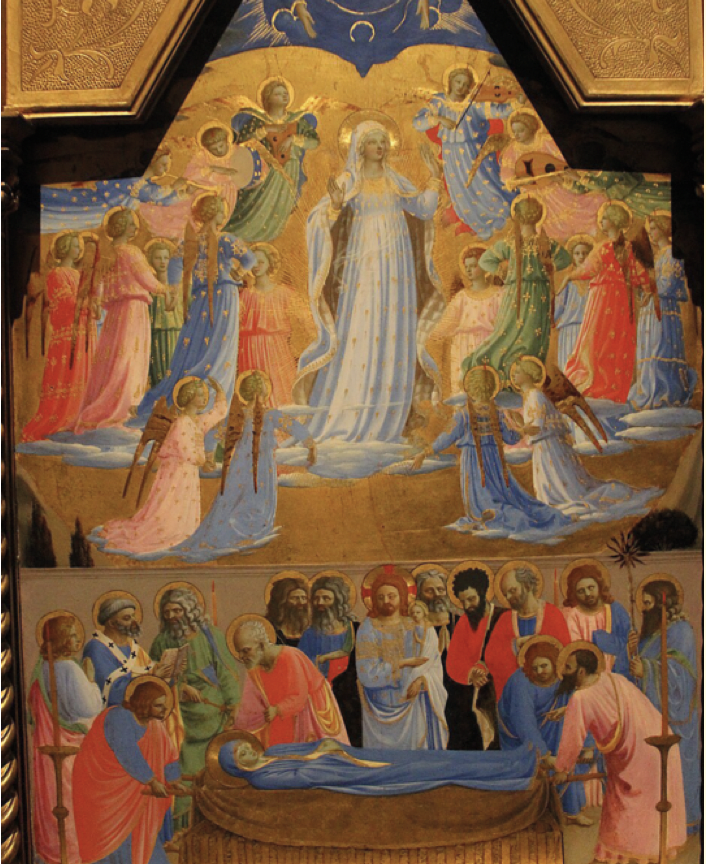
This Sunday, we take a break from our reading of Matthew’s Gospel to celebrate the solemnity of the Assumption of Mary, the Mother of God, body and soul, into the glory of heaven. For some preachers there may appear to be a difficult choice: either to expound on the doctrine of the assumption as defined by Pope Pius XII in 1950, or to preach on the Gospel reading. At a glance the two might seem unrelated, but of course that is not the case.
Pope Francis, in much of his teaching, explained this doctrine pastorally. His homily on 15 August 2014 in South Korea is a case in point. He reminded us that like Mary our Mother, we are called to share in the Lord’s victory over sin and death, ‘and to reign with him in his eternal Kingdom’. This great feast teaches us that God’s salvation embraces the whole person – body and soul. Like Mary, our bodies will one day be glorified in the new creation.
In the Gospel, we hear about Mary’s participation in her Son’s mission. Not only as the vessel by which the Word become incarnate, but in her passionate articulation of the values which would define the ministry of Jesus: the reversal of power structures to reflect God’s vision for humanity, the lowly lifted up. This is the Kingdom of God, in seed form on this earth. Pope Francis taught that ‘from Mary, full of grace, we learn that Christian freedom is more than liberation from sin. It is freedom for a new, spiritual way of seeing earthly realities. It is the freedom to love God and our brothers and sisters with a pure heart, and to live a life of joyful hope for the coming of Christ’s kingdom.’
An important dimension of this dogma, as described by Lumen Gentium, is that when Mary was taken up to heaven she did not lay aside her salvific duty, ‘but by her constant intercession continued to bring us the gifts of eternal salvation’ (#62). Pope Francis reminded us that we ask Mary to ‘guide our efforts to transform the world in accordance with God’s plan’ and to enable the Church to be ever more fully a leaven of his Kingdom in the midst of society. Mary participates in the fullness of the new creation and we pray for her intercession that God will bestow on us the grace to work for that new creation – the kingdom of peace and justice – here on earth.
Sunday 23 August 2026
Twenty-first Sunday in Ordinary Time
Isaiah 22.19–23
Psalm 137(138).1–3,6,8
Romans 11.33–36
Matthew 16.13–20
In today’s readings and Gospel, we are called to a new mission and identity. By bestowing Christ upon the world, God showed us how to be human and importantly, how to love. We are ‘touched by this Love in the fullness of his being: a being that is corporeal and spiritual, that is in a solidary relationship with others. The whole person – not a detached soul or a being closed within its own individuality, but a person and a society of persons – is involved in the salvific economy of the Gospel.’ (Compendium, §65) Through his ministry therefore, Jesus set us a task: to participate in divine life in order to achieve salvation and redemption. But as today’s Gospel shows this can only be achieved through Church and community.
In appointing Peter as his rock, Jesus wills us to become his representatives on earth. We are his Church, aligning heaven and earth by demonstrating to the world the freedom that the gospel brings. As bearer of the gospel’s message of Incarnation and Redemption, the Church can follow no other path: with her social doctrine and the effective action that springs from it, not only does she not hide her face or tone down her mission, but she is faithful to Christ and shows herself to men and women as ‘the universal sacrament of salvation’ [84]. This is especially true in times such as the present, marked by increasing interdependence and globalisation of social issues (Compendium, §65). Like Peter, we are each called to bring our faith and gifts to the altar and use them to serve the church. Nowhere is this more crucial than in the Church’s mission in to promote human dignity because as Pope Leo tells us, ‘by respecting the dignity of everyone and allowing yourselves to be moved by the pain of others, you can become protagonists of a new chapter in history’ (13 April 2026).
Sunday 30 August 2026
Twenty-second Sunday in Ordinary Time
Jeremiah 20.7–9
Psalm 62(63).2–6,8–9
Romans 12.1–2
Matthew 16.21–27
Today’s Gospel reminds us that to be a Christian means to take up the cross. No matter how much Peter denies this fact, Jesus demands this of him, and by extension demands it of us. Jesus’ death on the cross reminds us of the suffering that is expected of us, but his resurrection brings us to a place of hope. It brings an understanding that our suffering will not be in vain, rather it will result in a closer and more profound relationship with God, and the growth of our communities. Despite what society tells us, suffering need not be negative. It need not be something that we seek to throw off at the earliest opportunity. Rather it is a channel for salvation and a means to develop the compassion that is so crucial to the Kingdom of God. In a sermon on this Gospel passage, Pope Francis told us: ‘He exhorts: “For whoever wishes to save his life will lose it, but whoever loses his life for my sake will find it” (v. 25). This paradox contains the golden rule that God inscribed in human nature created in Christ: the rule that only love gives meaning and happiness to life. To spend one’s own talents, one’s energy, and one’s time only to save, protect, and fulfil oneself in reality leads to losing oneself, that is, to a sad and barren existence. Instead, let us live for the Lord and base our life on love, as Jesus did: we will be able to savour authentic joy, and our life will not be barren; it will be fruitful.’
To develop such a profound love requires sacrifice and a giving of one’s self to others. We can reach God and attain salvation by using our suffering to connect with and help others. As St Augustine tells us ‘now the true sacrifices are the works of mercy for ourselves and for our neighbour, when they are ascribed to God. The works of mercy, furthermore, are performed in order to be freed from unhappiness and become happy.’ We are taught therefore, that we need to stand in solidarity with others and whilst the earthly cost may be high, the rewards will be infinite.
Sunday 6 September 2026
Twenty-third Sunday in Ordinary Time
Ezekiel 33.7–9
Psalm 94(95).1–2,6–9
Romans 13.8–10
Matthew 18.15–20
The Gospel reading today begins what scholars refer to as ‘Discourse 4’ in Matthew’s Gospel, sometimes called ‘The Sermon on the Community’. If we consider the world ‘behind the text’, in other words the community the text was written for (in c.80), then we can read these passages as directed at the newly formed Christian communities, providing guidance on how to live with each other in the light of the gospel. We can see key themes: concern for weaker members of the community, church discipline and accountability, the centrality of forgiveness, and humility in leadership.
Anyone who has worked in education will recognise the progressive approach for dealing with complaints in today’s Gospel. In any complaints procedure, it’s always recommended to begin informally and try and resolve any differences between yourselves. Dom Henry Wansbrough, in his commentary in Universalis, points out that it’s the same process as is laid down in the Community Rule of the Dead Sea Scrolls found at Qumran. Does this mean this approach was widespread, does Matthew take his lead from this? In any event, Matthew locates the process in the wider context of a Christian community and the behaviour which should characterise it. Pope Francis tells us that ‘the approach is one of sensitivity, prudence, humility, attention toward the one who committed a fault, in order to avoid wounding or killing the brother [or sister] with words.’
The final stage, if no reconciliation is achieved, at first glance seems harsh. It looks like exclusion, ‘let such a one be to you as a Gentile and a tax collector’ (18.17). This should be read in the context that tax collectors and Gentiles responded positively to the Gospel and in the next passage we hear the emphasis from Jesus on forgiveness. So any exclusion is assumed to be temporary, not what we understand by excommunication. It is also striking, as The Jerome Biblical Commentary points out, that ‘the rabbinic privilege of binding and loosing originally promised to Peter (16.19) is now extended to all the disciples’ (18.18). We find the theology of this explained in On the Way to Life, the 2005 publication from the Bishops’ Conference. The implication is that we are all mediators of grace and forgiveness, not all in a sacramental way, but all mediators nevertheless: ‘In a sense, every member of the Church – not just the ordained priesthood and hierarchy – becomes a minister of grace and has the possibility of mediating it in and through their lives.’
Sunday 13 September 2026
Twenty-fourth Sunday in Ordinary Time
Ecclesiasticus 27.33 – 28.9
Psalm 102(103).1–4,9–12
Romans 14.7–9
Matthew 18.21–35
Peter, the leader of the community, is the one to ask Jesus the question which must have been on the mind of early Christian communities a good deal: ‘Lord, how often will my brother [NRSV: ‘another member of the church’] sin against me and I forgive him’ (18.21). Peter thinks that his solution – ‘seven times’ – is generous. Seven after all is the biblical number of perfection. Divine generosity is very different. Jesus insists on ‘seventy times seven’ which is not a mathematical formulation but an indication of the limitless forgiveness of God.
Jesus illustrates the point with the parable of the unforgiving servant, a narrative commentary on the fifth petition of the Our Father, ‘and forgive us our debts, as we also have forgiven our debtors’ (6.12). The Jerome Biblical Commentary warns us not to over-allegorise this parable, since we run the risk of seeing God as a cruel tyrant, whose first response to the servant who could not pay back his (enormous) debt, was to sell him, along with his wife and children. What turns this shocking proposal into a parable of the kingdom ‘is the fact that the king manifests compassion, in sharp contrast to the forgiven servant’. In story form, Jesus illustrates the dynamic of forgiveness he taught in the Lord’s prayer. God is always willing to forgive us, but we participate in that forgiveness to the extent that we act as conduits for the love of God and forgive others. If our hearts are hardened to our brothers and sisters, we have blocked the flow of divine love which wants to work through us into the world.
Forgiveness begs another question which has vexed the Christian community then and now, perhaps more so recently when the Church has had to face up to widespread abuse scandals. How do you balance the forgiveness we are called to show without limit, with the need for justice and attention to the victims of horrendous, life-changing violations? Pope Francis spent a good deal of time on this point in Fratelli Tutti. He taught that ‘If a criminal has harmed me or a loved one, no one can forbid me from demanding justice and ensuring that this person – or anyone else – will not harm me, or others again. This is entirely just; forgiveness does not forbid it but actually demands it’ (#241). Forgiveness does not mean forgetting. We cannot forget the crimes of humanity – the Shoah, the use of atomic bombs – but must remember what human beings are capable of and renew our efforts to promote human dignity and work for peace. ‘Those who truly forgive do not forget. Instead, they choose not to yield to the same destructive force that caused them so much suffering. They break the vicious circle; they halt the advance of the forces of destruction.’ (#250)
Sunday 20 September 2026
Twenty-fifth Sunday in Ordinary Time
Isaiah 55.6–9
Psalm 144(145).2–3,8–9,17–18
Philippians 1.20–24,27
Matthew 20.1–16
Today’s Gospel reading contains one of the best-known parables: the workers in the vineyard. On first glance, this parable might look like a discussion of worker’s rights: the day labourers being hired are, after all, the most expendable workers in society. And the manner in which they are being paid speaks to those most elemental questions of fairness and equality in the workplace. We have all experienced the indignation that comes with low pay or indeed working with someone we did not feel was working as hard as us, but who was still being paid the same as us or promoted beyond their competence. It is for this reason that this parable is probably the most disliked of all those preached by Jesus. But the Parable of Workers in the Vineyard is not about fairness in the workplace, it is an answer to Peter’s question: ‘Look, we have left everything and followed you. What then will we have?’ (Mt 19.27). It picks up on a concern that the disciples and the early Church has: who has priority and privilege in the eyes of God? Through telling this story, Jesus seeks to reassure us that, God’s goodness makes us all equal to one another – we are all loved equally. ‘The parable assures that God will see to it that they will be cared for: each will have what they need one day at a time. If there is hesitation to sell all and give to the poor so that one can be free to follow Jesus (19.21), the parable gives encouragement that dependence on God’s goodness is not ill-placed.’ (Barbara Reid, Parables for Preachers, Liturgical Press, 2001, p. 153)
But what does this mean for us in terms of our relationships with God and with one another? Do we trust God to provide our daily bread? In what way does the parable highlight our attitudes of privilege and entitlement in terms of our faith and in terms of our social relationships? Do we regard each other equally? If we trust in God completely, we should be able to answer these questions through our knowledge that our salvation will be fully rewarded if we live as he intended: treating everyone as equal and working for his justice in the world.
Sunday 27 September 2026
Twenty-sixth Sunday in Ordinary Time
Ezekiel 18.25–28
Psalm 24(25).4–9
Philippians 2.1–11 or Philippians 2.1–5
Matthew 21.28–32
Today’s parable is short. Only 67 words long. Here, Jesus once more uses the medium of fiction or the parable to make a point that is not easily received. These points are crucial as they centre on our happiness and salvation. At first glance, it would seem that the message of the parable is simple: the first son is the one who does God’s will, the one who eventually says yes. But this teaching comes at a significant point in the Gospel: Holy Week. Jesus has cleared the temple, healed the sick, and spoken out against those who do not put their faith in him, thereby increasing the ire of the ‘authorities’. His message is aimed at Jewish religious leaders. Those who are seen as ‘yes men’ but who don’t follow through on their promises. The son who refused and then repented represents the tax collectors and prostitutes – the outcasts – that Jesus subsequently mentions, whilst the son who agrees but doesn’t follow through epitomises the religious leaders who make a show of public piety but do not practice obedience to God. In making this point, Jesus places the outcasts before the religious authorities, casting them as the recipients of God’s transcendent love.
This week’s Gospel therefore shows us that our Christianity requires us to think in a different way to mainstream society. Through his ministry Jesus invites us to an even higher form of sharing: solidarity. He demonstrates the way to salvation, doing God’s will, and tells us that we are always welcome to change our minds if we have turned away from him. He offers us a place of life and hope, a place in which all people are equal and must be treated as brothers and sisters. It is up to us whether we accept the invitation.
Maria Power is a Senior Research Fellow in Human Dignity at Blackfriars Hall, Oxford.
Raymond Friel OBE is CEO of Caritas Social Action Network.