Vatican court finds faults in ‘trial of the century’ investigation


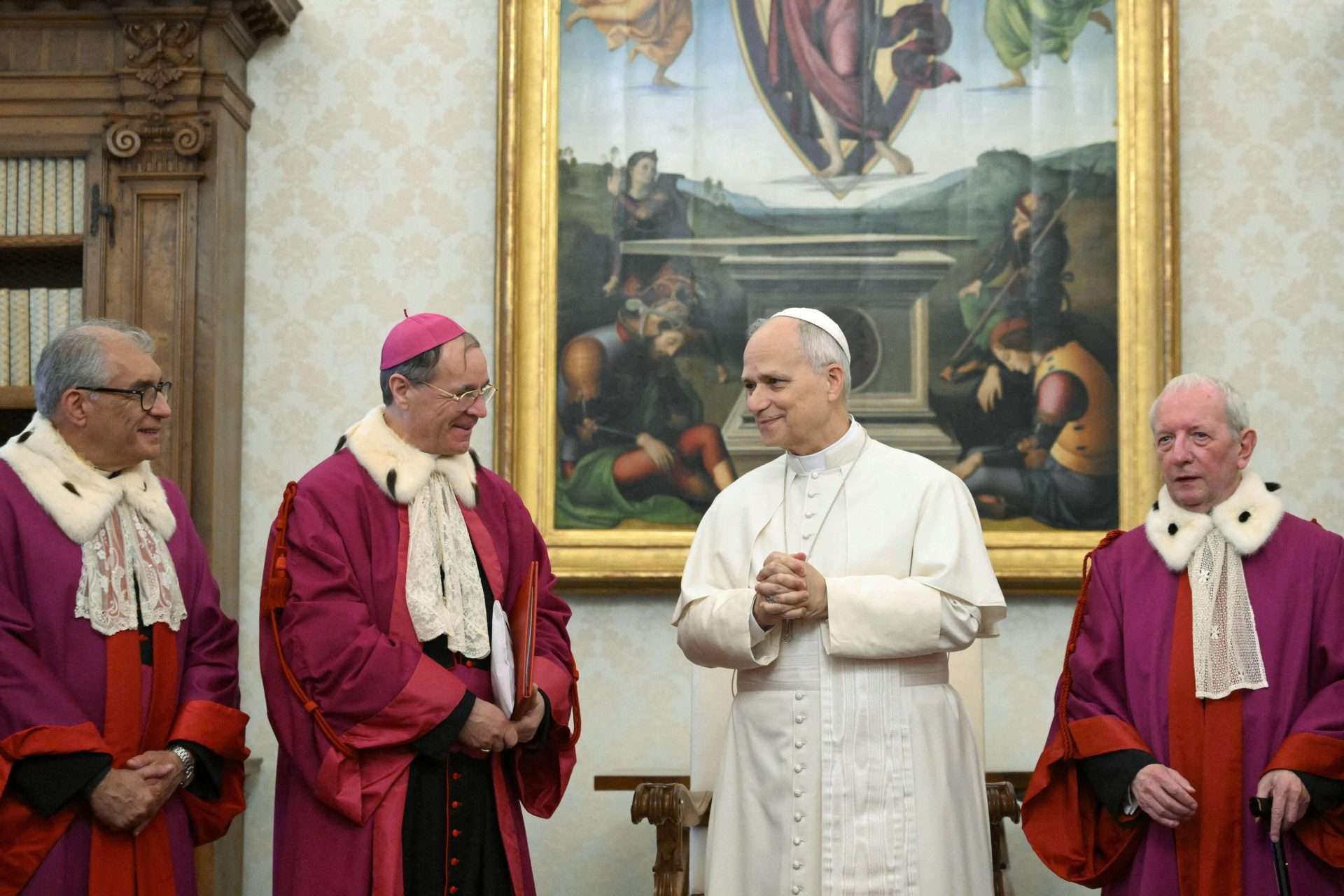
Pope Leo with Archbishop Alejandro Arellano Cedillo (second from left), dean of the Roman Rota and president of the Vatican City State appeals court
Simone Risoluti / Vatican Media / Abaca Press / Alamy
The court ruled a partial mistrial in response to objections to the conduct of the Vatican prosecutor and to four rescripts issued in secret by Pope Francis during the investigation.
The Vatican City appeals court ruled there was a partial mistrial in the case that led to the conviction of nine people on financial crimes charges in December 2023.
A decision issued on Tuesday ordered a review of the investigation and indictment that led to the trial of ten defendants including Cardinal Angelo Becciu, a former sostituto to the Secretariat of State and one of the most powerful figures in the Holy See, for alleged corruption in a failed 2014 investment in London property.
The trial ended after two years of hearings with the conviction of all but one defendant and sentences totalling more than 37 years’ imprisonment, including five-and-a-half for Becciu, as well as around €200 million in damages to the Holy See. All appealed their convictions.
In a 16-page decision, the appeals court found “relative nullity” in the actions of the Office of the Promoter of Justice – the Vatican City’s public prosecutor – because prosecutors did not share evidence with defendants and improperly redacted information related to some charges. The conduct of the Promoter of Justice Alessandro Diddi was subject to several objections during the trial.
However, while ordering a retrial to correct these faults, the court said this did not vacate the original trial and its legal effects.
“The court considers it appropriate to point out that … it does not declare the overall nullity of the entire first-instance proceedings,” the ruling said. “These, in fact, remain effective both with respect to the defendants and to the civil parties.”
It ordered the prosecutor’s office to present all documents from its investigations “in their original form” to the defence by 30 April for parties to review up to 15 June, ahead of a hearing scheduled for 22 June to begin new proceedings. This could see some charges dropped from the defendants’ indictment.
“The court of appeal’s ruling upheld our objections,” said a statement from Cardinal Becciu’s lawyers Fabio Viglione and Maria Concetta Marzo. “It demonstrates that we were right from the outset to note the violation of the right to defence and to demand compliance with the law in order to conduct a fair trial.”
In addition, the court addressed defence objections to four papal rescripts – orders granting privileges to groups or individuals within existing Vatican law – issued in secret by Pope Francis during the investigation.
While rejecting arguments based on the European Convention on Human Rights (to which the Vatican City State is not a signatory) and other international standards, the court said that one rescript in June 2019 “had an innovative character” because it allowed prosecutors to conduct “summary proceedings” rather than the “formal investigation” required in law.
This made the failure to publish the rescript a procedural error, compromising the investigation conducted under its terms.
The statement from Viglione and Marzo said the court “ruled that a papal rescript was invalid and void due to failure to publish it [which] in our view results in the complete nullity of the entire investigation and trial”.
While the judgment emphasises that “these findings do not, nor could they, affect the value and nature of the rescript”, observers said it was unprecedented for a Vatican court to rule on the procedural legitimacy of a papal act.
The judgment appeared three days after the opening of the judicial year of the Vatican City State Tribunal. Speaking at the ceremony to inaugurate the year on Saturday, Pope Leo said its work contributes “to the credibility of the legal order that underpins” the state.
“The administration of justice is not, in fact, limited to the resolution of disputes, but contributes to the protection of the legal order and the credibility of institutions,” he said.
“The observance of procedural safeguards, the impartiality of the judge, the effectiveness of the right of defence and the reasonable duration of proceedings are not merely technical instruments of the judicial process. They constitute the conditions through which the exercise of the judicial function acquires particular authority and contributes to institutional stability.”
Callow Vatican was ‘let down’ by financier in London property deal, judge rules
Stay updated — add us as a preferred news source on Google:


Help us keep The Tablet’s voice independent, clear and far-reaching.
Founded in 1840, The Tablet is the leading independent English-language Catholic weekly, celebrated for great writing, astute analysis, brilliant arts and books reviews and trustworthy reporting from correspondents in Britain, Ireland, Rome and across the world.
Independent, high-quality journalism is at the heart of what we do. The Tablet does not have deep pockets and we are not funded by rich donors. If you appreciate our work please consider supporting The Tablet’s Development Fund. It only takes a moment and you can cancel at any time.
- Support with £5 per month
- Support with £10 per month
- Support with other amount.

MOST READ ARTICLES
-
1
Pope returns to Vatican after hospital discharge
-
2
Diverse schools that are 100 per cent Catholic
-
3
Under endless skies
-
4
Battling confession fatigue
-
5
Nigerian bishop scorns suggestion of running in presidential election
-
6
Schismatic Spanish nuns strip contents of convent before eviction
FROM THE EDITOR'S DESK