Vatican commission votes against ordaining women deacons


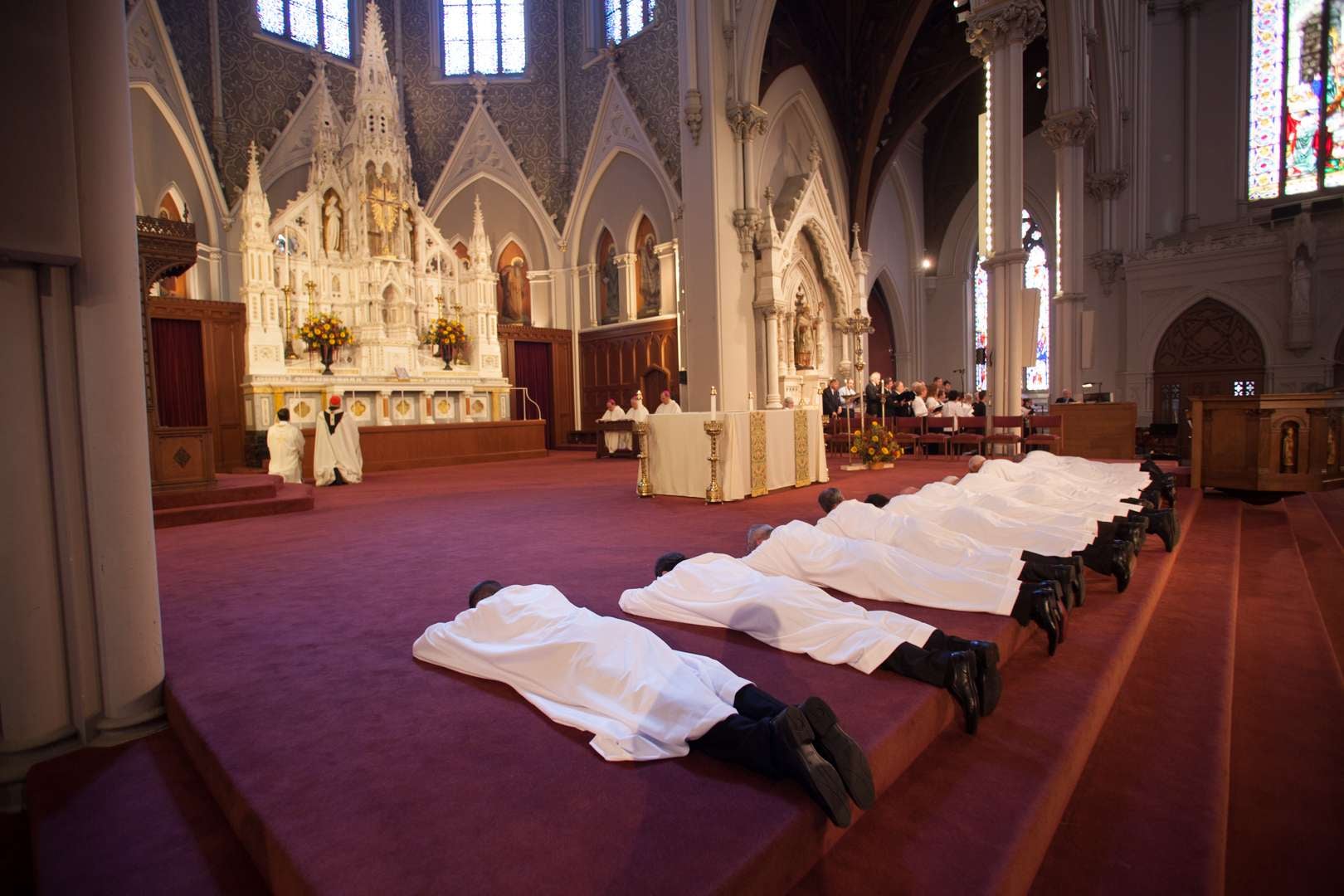
A diaconal ordination in Boston in 2013
Roman Catholic Archdiocese of Boston
A letter addressed to the Pope from the president of the study commission on the female diaconate was published on Thursday, including details of its votes on a series of statements.
A Vatican commission voted against endorsing the admission of women to the diaconate, according to a report from the cardinal leading it.
In a letter addressed to Pope Leo explaining the work of the study commission on the female diaconate, its president Cardinal Giuseppe Petrocchi said it had approved a statement that its findings “exclude the possibility of proceeding in the direction of the admission of women to the diaconate [when] understood as a level of the sacrament of ordination”.
However, it also said it could not make “a definitive judgment” at present, and called for further study of the female diaconate. It also approved a statement encouraging the development of “new ministries” open to all the baptised which could “contribute to the synergy between men and women”.
The statements date from the first two sessions of the commission, in February 2021 and July 2022. At the first session, the commission’s ten members also unanimously approved a statement that theological study of the diaconate “raises questions about the compatibility of the diaconal ordination of women with the Catholic doctrine of ordained ministry”.
According to Cardinal Petrocchi’s letter published on Thursday, at the same session the commission’s members voted against three different statements on the institution of a female diaconate: one saying they were not in favour, one saying it was not a suitable time for it, and one saying they were in favour.
The members approved the statement to “exclude the possibility” at the second session by seven votes to one. Petrocchi did not explain why just eight members of the commission voted on it.
Pope Francis instituted the commission in 2020, to succeed the first commission to study the female diaconate formed in 2016 which did not publish a report. After its July 2022 meeting, Francis revived the second commission in 2023 in response to the discussion of women deacons during the Rome assembly of the Synod on Synodality in October that year.
This was also understood to be a subject for one of the 12 study groups Francis established after the Rome assembly to address controversial topics. However, following the publication of the groups’ interim reports in November, an official from the Dicastery for the Doctrine of the Faith confirmed that Study Group 5 – assigned to “some theological and canonical matters regarding specific ministerial forms” – was not considering the female diaconate and had forwarded all contributions on the subject to the commission.
Petrocchi, the 77-year-old former Archbishop of L’Aquila in central Italy, said the commission met for its last session in February 2025 to consider such public contributions. He said that because these came from 22 individuals and groups “representing a few countries”, they could not be considered “as the voice of the Synod, still less of the People of God as a whole”.
The letter acknowledged the historical evidence for a female diaconate, although a statement from the July 2022 session said it was “a sui generis ministry” and “not placed in the line of apostolic succession”.
“We know, however, that a purely historical perspective does not allow us to reach any definitive certainty,” Petrocchi wrote. “In the final analysis, the question must be decided at the doctrinal level.”
At its February 2025 session, the commission was divided five votes to five on a statement saying masculinity “is not accidental but an integral part of sacramental identity”.
The same session voted nine to one in favour of a statement affirming that it is “now appropriate to expand women’s access to institutional ministry in the service of the community” as part of making “adequate ecclesial recognition of the diakonia [ministry] of all the baptised”.
Petrocchi emphasised the need to develop this “baptismal diakonia”, though he also described an “intense dialectic” between one theological approach that considers the diaconate “ministerial” rather than “sacramental” and another that insists on the unity of Holy Orders. According to the latter, “if the admission of women to the first degree of orders [the diaconate] were approved, it would make exclusion from the others inexplicable”.
Phyllis Zagano, a leading authority in studies of women in the diaconate who served on the 2016 study commission, said the letter “does its best to present the topic in a negative light, selectively choosing comments from previous reports without providing complete context”.
She said it “underscores the essentially heretical belief that women cannot image Christ, bolstered by the argument that since women are barred from priestly ordination, they may not be ordained as deacons”.
“The long report does not present evidence or a theological argument, only the opinion that more study is needed,” she said. “In short, they cannot say ‘no’, they simply do not want to say ‘yes’.”
Saint Phoebe and a tale of two deacons
East and West: Understanding the History of the Female Diaconate
Stay updated — add us as a preferred news source on Google:


Help us keep The Tablet’s voice independent, clear and far-reaching.
Founded in 1840, The Tablet is the leading independent English-language Catholic weekly, celebrated for great writing, astute analysis, brilliant arts and books reviews and trustworthy reporting from correspondents in Britain, Ireland, Rome and across the world.
Independent, high-quality journalism is at the heart of what we do. The Tablet does not have deep pockets and we are not funded by rich donors. If you appreciate our work please consider supporting The Tablet’s Development Fund. It only takes a moment and you can cancel at any time.
- Support with £5 per month
- Support with £10 per month
- Support with other amount.

MOST READ ARTICLES
-
1
Pope returns to Vatican after hospital discharge
-
2
Diverse schools that are 100 per cent Catholic
-
3
Under endless skies
-
4
Battling confession fatigue
-
5
Nigerian bishop scorns suggestion of running in presidential election
-
6
Schismatic Spanish nuns strip contents of convent before eviction
FROM THE EDITOR'S DESK


