Ukrainians defiant on ‘shameful’ anniversary of Russian invasion


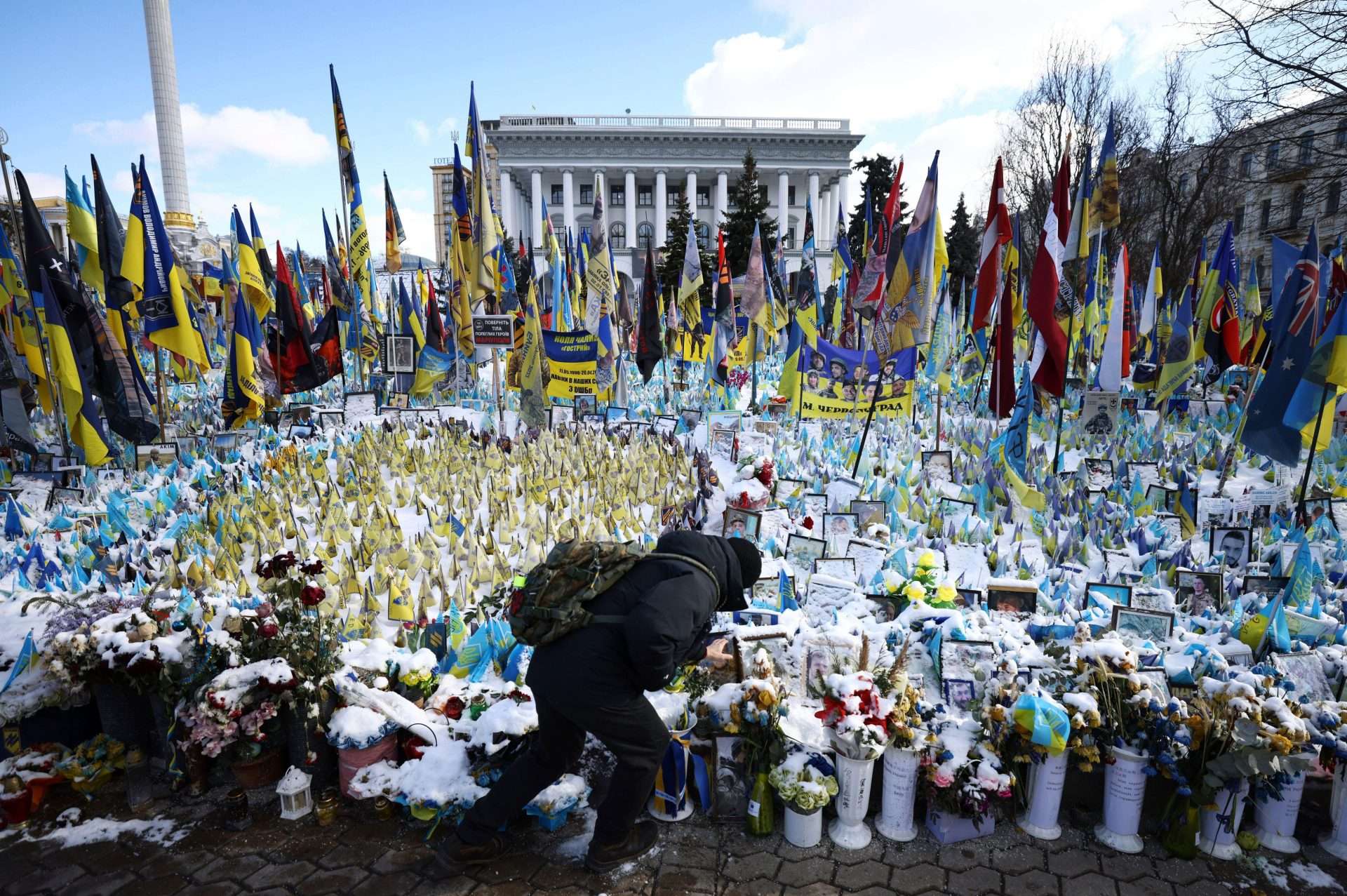
Memorials to the victims of the Russian invasion in Kyiv‘s Independence Square.
The Yomiuri Shimbun, Associated Press / Alamy
Major Archbishop Sviatoslav Shevchuk appealed for a peace ‘that does not appease dictators’ as the US opened negotiations with Russia.
The Pope said the third anniversary of the Russian invasion of Ukraine and the start of the full-scale war was “a painful and shameful anniversary for all of humanity”.
In his Angelus address published at noon on Sunday while he remained in hospital, Pope Francis renewed his “solidarity with the martyred Ukrainian people” as part of his prayer for peace in conflicts throughout the world.
The anniversary on 24 February – now marked in Ukraine as a National Day of Prayer – came during a deepening diplomatic crisis, with the US government threatening to cut support for Ukraine and pursuing bilateral negotiations with Russia without Ukrainian or European representation.
Speaking during a visit to the US last week, the head of the Ukrainian Greek Catholic Church (UGCC) Major Archbishop Sviatoslav Shevchuk appealed for a peace “that does not appease dictators”. He warned that President Donald Trump’s comments on the war and on Ukraine’s President Volodymyr Zelenskyy mirrored “Russian propaganda talking points”.
Archbishop Visvaldas Kulbokas JCL, the apostolic nuncio to Ukraine, told The Tablet there was “much disappointment” at US conduct but said “statements of politicians have long since become unreliable for the Ukrainian people”.
He cited the words of both Russian and Ukrainian leaders ahead of the invasion in 2022 and the failure of Ukraine’s allies to fulfil their promise to be “as supportive as necessary”, besides his own diplomatic experience in Lebanon, to show “we can only place our hopes in God and the people of good will”.
Kulbokas said the Holy See was “committed to supporting morally the people of Ukraine”, expressed in its willingness to mediate in humanitarian areas which “require a great deal of diplomacy”.
“Russia often deliberately turns [civilian Ukrainian prisoners] into its own citizens, so as to be able to claim that ‘no requirements of international humanitarian law apply to them’,” he said. “In such cases, the work is certainly difficult, and it depends on what kind of relationship the Holy See’s negotiators are able to build during the talks to the Russian representatives.”
On 19 February a group of 14 Ukrainian women presented details of their relations and loved ones held captive in Russia to the Archbishop of Bologna Cardinal Matteo Zuppi, the Pope’s peace envoy to Ukraine who has helped facilitate prisoner exchanges.
Catholic agencies have provided around €500 million of humanitarian aid to Ukraine, Kulbokas estimated, also noting that the Vatican’s Bambino Gesù paediatric hospital has treated nearly 3,000 Ukrainian children injured in the fighting. He noted that the Trump administration’s freeze on foreign aid would affect humanitarian projects for victims of the war.
He said the “brutality” of the war was increasing and that “drone attacks against civilian targets are becoming more intense”. On 23 February Russia launched its largest drone attack on Ukraine, using more than 200 drones to strike cities in what President Zelenskyy called an “aerial terror”.
Peace in Ukraine must not ‘appease dictators’, warns Shevchuk
Archbishop Shevchuk told UGCC clergy in Canada on Sunday where he was attending his Church’s synod that “the voice of hope comes from Ukraine because Ukraine prays”. He said that during meetings with members of the Trump administration he had asserted that “others may have more money and other things, but no one else possesses the power of the spirit of God, which pulsates in the body of our people”.
He pursued this theme in an address to a rally in Toronto on the anniversary. “Today, we declare to the world that a nation that believes in the Resurrection cannot be defeated,” he said. “We know that God is with us because He is always on the side of truth.”
Speaking on the anniversary in Istanbul’s St Nicholas’ Church, which serves the city’s Ukrainian-speaking population, the Ecumenical Patriarch Bartholomew I of Constantinople said the Church “cannot remain indifferent when injustice prevails” and accused Russia of pursuing “imperial ambitions that have no place in today’s world”.
“No force can extinguish the spirit of a people who refuse to be broken,” he said. “No nation has the right to impose its will upon another, and no power can erase a people’s history. Ukraine’s sovereignty is not up for debate, nor can it be negotiated away under the guise of diplomacy.”
In Russia, marking “Defender of the Fatherland Day” on 23 February, Patriarch Kirill of Moscow said that “no external force can defeat Russia – historically, only internal discord has posed a real danger”. He praised President Vladimir Putin for erasing any such threat.
“Today, we face difficult times,” he said. “Those who defend Russia with arms in hand are engaged in a struggle that is not merely political but a battle for the future of historic Rus’.”
In a message to Kirill marking the occasion, President Putin said the day was “a symbol of the people’s boundless respect for the victories and heroic feats of our ancestors”.
“The unbreakable link between historical traditions of devoted service to the Motherland and genuine love for one’s homeland continues to inspire the warriors of Russia today,” he said.
In his remarks to The Tablet, Archbishop Kulbokas said the experience of war brought some people to faith, “especially when they see active believers”, but added that Christianity was undermined when its basic tenets “seem no longer important to some Churches, and other priorities come to the fore”.
“Let us be Christians,” he said, “let war and the sower of death be condemned unequivocally. There is no need to justify bad actions, as if minimising their responsibility – a Christian is certainly not called to lull consciences.”
Stay updated — add us as a preferred news source on Google:


Help us keep The Tablet’s voice independent, clear and far-reaching.
Founded in 1840, The Tablet is the leading independent English-language Catholic weekly, celebrated for great writing, astute analysis, brilliant arts and books reviews and trustworthy reporting from correspondents in Britain, Ireland, Rome and across the world.
Independent, high-quality journalism is at the heart of what we do. The Tablet does not have deep pockets and we are not funded by rich donors. If you appreciate our work please consider supporting The Tablet’s Development Fund. It only takes a moment and you can cancel at any time.
- Support with £5 per month
- Support with £10 per month
- Support with other amount.

MOST READ ARTICLES
-
1
Pope returns to Vatican after hospital discharge
-
2
Diverse schools that are 100 per cent Catholic
-
3
Under endless skies
-
4
Battling confession fatigue
-
5
Nigerian bishop scorns suggestion of running in presidential election
-
6
Schismatic Spanish nuns strip contents of convent before eviction
FROM THE EDITOR'S DESK


