Ukraine prays for Francis’ intercession to end ‘barbaric’ attacks


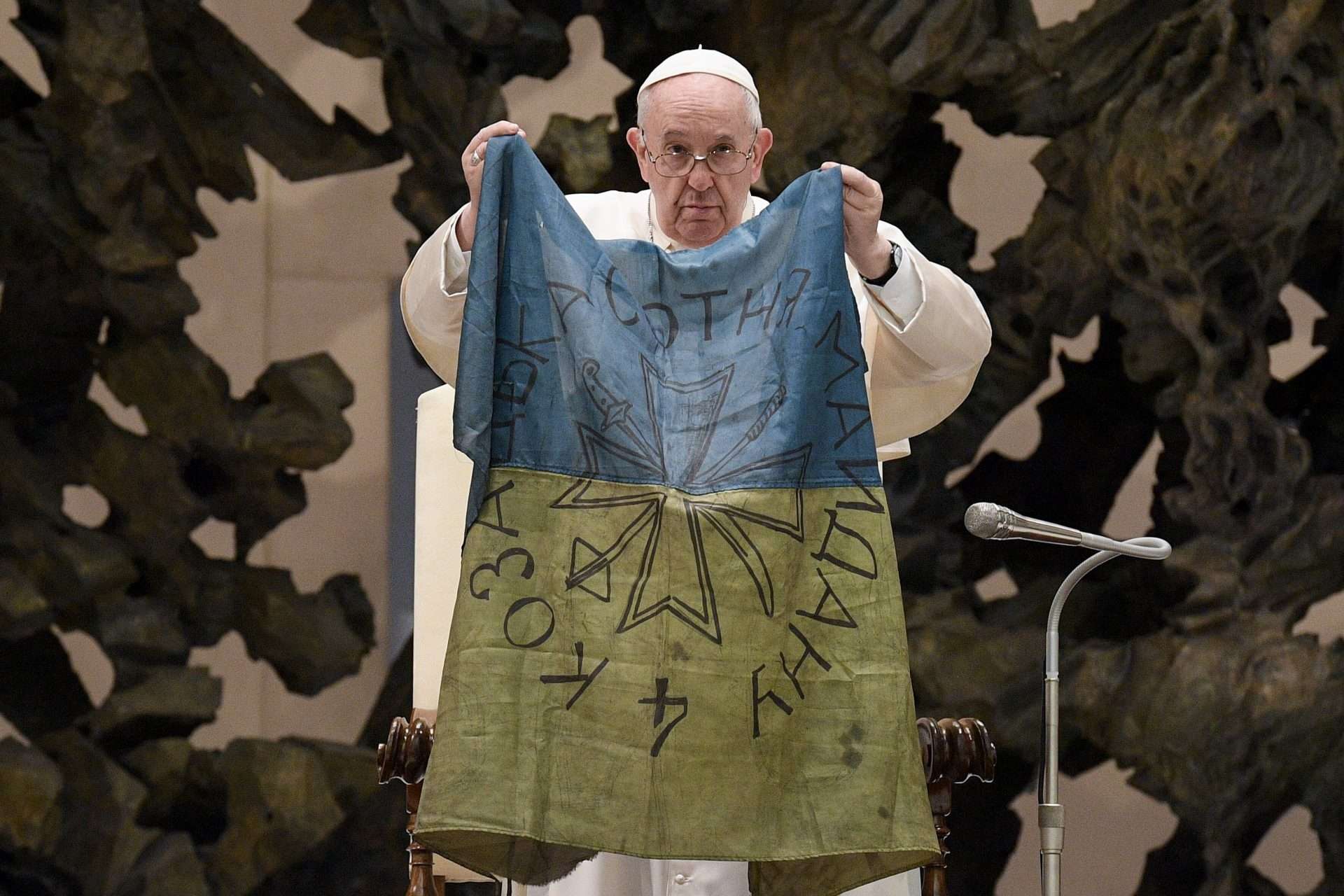
Pope Francis in 2022 with a flag from Bucha, the site of Russian atrocities early in the invasion of Ukraine.
Vatican Media / CNA
‘I have witnessed how the Holy Father did everything in his power to stop the war. I am convinced that now, in heaven, he has even greater opportunities to help Ukraine.’
Religious and political leaders around the world must “speak with one voice” to end Russia’s “barbaric aggression”, the head of the Ukrainian Greek Catholic Church (UGCC) said after Thursday’s missile attack on Kyiv.
At least eight people were killed and 70 injured when a missile struck a residential building on the evening of 24 April, prompting an international outcry including from the US President Donald Trump.
Major Archbishop Sviatoslav Shevchuk, the Ukrainian Catholic patriarch, said the international community must “act together to stop Russian aggression” and “help Ukraine to survive and live”.
After Pope Francis’ death on Monday, the apostolic nuncio to Ukraine Archbishop Visvaldas Kulbokas told The Tablet that “we will have in Francis a powerful intercessor along with all the saints” for the end of the war.
“Pope Francis was a Man with a capital letter, he was and remains a great gift to the Church,” he said. “I have a feeling that at this moment I can even feel his breathing next to me and his hand on my head. I have never experienced such a thing before.”
Speaking at the end of a liturgy on Wednesday, Archbishop Shevchuk said: “I have witnessed how the Holy Father did everything in his power, as the Vicar of Christ on earth, to stop the war. I am convinced that now, in heaven, he has even greater opportunities – and even fuller understanding – to help Ukraine.”
In a letter of condolence on behalf of the UGCC, Shevchuk gave thanks for Francis’ “tireless efforts to end the war in Ukraine, his constant appeals for a just peace, and his fatherly closeness to the ‘martyred’ Ukrainian people”.
“I recall with prayerful gratitude the Pope’s commitment to help in many difficult situations, especially concerning our captives and deported children. When the powerful of this world refused to hear his calls for peace, he reached out to the peripheries of human suffering, revealing to them a merciful and loving God.”
Peace in Ukraine was among the prayers in Francis final Urbi et Orbi message on Easter Sunday. In a message of condolence, Ukraine’s President Volodymyr Zelenskyy said his life was “devoted to God, to people and to the Church”, and that he had “prayed for peace in Ukraine and for Ukrainians”.
Orthodox churches remember friendship of Pope Francis
Thursday’s attack followed faltering efforts towards a ceasefire over Holy Week, stymied first by the Palm Sunday missile strike in Sumy and a further strike Kryvyi Rih, which together claimed more than 50 lives.
Russia’s President Vladimir Putin announced a pause in the fighting on Holy Saturday, but the Kremlin spokesman Dmitry Peskov declined Zelenskyy’s proposal for a full 30-day unconditional truce. However, both sides claimed the other continued attacks over the weekend. Ukraine accused Russia of violating a ceasefire on Easter Sunday more than 2,000 times.
The United Arab Emirates facilitated a large prisoner exchange which took place on Holy Saturday, returning 277 captured Ukrainian soldiers to their families. In December, Ukraine’s Ombudsperson Dmytro Lubinets warned that over 16,000 Ukrainian civilians remained in Russian detention.
Archbishop Shevchuk called on the faithful to remember Ukrainian defenders and pray for those still held in Russian captivity.
“We ask Christ to visit those in Russian captivity, just as He once shattered the chains of prisoners and opened prison doors. May He, who leads us to the light of the Resurrection, help us find all who are missing,” he said on Easter Sunday.
In Russia, Patriarch Kirill of Moscow made an appeal during a service on Easter Sunday for a “just and lasting peace”. His plea adopted the language often used by Ukrainian state and religious leaders, with its emphasis on the need for a sustainable end to the war, but incorporated a strong political message by emphasising peace in “historical Rus” – encompassing parts of Russia, Ukraine and Belarus.
“Let us pray and work so that a just and lasting peace can be established in the vast expanses of historical Rus and so that no forces can destroy the spiritual unity of the people who found grace in the Kiev baptismal font,” the Kirill said.
In his Easter message, Metropolitan Epifaniy of the independent Orthodox Church of Ukraine called for “renewed hope of truth and goodness”, praying for “strength to continue the struggle against darkness and sin”.
“Although we celebrate Easter again in conditions of war, in conditions of grief and suffering, deaths and destruction brought by the Russian aggressor to the Ukrainian peaceful land, we still rejoice today,” he said. “We rejoice in knowing that Christ has risen as a conqueror over evil.”
During a debate in the Russian parliament last week, a speaker claimed the invasion of Ukraine was part of a fight against “satanism” and hybrid “information and ideological” operations by the West.
“We recognised the LGBT ideology as inappropriate and adopted laws that do not allow it to be spread. Satanism is no better. It is worse, it is more aggressive,” said Andrei Kartapolov, chairman of the State Duma Defence Committee, in a debate on the definition of “satanism”.
Supporters said this was necessary to protect Russia from the “destruction of its traditional confessions”, comparing it to both Nazism and LGBTQ rights as threats to the state. The definition would form part of amendments to several laws, including that on freedom of conscience.
The war in Ukraine: diplomacy beyond revenge
Stay updated — add us as a preferred news source on Google:


Help us keep The Tablet’s voice independent, clear and far-reaching.
Founded in 1840, The Tablet is the leading independent English-language Catholic weekly, celebrated for great writing, astute analysis, brilliant arts and books reviews and trustworthy reporting from correspondents in Britain, Ireland, Rome and across the world.
Independent, high-quality journalism is at the heart of what we do. The Tablet does not have deep pockets and we are not funded by rich donors. If you appreciate our work please consider supporting The Tablet’s Development Fund. It only takes a moment and you can cancel at any time.
- Support with £5 per month
- Support with £10 per month
- Support with other amount.

MOST READ ARTICLES
-
1
Pope returns to Vatican after hospital discharge
-
2
Diverse schools that are 100 per cent Catholic
-
3
Under endless skies
-
4
Battling confession fatigue
-
5
Nigerian bishop scorns suggestion of running in presidential election
-
6
Schismatic Spanish nuns strip contents of convent before eviction
FROM THE EDITOR'S DESK