The faith-based activists willing to face arrest for standing up for Gaza


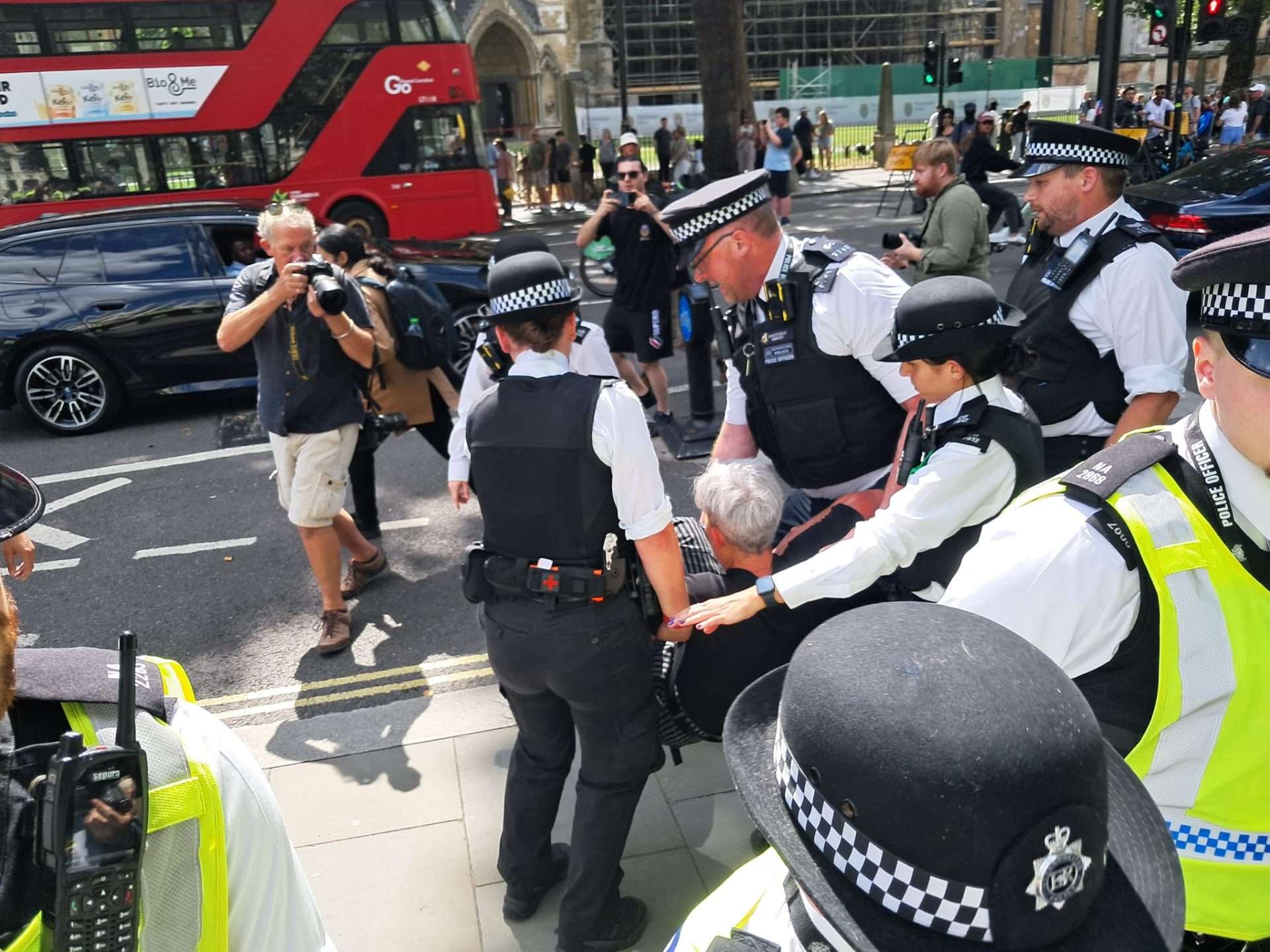
Protesters and police at ‘Lift the Ban’ civil disobedience protest, Parliament Square, 9 August.
Michael Tangeman
Faith-based protests over Gaza are on the rise and likely to continue
Fr John McGowan OCD knows a thing or two about terrorism.
A member of the Discalced Carmelites and longtime parish priest, what McGowan knows he learned first-hand while living and working at the Carmelite house in the Notre Dame Centre in Jerusalem from 1998-2003, seeing the devastating impact of a terror campaign of suicide bombings of buses, restaurants and shopping centres that killed hundreds of Israeli civilians during the Second Intifadah.
“You had to go out, you had to have exercise. But you never knew if you were going to come back,” he said, “and that’s not exaggerating.”
As he headed into central London on the morning of 9 August from his parish of St Joseph in the Buckinghamshire village of Chalfont St Peter, McGowan also knew he was himself almost certainly about to be arrested later that day on terror-related charges, even though his only offence would be to engage non-violently in an act of passive civil disobedience to protest Britain’s refusal to withdraw support for the Israeli government over its relentless campaign of bombing of Gaza.
Despite the risk of arrest, Fr McGowan pressed on to join the growing ranks of faith-based activists willing publicly to protest against their government’s continued supply of military arms and component parts for use by the Israeli military in Gaza.
In a series of massive National March for Palestine protests through Central London streets organised by the Palestine Solidarity Campaign since the end of 2023, and now in separate sporadic non-violent civil disobedience around the country over a government ban on direct-action protest group Palestine Action, an increasing number of Catholics, Quakers, Baptists and Methodists have joined Jews and Muslims in stepping up their opposition to government policy on Gaza.
Beginning in early 2024, the inter-denominational Christians for Palestine group has been meeting for prayer at nearby churches in advance of each march. They then form a Christian Bloc to join the march behind the contingent of Jewish protesters against Israeli policy in Gaza, in a show of inter-faith solidarity and support.

Fr John McGowan OCD, Photo Michael Tangeman
The Christians for Palestine activists believe in “exercising our right to protest peacefully, planned, notified in advance with the police, at scale, telling our elected leaders this is what matters to us,” says Colette Joyce, a group member and lay Catholic, who along with the Revd Sam Fletcher, an Anglican priest, led scripture readings at the prayer service in advance of the 9 August march.
Joyce, who from 2020-2025 was Justice and Peace Co-ordinator for the Diocese of Westminster, said that although the marches are “having some effect – I’d say our politicians, leaders in government, have moved their position from where they were at the start to where they are now – it clearly hasn’t done enough to end the war or to end British support for what’s going on. So at that point, I understand why people get frustrated and want to take the next step.”
After the 300,000-strong 9 August march through Central London last month, Fr John McGowan took that next step, making his way to Parliament Square to join hundreds of others protesting against the ban on Palestine Action, proscribed as a “terror group” in July after activists spray-painted two military aircraft at RAF Brize Norton to protest Britain’s refusal to stop the flow of arms and component parts to Israel.
Organised by the group Defend Our Juries, the “Lift the Ban” civil disobedience protests aim to highlight what the organisers say is the government’s attempt to muzzle dissent over Gaza by denying Palestine Action due process in court, where they are unable to present their own defence under the terms of anti-terror legislation.
“I heard they made Palestine Action a terrorist group, so I read about what they were supposed to have done and I thought, ‘they’re not a terrorist group’. There’s no way I would support a terrorist organisation,” Fr McGowan said.
That afternoon, Fr McGowan was arrested by police along with 532 others, nearly all of whom now face charges under Section 13 of the Terrorism Act 2000 for “displaying an item in support of a proscribed organisation”, in his case for holding a simple sign bearing the words, “I support Palestine Action”.
McGowan said he was instructed to report to Poplar Police Station on 22 September to learn whether the government will proceed with the charges against him, for which he could face up to six months in prison, if convicted.
McGowan acknowledges that taking action that involves risk of arrest and jail time is not something to which everyone is able to commit.
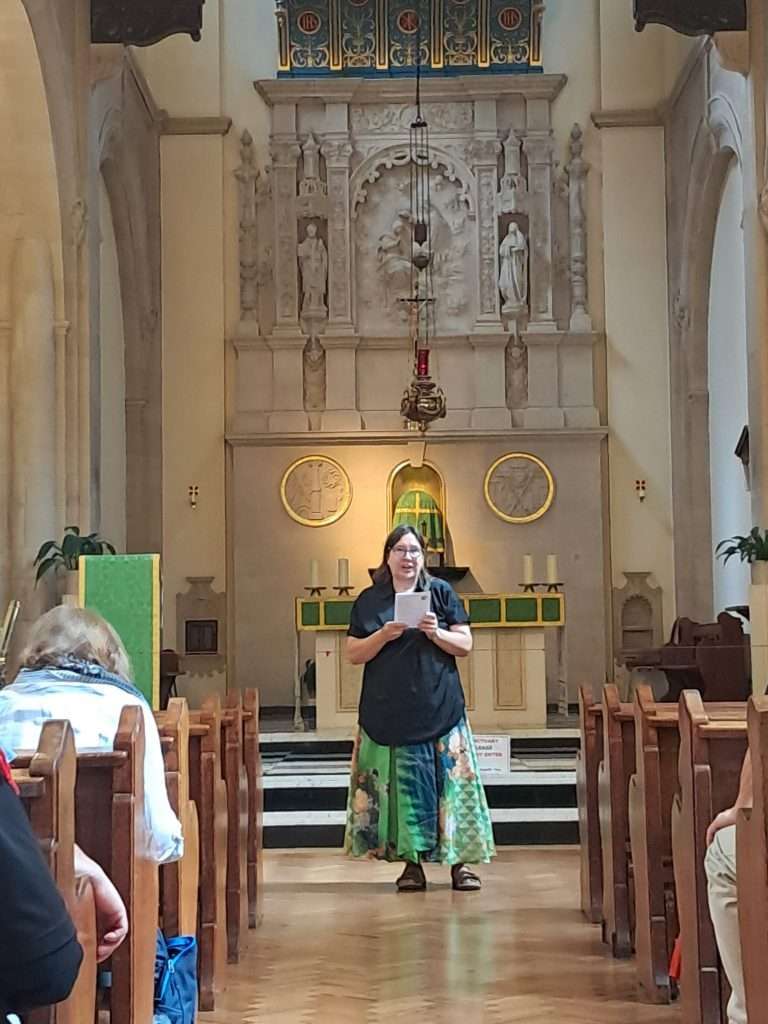
Colette Joyce during Christians for Palestine 9 August prayer service at St Anselm and St Cecilia’s church, London. Photo Michael Tangeman
But for those who are able, says Colette Joyce, “it’s very brave that they do. We prayed for everyone that was taking part in that action.”
The next Parliament Square “Lift the Ban” protest along with the 30th National March for Palestine are planned for this Saturday, 6 September.
Father McGowan will not be there, excluded from Central London as part of his bail conditions.
But Defend Our Juries say that with more than 2,500 individuals having volunteered to participate this time, arrests are expected to double to more than 1,000, overwhelming the police’s ability to book all participants and calling into question the viability of the government’s ban on Palestine Action.
Michael Tangeman is an Irish-American journalist and author of the book, Mexico at the Crossroads: Politics, the Church, and the Poor.
Stay updated — add us as a preferred news source on Google:


Help us keep The Tablet’s voice independent, clear and far-reaching.
Founded in 1840, The Tablet is the leading independent English-language Catholic weekly, celebrated for great writing, astute analysis, brilliant arts and books reviews and trustworthy reporting from correspondents in Britain, Ireland, Rome and across the world.
Independent, high-quality journalism is at the heart of what we do. The Tablet does not have deep pockets and we are not funded by rich donors. If you appreciate our work please consider supporting The Tablet’s Development Fund. It only takes a moment and you can cancel at any time.
- Support with £5 per month
- Support with £10 per month
- Support with other amount.

MOST READ ARTICLES
-
1
Pope Leo diagnosed with lung cancer after operation
-
2
Breaking up … for now
-
3
The Tablet Lecture 2026: Keeping the dream of peace alive
-
4
Vatican confirms Pope’s Latin America travel plans despite operation
-
5
A tiny gem
-
6
Archbishop bars Catholics from firing squad for US military execution
FROM THE EDITOR'S DESK