Report warns of ‘particular challenges’ of assisted dying for faith-based hospices


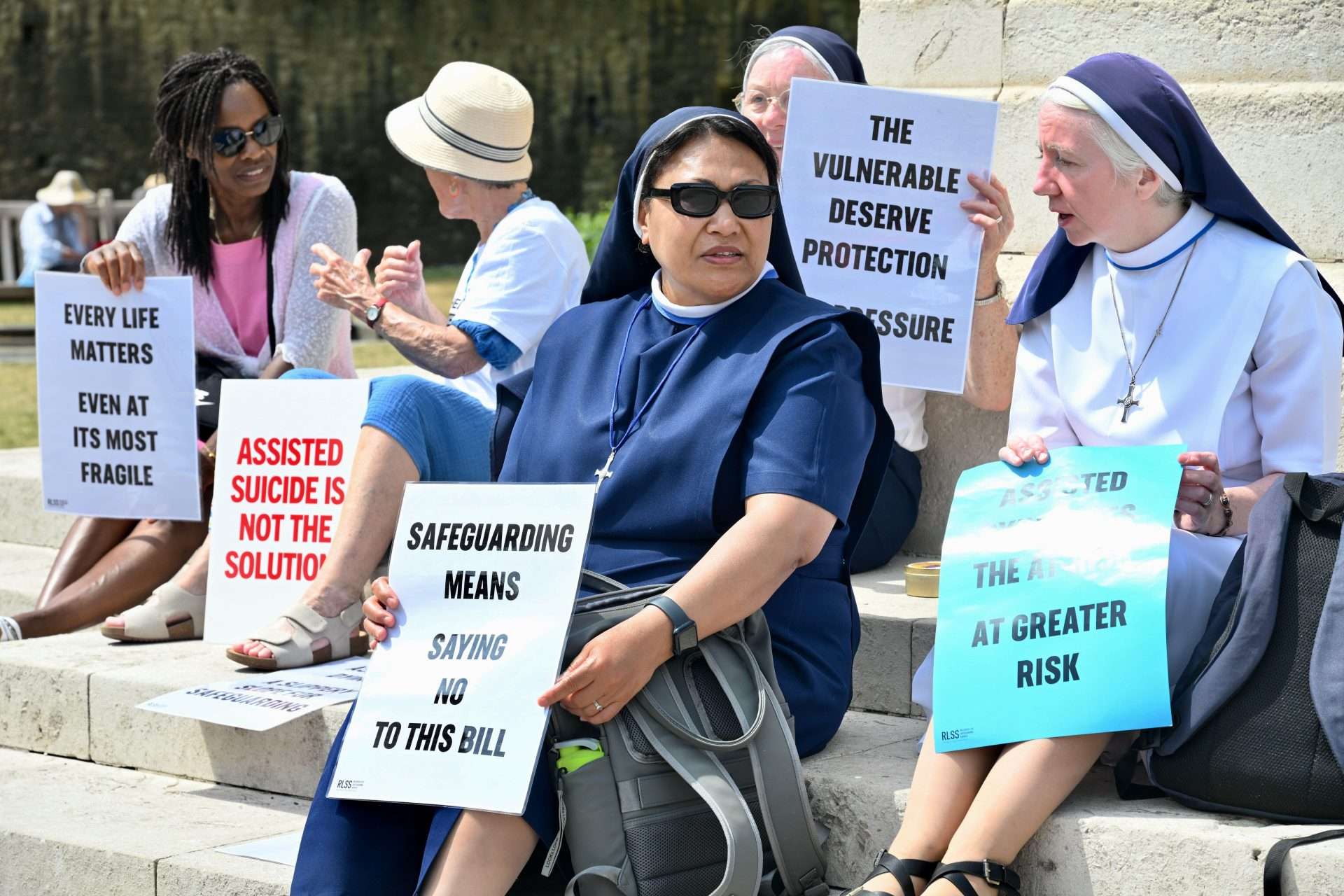
Nuns opposed to the assisted dying bill, Houses of Parliament, Westminster in June
Archbishop Sherrington says report confirms there is no ‘safe’ way to introduce assisted suicide
A new report on assisted dying warns of the ‘financial challenge’ ahead of implementing a new service as this.
Estimates of costs have so far been limited to direct costs, says the report by the Nuffield Trust, which has a neutral position on assisted dying.
“International evidence demonstrates that wider costs need to be considered, including to develop the infrastructure to support implementation of assisted dying services,” the report says, warning that “trade-offs” with other competing priorities will have to be made. “No decisions have yet been made about funding mechanisms and reimbursement for assisted dying: addressing funding requirements will need to be an urgent priority if it becomes legal in the UK.”
In the report, Assisted dying in practice: International experiences and implications for health and social care, the authors review evidence from countries where assisted dying has been legalised, to understand the implications of a change in the law for the health and social care system in the UK.
It come as the the UK and Scottish Parliaments are debating bills to legalise assisted dying across England, Scotland and Wales with key decisions on funding and implementation yet to be made. The Westminster Bill will be debated in the House of Lords this autumn. The authors examined the impact of assisted dying legislation in Australia, Austria, Belgium, Canada, the Netherlands, New Zealand, Spain, Switzerland and the US.
“Finding both the funding and organisational capacity to implement assisted dying will be extremely challenging,” the report says, in regard to England. “In the UK, palliative care is reliant on a patchwork of provision from organisations like hospices and social care providers, whose funding comes from voluntary, private and public sector sources. The willingness of providers to engage with assisted dying – by providing services or training staff – could present particular challenges, especially for faith-based and third-sector independent hospices and social care organisations.”
Archbishop of Liverpool John Sherrington, lead bishop for life Issues, said, “This Nuffield report once again confirms that, despite what the bill’s proponents might say, there is no ‘safe’ way to introduce assisted suicide. It always leads to the erosion of a culture of care, puts a material and moral strain on the health services, results in more and more patients being left vulnerable at the end of their lives, and places healthcare professionals in morally difficult situations.”
Dr Gordon Macdonald, chief executive of Care Not Killing, criticised the report for “limited” scope. He said, “It sets out to examine the impact of assisted dying on the healthcare systems of 15 jurisdictions. It does not assess the impact on the legal system or the social and political factors that led to the introduction of initial legislation. Crucially, it takes no account of media reports or material produced by non-academic sources.”
He added said, “We agree with the report that in all the jurisdictions that have legalised assisted suicide or euthanasia, over time there is pressure to erode safeguards and widen eligibility criteria. It is time that Parliament ditched the dangerous and controversial bill and instead turn their attention to fixing the UK’s broken palliative and social care systems that are failing many vulnerable, elderly and disabled people.”
Andrea Williams, chief executive of Christian Concern, said, “Kim Leadbeater’s ill thought through bill is being rushed through parliament without proper time for scrutiny or debate. It involves changing the very foundation of the NHS so that the NHS is not just focused on treating illnesses, but also on helping patients to end their lives. This change undermines the very basis of medicine and the reason that people choose to work in clinical fields of medicine and medical care. It constitutes a massive cultural and moral change to our society which will have a huge impact on the NHS in general.
“We have argued that this bill will be very difficult to implement for all sorts of reasons. The Nuffield Report now provides solid evidence from other jurisdictions of the multiple problems faced by countries that decide to facilitate assisted suicide.
“The NHS is already stretched to the limit and struggling to provide the heavy demand on its services. Legalising assisted suicide will only add to these pressures by requiring the NHS to determine the eligibility of patients who request it and by forcing the NHS to assist in the suicide of those who qualify. This report highlights the multiple challenges with forcing the NHS to provide assisted suicide to anyone who is eligible.”
Stay updated — add us as a preferred news source on Google:


Help us keep The Tablet’s voice independent, clear and far-reaching.
Founded in 1840, The Tablet is the leading independent English-language Catholic weekly, celebrated for great writing, astute analysis, brilliant arts and books reviews and trustworthy reporting from correspondents in Britain, Ireland, Rome and across the world.
Independent, high-quality journalism is at the heart of what we do. The Tablet does not have deep pockets and we are not funded by rich donors. If you appreciate our work please consider supporting The Tablet’s Development Fund. It only takes a moment and you can cancel at any time.
- Support with £5 per month
- Support with £10 per month
- Support with other amount.

MOST READ ARTICLES
-
1
Pope returns to Vatican after hospital discharge
-
2
Diverse schools that are 100 per cent Catholic
-
3
Under endless skies
-
4
Battling confession fatigue
-
5
Nigerian bishop scorns suggestion of running in presidential election
-
6
Schismatic Spanish nuns strip contents of convent before eviction
FROM THE EDITOR'S DESK