Recognition of Traynor’s miracle cure ‘a chance for discussion’


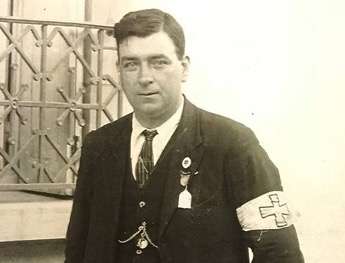
John Traynor, known as Jack, returned to Lourdes each year as a brancardier after his cure.
Liverpool Archdiocesan Lourdes Pilgrimage Association
John Traynor was cured of epilepsy, paraplegia, paralysis of his right arm and multiple unhealed wounds and sores during Liverpool’s first diocesan pilgrimage to Lourdes in 1923.
The recognition of John Traynor’s cure at Lourdes as a miracle is an opportunity for questions and public discussion, his great-great-grandson said.
“I would like people to be talking about it,” said Alex Taylor, one of five of Traynor’s descendants at the Metropolitan Cathedral of Christ the King in Liverpool on 8 December to hear Archbishop Malcolm McMahon declare the cure “a miracle wrought by the power of God through the intercession of Our Lady of Lourdes”. They had heard of the declaration just days beforehand, although Taylor, a professional filmmaker, had previously researched the cure for a documentary project.
“It was just taken for granted growing up,” he told The Tablet, explaining that it was “colloquially” understood in the family to have been miraculous “regardless of the official designation”.
Traynor was cured of epilepsy, paraplegia, paralysis of his right arm and multiple unhealed wounds and sores – all resulting from injuries sustained in the Frist World War – during Liverpool’s first diocesan pilgrimage to Lourdes in 1923. Contemporary doctors confirmed “that the process of their prodigious healing is absolutely outside and above the forces of nature”, but no formal communiqué reached the Archbishop of Liverpool to make a canonical declaration.
Efforts over subsequent decades to secure formal recognition of the cure failed to find the necessary documentation. An attempt in 1993 concluded it was not properly recorded, while Taylor said his research “hit this wall” in 2018.
Dr Alessandro de Franciscis, the president of the Lourdes Office of Medical Observations (Bureau des Constatations Médicales – BdCM), commissioned Dr Kieran Moriarty to revisit Traynor’s dossier on the centenary of the cure in 2023. He said that “Lourdes had done its job and also Liverpool” in documenting the cure, but that no dioceses received formal communiqués to allow any formal declarations from 1914 to 1946.
He told The Tablet that he “always heard about John Traynor” since first coming to Lourdes, but that the BdCM “never put any pressure” on cases to have miracles declared. “It is not an industrial process,” Dr de Franciscis said.
Dr Moriarty, who located the medical documentation to support the formal declaration, said he had “talked about the cure many times” with de Franciscis as a member of the Lourdes International Medical Committee, and found that it was unofficially understood to be a miracle at the shrine.
Speaking to The Tablet shortly after Archbishop McMahon’s declaration, he said this made the accurate documentation all the more important. “I’m very conscious of the fact that if we make a decision and a cure is recognised, it becomes part of the history of the Catholic Church,” he said.
Archbishop of Liverpool declares Lourdes cure miraculous, 101 years later
Polishing the rock of Massabielle
“We are not talking about magic,” said de Franciscis, “this is biology, these are human bodies.” He said the significance of official miracles was the recognition of divine intervention in nature, referring to the story in Mark’s gospel of the paralysed man brought to Jesus by friends who broke through the roof of a house to lower him down on a stretcher.
De Fracnciscis cited Jesus’ challenge to the scribes who object to him telling the man his sins are forgiven: “Why do you raise such questions in your hearts? Which is easier, to say to the paralytic, ‘Your sins are forgiven’, or to say, ‘Stand up and take your mat and walk’? But so that you may know that the Son of Man has authority on earth to forgive sins,” he said to the paralytic, “I say to you, stand up, take your mat and go to your home.” (Mark 2:8-11)
Miraculous cures, de Franciscis said, signified the forgiveness of sins and the hope expressed by the Jubilee Year. “We have forgotten that we can forgive sins,” he said.
Taylor said the recognition of Traynor’s miraculous cure means his story “can be shared” and discussed. When he spoke about his family’s story as a student, he said, he was asked “loads and loads of questions about it” that had led him to pursue “a deeper understanding of what happened”.
“I’m not sure what I was seeking,” Taylor said, reflecting that the Church’s formal recognition could not make anybody believe in a miracle. “It comes down to faith at the end.”
Stay updated — add us as a preferred news source on Google:


Help us keep The Tablet’s voice independent, clear and far-reaching.
Founded in 1840, The Tablet is the leading independent English-language Catholic weekly, celebrated for great writing, astute analysis, brilliant arts and books reviews and trustworthy reporting from correspondents in Britain, Ireland, Rome and across the world.
Independent, high-quality journalism is at the heart of what we do. The Tablet does not have deep pockets and we are not funded by rich donors. If you appreciate our work please consider supporting The Tablet’s Development Fund. It only takes a moment and you can cancel at any time.
- Support with £5 per month
- Support with £10 per month
- Support with other amount.

MOST READ ARTICLES
-
1
Pope returns to Vatican after hospital discharge
-
2
Diverse schools that are 100 per cent Catholic
-
3
Under endless skies
-
4
Battling confession fatigue
-
5
Nigerian bishop scorns suggestion of running in presidential election
-
6
Schismatic Spanish nuns strip contents of convent before eviction
FROM THE EDITOR'S DESK