Pope begins apostolic journey as ‘pilgrim of peace’ in Algeria


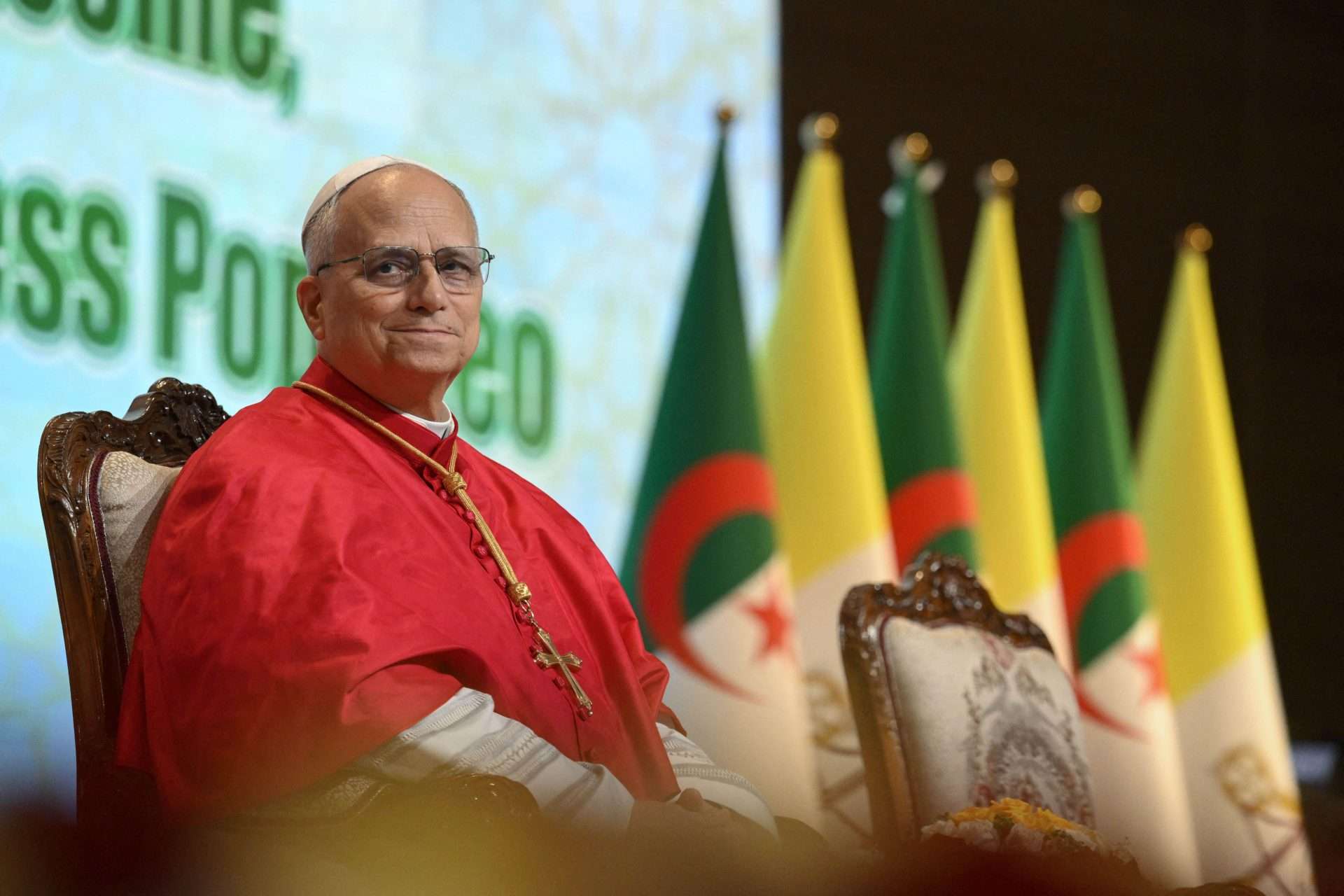
‘The profound religious sense of the Algerian people fosters a culture of encounter and reconciliation, of which my visit also seeks to be a sign,’ the Pope said.
IPA / Alamy
‘Africa knows all too well that people and organisations that dominate others destroy the world, which the Most High has created in order that we might all live together.’
Pope Leo said he came to Algeria “as a pilgrim of peace” at the start of his 11-day apostolic journey to four African countries.
In an address to civil authorities and the diplomatic corps in Algiers after his arrival on Monday, the Pope said he was “here among you as a witness of the peace and hope that the world so ardently desires, and that your people have always sought”.
“The profound religious sense of the Algerian people fosters a culture of encounter and reconciliation, of which my visit also seeks to be a sign,” he said. “In a world full of conflicts and misunderstandings, let us meet and strive for mutual understanding, recognising that we are all one family.”
Algerians, he said, “have never been defeated by their trials because they are imbued with a spirit of solidarity, hospitality and community that is woven into the daily lives of millions of humble and upright people”.
“They are the truly strong ones, to whom the future belongs: those who do not allow themselves to be blinded by power or wealth, and those who refuse to sacrifice the dignity of their fellow citizens for the sake of personal or collective gain.”
Leo praised the alms-giving custom of sadaka, which also means justice, as a vision “both simple and radical, for it recognises the image of God in others”, affirming that “a religion without mercy and a society without solidarity are a scandal in God’s eyes”.
“Yet many societies that consider themselves advanced are plunging ever deeper into inequality and exclusion,” he continued. “Africa knows all too well that people and organisations that dominate others destroy the world, which the Most High has created in order that we might all live together.”
Dialogue and cooperation, he said, are “more important than ever in the face of continuous violations of international law and neocolonial tendencies”.
The Church, he continued, “through her communities and societies, wishes to contribute to the common good of Algeria, strengthening its distinctive identity as a bridge between North and South, and between East and West”.
The Mediterranean and the Sahara on Algeria’s borders, which many migrants cross on dangerous irregular routes, are “geographical and spiritual crossroads” which must not become “graveyards where hope also dies”, the Pope said, condemning “those who exploit human life” and despoil the sea and desert.
“The Mediterranean, the Sahara and the vast sky above them whisper to us that reality surpasses us on all sides, that God is truly great, and that everything lives in his mysterious presence,” he said.
Leo observed that Algerian society is “familiar with the tension between religious sensibility and modern life” and the “opposed dynamics of fundamentalism and secularisation” that result from it.
“Consequently, religious symbols and words can become, on the one hand, blasphemous languages of violence and oppression, or on the other, empty signs in the immense marketplace of consumption that does not satisfy us,” he said.
“These absurd polarisations, however, must not dishearten us. They must be confronted with intelligence.”
Earlier in the day, shortly after his arrival in Algiers, the Pope had visited the Maqam Echahid, the martyrs’ memorial commemorating the 1954-62 war that led to Algerian independence.
“In this place, let us remember that God desires peace for every nation: a peace that is not merely an absence of conflict, but one that is an expression of justice and dignity,” Leo said.
“The future belongs to men and women of peace. In the end, justice will always triumph over injustice, just as violence, despite all appearances, will never have the last word.”
He concluded his address by reciting the Beatitudes from St Matthew’s gospel.
Pope Leo remarked in his various addresses that he had twice visited Algeria before as an Augustinian. On Tuesday he was due to visit Anaba, the modern site of St Augustine’s see of Hippo.
“As you know, I come to Algeria with great joy because it is also the land of my spiritual father, St Augustine,” he said at the Great Mosque of Algiers. “He sought to teach the world so many things, above all through the search for truth, the search for God, recognising the dignity of every human being, and the importance of building peace.”
He emphasised the need “to learn to live together with respect for the dignity of every human person” and praised the work of the educational centre at the mosque.
“How important it is for human beings to develop the intellectual capacity that God has given us, so that we may discover how great creation is, the greatness of what God has left us in all of creation and especially in the human person,” he said.
Later that day, he addressed members of the Catholic community in Algiers at the Basilica of Our Lady of Africa, praising their “discrete and precious presence in this land [which] is marked by an ancient heritage and by luminous witnesses of the faith”.
“You are the heirs of a host of witnesses who gave their lives, motivated by love for God and neighbour,” he said, commemorating the 19 martyrs of Algeria killed between 1994 and 1996, whom Pope Francis beatified in 2018.
“You are also heirs to a still more ancient tradition, dating back to the early centuries of Christianity,” Leo continued. “In this land resounded the fervent voice of Augustine of Hippo, preceded by the testimony of his mother, Saint Monica, and of other saints.”
He emphasised the importance of prayer, charity and unity for the work of the Church in Algeria, describing how the martyrs “remained faithful to charity even to the point of sacrificing themselves”.
“In a world where division and wars sow pain and death among nations, in communities, and even within families, your experience of unity and peace is a compelling sign,” Leo said. “Together, you spread fraternity and inspire a deep longing for communion and reconciliation with a powerful and clear message that is borne in simplicity and humility.”
How will Leo carry out his mission to Algeria’s inconvenient Christians?
Papal visit offers ‘crack of light’ for peace in Africa
Stay updated — add us as a preferred news source on Google:


Help us keep The Tablet’s voice independent, clear and far-reaching.
Founded in 1840, The Tablet is the leading independent English-language Catholic weekly, celebrated for great writing, astute analysis, brilliant arts and books reviews and trustworthy reporting from correspondents in Britain, Ireland, Rome and across the world.
Independent, high-quality journalism is at the heart of what we do. The Tablet does not have deep pockets and we are not funded by rich donors. If you appreciate our work please consider supporting The Tablet’s Development Fund. It only takes a moment and you can cancel at any time.
- Support with £5 per month
- Support with £10 per month
- Support with other amount.

MOST READ ARTICLES
-
1
Pope returns to Vatican after hospital discharge
-
2
Diverse schools that are 100 per cent Catholic
-
3
Under endless skies
-
4
Battling confession fatigue
-
5
Nigerian bishop scorns suggestion of running in presidential election
-
6
Schismatic Spanish nuns strip contents of convent before eviction
FROM THE EDITOR'S DESK