No plans for ‘premature’ papal visit to Ukraine, says Parolin


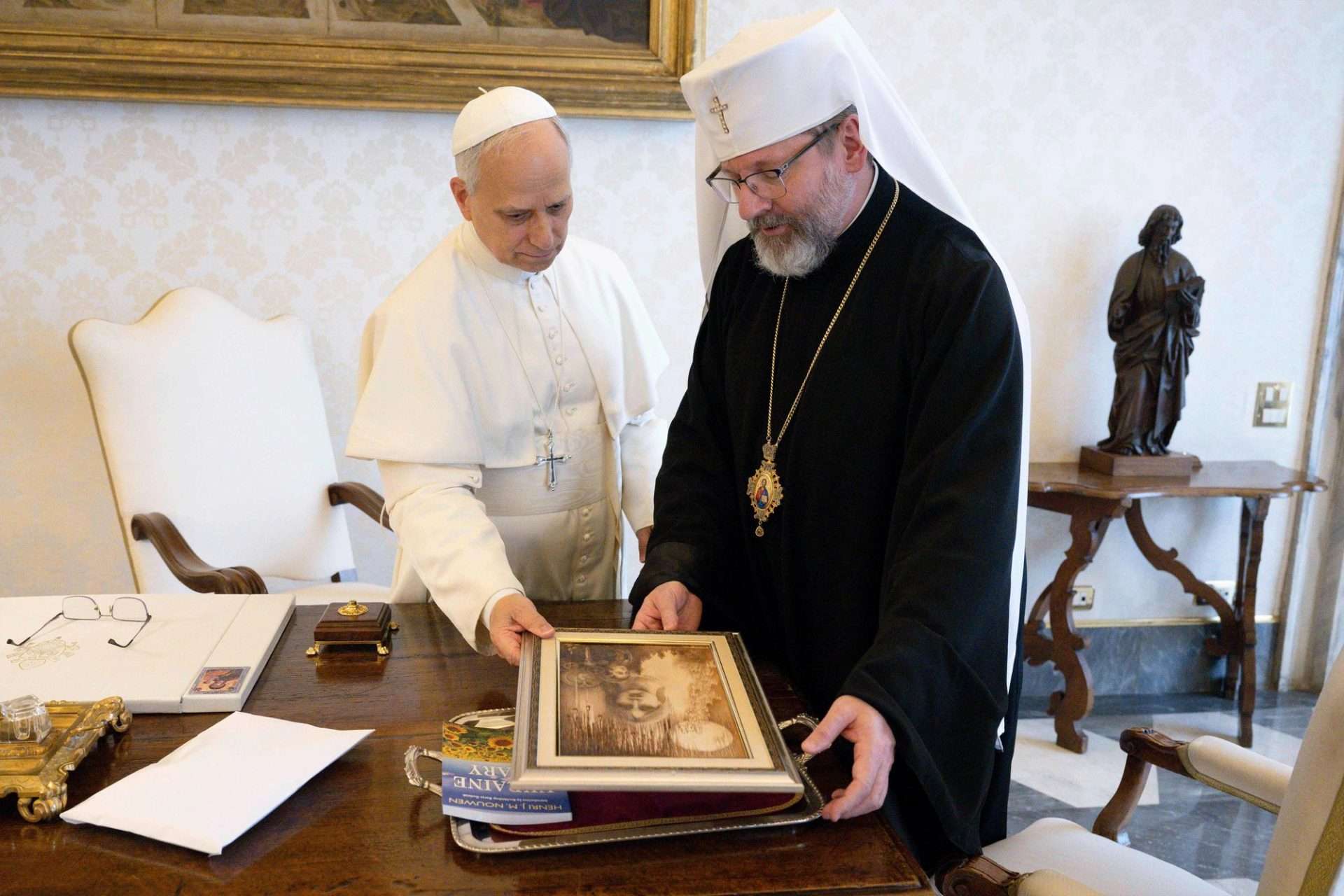
Major Archbishop Sviatoslav Shevchuk gave Pope Leo a symbolic painting, Prayer Requiem, by an artist whose son was killed in the war.
Secretariat of the Head of the Ukrainian Greek Catholic Church in Rome / Vatican Media
The Holy See’s secretary of state said the Pope was willing to offer the Vatican as a venue for a direct meeting between Russia and Ukraine after talks in Istanbul failed to agree a ceasefire.
The Vatican is not considering plans for an apostolic visit to Ukraine by the new pope, the Secretary of State Cardinal Pietro Parolin confirmed, describing President Volodymyr Zelenskyy’s invitation to Pope Leo XIV as “premature”.
President Zelenskyy spoke to the Pope on Monday, in one of his first calls with international leaders, inviting him to Ukraine and thanking him for the Vatican’s contribution to humanitarian relief for the victims of the war.
Parolin welcomed the US-backed initiative for direct talks between Zelenskyy and Putin in Istanbul, which he said signalled a new “opening for peace” and a “serious starting point”.
Speaking to reporters at an event organised by the Ukrainian Greek Catholic Church at the Pontifical Gregorian University in Rome, Parolin said: “We are pleased that there is finally the possibility of a direct meeting. We hope that the existing issues can be resolved there and that a genuine peace process can begin.”
In anticipation of the meeting in Istanbul between the Ukrainian and Russian delegations, one of Pope Leo’s first social media posts expressed the Holy See’s readiness to “help enemies meet”.
“The Holy See is willing to help enemies meet, so they may look each other in the eye and so people may be given back the dignity they deserve: the dignity of peace. With heart in hand, I say to the leaders of nations: let us meet; let us dialogue; let us negotiate!” the Pope said.
Despite high expectations, Russia’s President Vladimir did not travel to Istanbul for the talks, instead sending lower-level government representatives to meet the Ukrainian counterparts in the first direct talks between the parties in three years.
Commenting on the Istanbul meeting, US Secretary of State Marco Rubio expressed doubts about the likelihood of any meaningful progress until President Donald Trump and Putin meet face-to-face.
In response to a question, Parolin said the Vatican does not wish to interfere with the “ongoing initiatives”, adding that it will continue to offer its good offices and help facilitate meetings on Ukraine but without assuming any formal mediation role.
After Russia and Ukraine failed to agree a ceasefire on Friday, Parolin described the outcome of the Istanbul meeting as “tragic”.
“It’s all tragic because we hoped that a process would begin, perhaps slowly, but with a peaceful resolution of the conflict. Instead, we are back to square one,” he said on Friday. “Now we will see what to do, but the situation is very difficult.”
He also said the Pope was willing “if necessary” to offer the Vatican as a venue for a direct meeting between Russia and Ukraine.
In his remarks to reporters earlier in the week, Parolin also confirmed that the Vatican remains active in the humanitarian dimension of the conflict, especially regarding the repatriation of Ukrainian children abducted by Russia.
However, in a recent interview the apostolic nuncio to Ukraine Archbishop Visvaldas Kulbokas said that financial constraints were limiting the Vatican’s engagement.
On Thursday, the head of the Ukrainian Greek Catholic Church also invited Pope Leo to visit Ukraine and gave him a list of Ukrainians held captive in Russia or missing in combat.
At a private audience in Rome, Major Archbishop Sviatoslav Shevchuk told the Pope: “Every time I visit our parishes in different regions of Ukraine, I meet families of prisoners of war and those missing in action, and they give me the names of their relatives with a request to personally hand them over to the Pope.”
Noting Pope Francis’ role in facilitating prisoner exchanges, he continued: “When the Russian side receives these lists from the Vatican, we have evidence that the treatment of these prisoners is even improving.”
Archbishop Shevchuk told Pope Leo that Ukrainians “have already recognised you as the Pope of Peace” following his words in St Peter’s Square on his election last week. The Pope told Shevchuk: “I am with the Ukrainian people.”
Addressing the Vatican diplomatic corps on Friday, the Pope said the Holy See would promote “truth, justice and peace” in all parts of the world, “starting with those places that suffer most grievously, like Ukraine and the Holy Land”.
“This effort, in which all of us are called to take part, can begin to eliminate the root causes of all conflicts and every destructive urge for conquest,” he said. “It demands a genuine willingness to engage in dialogue, inspired by the desire to communicate rather than clash.”
The war in Ukraine: diplomacy beyond revenge
Ukraine welcomes Pope’s plea for peace at Regina Caeli
Stay updated — add us as a preferred news source on Google:


Help us keep The Tablet’s voice independent, clear and far-reaching.
Founded in 1840, The Tablet is the leading independent English-language Catholic weekly, celebrated for great writing, astute analysis, brilliant arts and books reviews and trustworthy reporting from correspondents in Britain, Ireland, Rome and across the world.
Independent, high-quality journalism is at the heart of what we do. The Tablet does not have deep pockets and we are not funded by rich donors. If you appreciate our work please consider supporting The Tablet’s Development Fund. It only takes a moment and you can cancel at any time.
- Support with £5 per month
- Support with £10 per month
- Support with other amount.

MOST READ ARTICLES
-
1
Pope returns to Vatican after hospital discharge
-
2
Diverse schools that are 100 per cent Catholic
-
3
Under endless skies
-
4
Battling confession fatigue
-
5
Nigerian bishop scorns suggestion of running in presidential election
-
6
Schismatic Spanish nuns strip contents of convent before eviction
FROM THE EDITOR'S DESK