Indian Supreme Court freezes place-of-worship disputes after violence


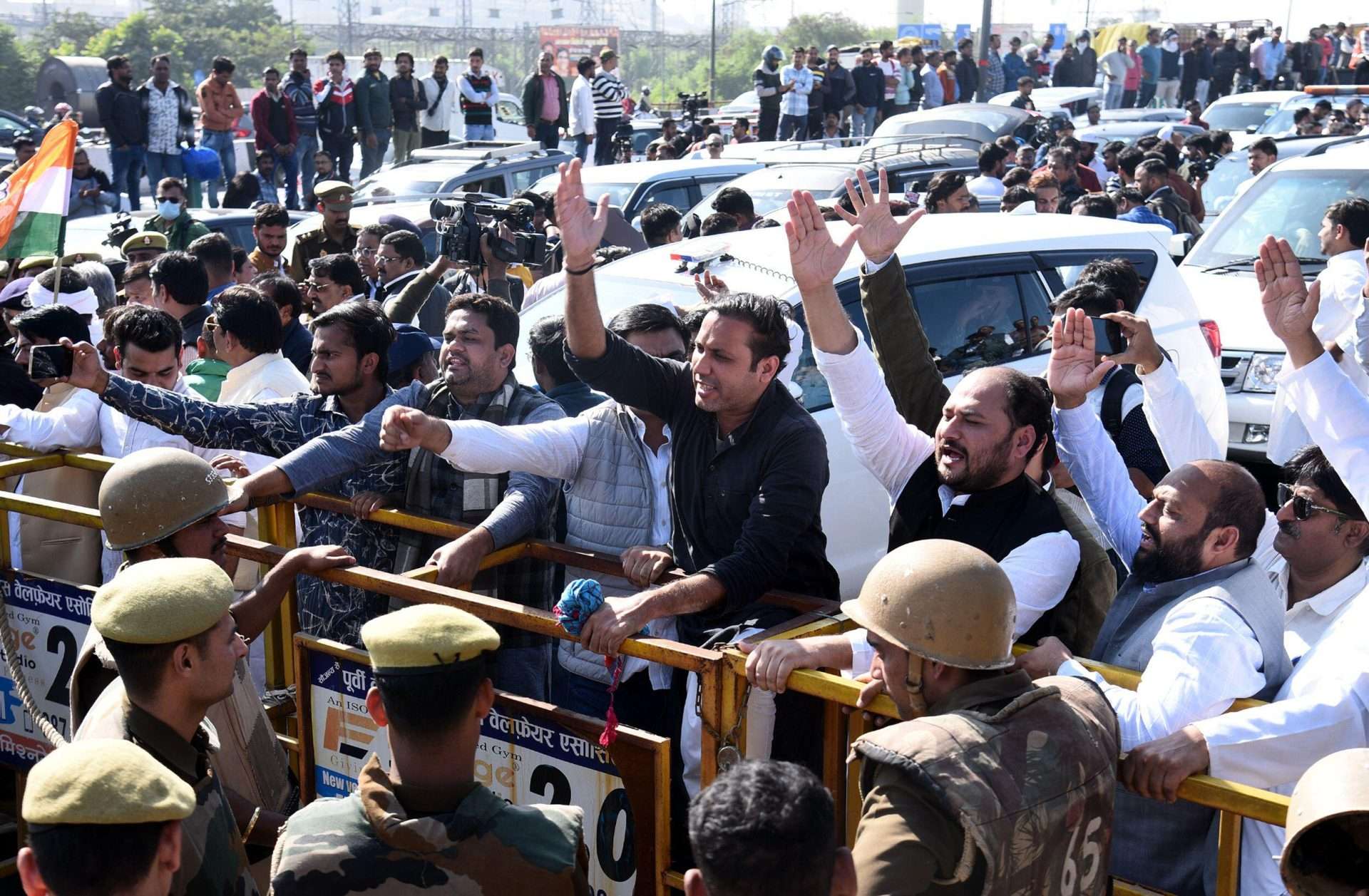
Protests against police blocking the road to the Sambhal mosque on 4 December, when Rahul Gandhi, leader of the opposition, planned to visit the site.
Sipa US / Alamy
The Supreme Court order barred lower courts from registering fresh suits or passing orders in pending challenges to the Places of Worship Act.
India’s Supreme Court froze an array of legal challenges seeking to claim back land where Mughal invaders are said to have razed temples to build mosques centuries ago.
A special bench of the court headed by Chief Justice Sanjiv Khanna, hearing challenges to the Places of Worship (Special Provisions) Act of 1991 from claimants to mosque sites, passed the freezing order last week after a lower court’s decision to order a survey of a mosque on 19 November prompted widespread violence.
Riots broke out around the sixteenth-century Mughal-era mosque in Sambhal, in the north of Uttar Pradesh, as the court-mandated surveyors investigated the site for evidence of an historic temple. The violence left six dead and more than 20 police personnel injured.
The Supreme Court order barred lower courts from registering fresh suits or passing orders in pending challenges to the Places of Worship Act.
The act protects the “religious character” of a place of worship as it was on 15 August 1947, the day India gained independence. Only the dispute over Babri Masjid – a mosque in Ayodhya, Uttar Pradesh, said to have been built over Ram Janmabhoomi, the legendary birthplace of Rama – was exempt from the law as it was sub judice in 1991. Hindu nationalists demolished the mosque the next year, triggering widespread communal violence in which more than 2,000 people died.
The freezing order affected 18 current suits concerning 10 sites. These include the Gyanvapi mosque in Varanasi and the Shahi Eidgah mosque in Mathura, both in Uttar Pradesh, and the renowned Ajmer Sharif Dargah mosque in Rajasthan – all alleged to have been built on demolished temples.
Petitioners have argued the act infringes fundamental rights under Articles 14 (Right to Equality) and 25 (Freedom of Religion) of the Constitution.
The protracted legal battle following the demolition of the Babri Masjid on 6 December in 1992 concluded in November 2019 when the Supreme Court allowed the construction of a Hindu temple of the dispute site, granting the Muslim community another site to build a mosque.
Some Muslim leaders opposed the settlement, warning that it would encourage further disputes, and were vindicated in 2020 when the first of a series of further suits were filed against the Places of Worship Act.
These included the Gyanvapi mosque, which petitioners claimed was built on the ruins of Kashi Vishwanath temple. In 2022 a court in Varanasi ordered a survey of the mosque complex, after five Hindu women demanded daily access to it to worship a deity on its outer wall. When the case reached the Supreme Court in 2022, the then Chief Justice D Y Chandrachud orally observed that a survey “may not necessarily fall foul” of the Places of Worship Act.
The Muslim organisation Jamiat Ulama-i-Hind has argued that the act protects secularism and should not be challenged as it would lead to litigation against many mosques and widen religious divisions. It warned that challenges would affect other places of worship, including temples, gurudwaras, churches and monasteries.
Fr Suresh Mathew OFM Cap, a former editor of the Indian Currents weekly, said the controversy was a “symptom of larger malaise”.
“Beneath the veneer of a law and order problem, the Sambhal violence reveals a more sinister reality – one of deliberate communal provocation, orchestrated to polarise and divide.”
He said that majority communities should learn to treat disputed places of worship as a closed chapter and not pursue revenge. Gods of all descriptions will be more than pleased by this act of mutual respect and recognition, he said.
Stay updated — add us as a preferred news source on Google:


Help us keep The Tablet’s voice independent, clear and far-reaching.
Founded in 1840, The Tablet is the leading independent English-language Catholic weekly, celebrated for great writing, astute analysis, brilliant arts and books reviews and trustworthy reporting from correspondents in Britain, Ireland, Rome and across the world.
Independent, high-quality journalism is at the heart of what we do. The Tablet does not have deep pockets and we are not funded by rich donors. If you appreciate our work please consider supporting The Tablet’s Development Fund. It only takes a moment and you can cancel at any time.
- Support with £5 per month
- Support with £10 per month
- Support with other amount.

MOST READ ARTICLES
-
1
Pope returns to Vatican after hospital discharge
-
2
Diverse schools that are 100 per cent Catholic
-
3
Under endless skies
-
4
Battling confession fatigue
-
5
Nigerian bishop scorns suggestion of running in presidential election
-
6
Schismatic Spanish nuns strip contents of convent before eviction
FROM THE EDITOR'S DESK