Consistory can model communion for whole Church, says Leo


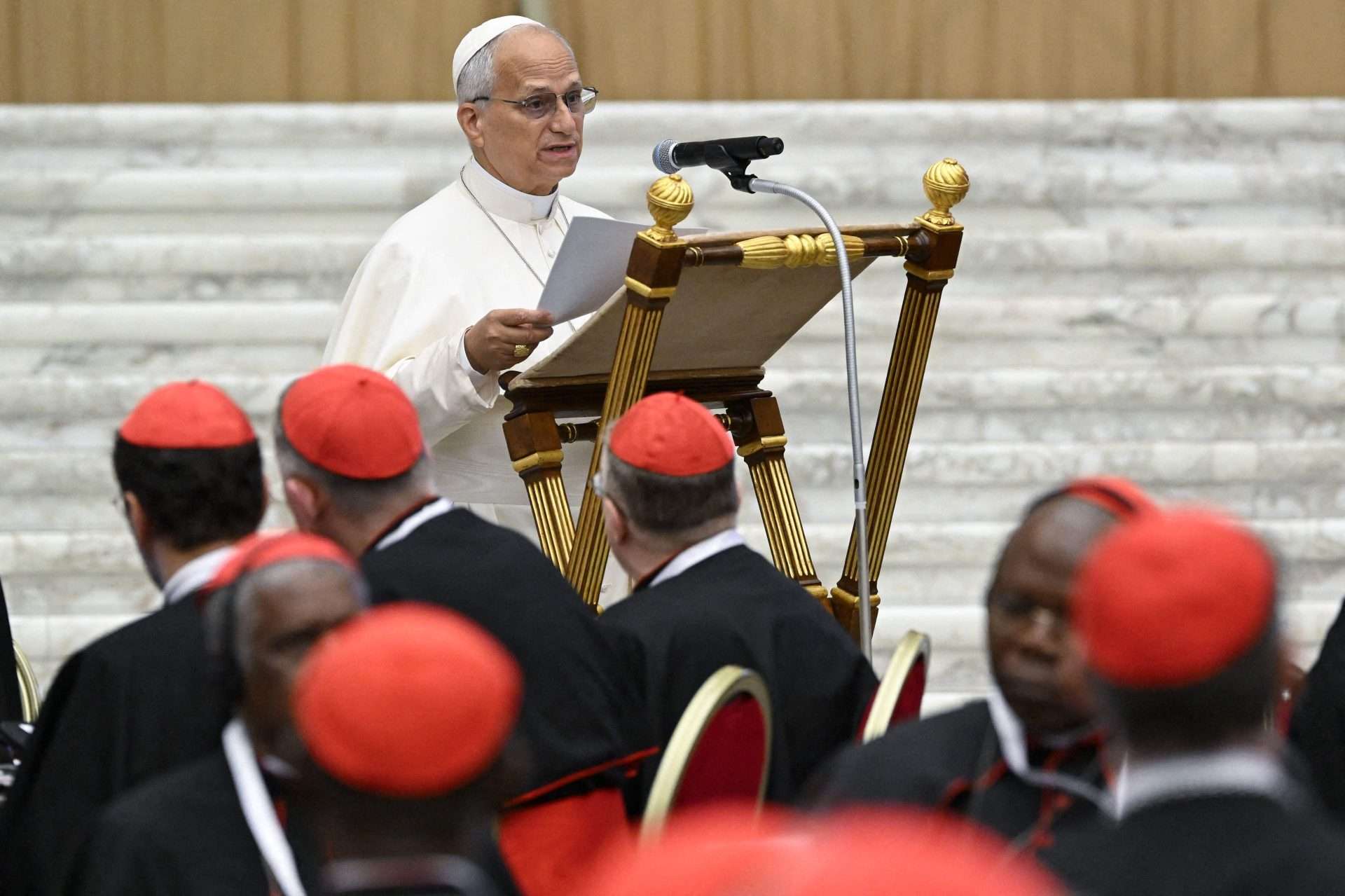
Pope Leo said he was ‘particularly struck’ by the cardinal’s discussion of young people, whose ‘search for authenticity, for real relationships and for a sense of meaning reminds us that the Gospel continues to meet the deepest longings of the human heart’.
Simone Risoluti / Vatican Media / Abaca Press / Alamy
‘It is not a parliament, not a congress where opinions or interests prevail, but an experience of communion at the service of mission.’
The extraordinary consistory of the College of Cardinals “must not remain an isolated meeting” but promote encounter throughout the Church, the Pope said.
Pope Leo said the two working days of the consistory were “a precious moment” and “strengthen my hope” as he addressed the cardinals at its conclusion on Saturday.
His address reviewed the consistory’s four sessions of work, conducted in private with cardinals holding discussions in 20 small groups that produced reports to present to the Pope, and some presenting them in plenary sessions. The Holy See issued statements summarising each session of discussions.
Following Pope Leo’s opening address to the consistory on Friday, the Archbishop of Kraków Cardinal Grzegorz Ryś delivered a biblical reflection on the parable of the Good Samaritan before the groups discussed the question “In what world are we called to proclaim the Gospel?”
Cardinal Ryś concluded that the figure of the victim left for dead and the Samaritan each represent two faces of the modern world, “a half-dead countryman and an alien teaching is where true life is”, according to the Holy See statement.
It said all the groups’ reports “deliberately emphasised the suffering experienced by men and women in this era of profound social transformation”.
Some noted the growth of “polarisation” driving political crises and violent conflicts, as well as “individualism and the crisis of the family”, besides “a widespread sense of distrust, fatalism and powerlessness regarding institutions”. Some also discussed social phenomena such as mass migration, the effects of the climate crisis and living conditions in large cities.
The statement said the groups recognised “the responsibility entrusted to the Church at this pivotal moment in history”.
“Numerous groups observed that, while many institutions are experiencing a crisis of credibility, the Church feels called to speak with authority on behalf of human dignity, peace, reconciliation, and the common good,” it said.
“Especially in contexts where it is close to people’s suffering, there is a growing awareness of how the Church can find the credibility that other institutions lack.”
Commenting on the opening session in his address on Saturday, Pope Leo said the cardinals had recognised “an even more profound suffering: the solitude, the crisis of relationships, the loss of hope, the difficulty of recognising each other as brothers and sisters”.
He said he was “particularly struck” by their discussion of young people, whose “search for authenticity, for real relationships and for a sense of meaning reminds us that the Gospel continues to meet the deepest longings of the human heart”.
The second session on Friday began with a reflection from the prefect of the Dicastery for the Doctrine of the Faith Cardinal Víctor Manuel Fernández, based on the first ten paragraphs of chapter five of Magnifica Humanitas, which include the declaration that just war theory is “outdated”.
Cardinal Fernández said the Church must confront the “paradox” whereby its “social doctrine is manipulated to provide a theoretical foundation for the most unjust wars”, requiring a new emphasis on “conditions for legitimate defence”.
He specifically condemned Israeli military interventions in Gaza and Lebanon, as well as wars waged by Russia and the US, while in a wider discussion of the “culture of power” he said the European Union accepted “inconsistency as a strategy”, applying sanctions to some that violate international law but not to others where it has economic interests.
Bishops, said Fernández, must oppose this approach by any state, as well as the “discrediting of those who think differently” which drives political polarisation and the claim that war belongs to a scheme of “political realism”.
He said the Church can respond to this “bleak landscape” because its social doctrine includes the defence of life from conception to natural death alongside the protection of the vulnerable and marginalised and strong opposition to war.
During the working session, all the groups addressed “the dehumanising force of the culture of power, its universal reach, the temptation to conform to the logic of the powerful, and the normalisation of war and polarisation, which lower society’s tolerance for violence and encourage dangerously simplistic approaches to resolving conflicts”, according to the statement from the Holy See.
Many echoed Cardinal Fernández’s argument about the Church’s vocation to respond to this situation, including by moving beyond the logic of “just war” to a theory of proportionate defence.
Reflecting on their discussions in his concluding address the next day, Pope Leo warned that the “culture of power” is present in “our ways of thinking, of living relationships, of exercising power, of using economics, technology and even religion”.
“If this is the root of the crisis, the response requires the reconstruction of a culture of cooperation and dialogue, that can also give new strength to multilateralism, so that people can learn again to seek the common good together for the entire human family,” he said.
Leo welcomed the cardinals’ discussion of “nonviolent response in the face of many forms of violence”, calling this a “profoundly evangelical way of living in history” which does not amount to “the renunciation of conflict in a passive manner, but choosing to confront it without reproducing its logic”.
He said the subject of legitimate defence “merits further development with the necessary theological and pastoral rigour”.
On Saturday morning, after a Mass in St Peter’s where Cardinal Giovanni Battista Re, dean of the College of Cardinals, was main celebrant, the Archbishop of Johannesburg Cardinal Stephen Brislin introduced the third session with a reflection on the wider themes of Magnifica Humanitas based on its introduction and conclusion.
He said the encyclical develops a “grammar of building” in response to the question “What form does human endeavour take when it has access to ever more effective tools?”
Cardinal Brislin said this leaves the Church with the responsibility “to engage with the struggles of history in its own distinctive way, adopting a synodal approach, rooted in the theological virtues and focused on serving the individual”.
During the working session, most of the groups “focused their reflections on understanding the deep rifts of our time – between peoples and nations, within societies and inside families – and on how these rifts create wounds”, according to the Holy See statement.
They warned of “a tribal mentality” and “an exaggerated individualism”, with many groups discussing how the understanding of the common good “requires a language of the heart to overcome conformity, corruption, and the sense of impossibility that arises from realising that the assets and resources needed to achieve it are in the hands of a few”.
Pope Leo acknowledged the cardinals’ “insistence” on the Church’s social doctrine in his concluding address that evening, as well as their observation that “today the common good is not simply an object to pursue: it is a reality to rediscover together”.
“We live in a time when it is becoming difficult even to recognise what is truly good for all,” he said. “Because of this, rooted in Christ, the Church is called to protect places of encounter, of listening and of dialogue in which a renewed culture of the common good can mature.”
Cardinal Mario Grech, secretary general of the Secretariat of the Synod, opened the fourth session on Saturday afternoon with an address on the “implementation phase” of the Synod on Synodality.
He said it was “a favourable time for the whole Church to experience – while respecting the diversity of ministries – synodal participation as a dynamic force of communion” and that the consistory “does not stand apart from the mature ecclesial spirituality of synodality”.
Setting out the programme for the next stage of the Synod, which he said would not repeat the exercise of the “listening phase”, Cardinal Grech emphasised its theological significance.
“Synodality finds both its source and its summit in the liturgical celebration and, in a particular way, in the full, conscious, and active participation of the faithful in the Eucharistic Synaxis,” he said. “Through the action of the Spirit, we become what we celebrate. The mystery of the epiclesis brings about a profound reciprocity between Synaxis and Synod. The Synaxis is Synod.”
The fourth session took place in the Synod Hall, with cardinals responding to the reflecting individually rather than in small groups. A statement from the Holy See said they discussed the relationship of synodality with priesthood and the hierarchy, as well as the risk that “the complexity of consultation could weigh down the Church at a time when it is called to give its witness”.
Pope Leo delivered his concluding address at the end of the session and said the question of synodality – “How can we together protect the gift that the Lord has given his Church?” – was an appropriate conclusion to the consistory’s work.
“When this question becomes the centre of our discernment, the questions of authority, of co-responsibility and of decision-making find their right answer, illuminated by mission and by the common faith in the Gospel,” he said. “Therefore, I wish to affirm once more the implementation process of the Synod.”
He said he drew hope from the consistory not only “what we have shared, but from the manner in which we have done so”, offering its listening as an example to the Church. He confirmed that he plans to hold such meetings annually from next year.
“It is not a parliament, not a congress where opinions or interests prevail, but an experience of communion at the service of mission,” Leo said.
“It is a style we are called to promote across the Church, because all the baptised according to their vocation and responsibility participate in the construction of the civilisation of love and the service of the common good.”
Leo asks cardinals for ‘synodal and collegial’ support at consistory
Pope Leo to gather bishops’ conference presidents for Amoris Laetitia meeting
Stay updated — add us as a preferred news source on Google:


Help us keep The Tablet’s voice independent, clear and far-reaching.
Founded in 1840, The Tablet is the leading independent English-language Catholic weekly, celebrated for great writing, astute analysis, brilliant arts and books reviews and trustworthy reporting from correspondents in Britain, Ireland, Rome and across the world.
Independent, high-quality journalism is at the heart of what we do. The Tablet does not have deep pockets and we are not funded by rich donors. If you appreciate our work please consider supporting The Tablet’s Development Fund. It only takes a moment and you can cancel at any time.
- Support with £5 per month
- Support with £10 per month
- Support with other amount.

MOST READ ARTICLES
-
1
Pope returns to Vatican after hospital discharge
-
2
Diverse schools that are 100 per cent Catholic
-
3
Under endless skies
-
4
Battling confession fatigue
-
5
Nigerian bishop scorns suggestion of running in presidential election
-
6
Schismatic Spanish nuns strip contents of convent before eviction
FROM THE EDITOR'S DESK


