Bishop welcomes ‘encouraging’ rise in interest in sacramental marriage in Ireland


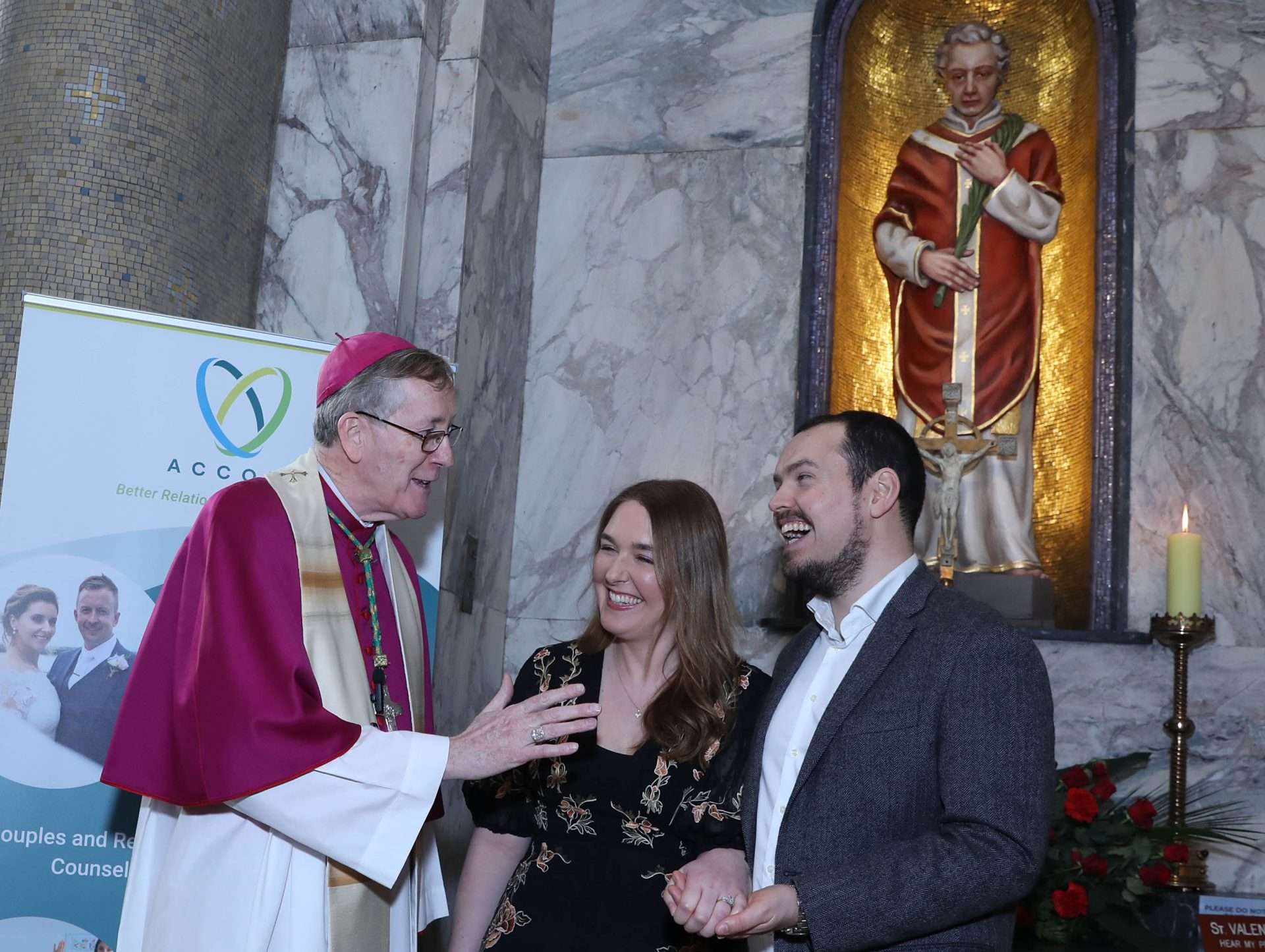
Bishop Denis Nulty and an engaged couple at the shrine of St Valentine in Dublin.
60 per cent of unmarried Catholics in Ireland would want to marry in a Catholic Church, including 63 per cent of under-35s, the marriage support charity Accord has found.
St Valentine’s shrine in Dublin “serves as a beacon to the Christian virtues of faith, love and hope,” the greatest of which is love St Paul reminded us, Bishop Denis Nulty said.
Speaking at Dublin’s Whitefriar Street church where the relics of St Valentine are venerated, Bishop Nulty, who is President of the Catholic marriage support agency, Accord, told engaged couple Lauren Stewart and David Higgins, “We are standing on holy ground, rubbing shoulders with a third century saint.”
The couple plan to marry in April and were there to be blessed by Bishop Nulty ahead of their wedding.
Speaking in front of the shrine, Bishop Nulty said he was always moved by the number of couples and individuals who call in to the church to spend quiet time there. “Pilgrims, including couples like Lauren and David, make this a holy place, and we are grateful for your fidelity and love.”
He welcomed those who come to the shrine on St Valentine’s Day to “renew their vows, their love, their commitment to one another”.
In November 1836 the reliquary containing St Valentine’s relics was first brought to the church. St Valentine was a priest who performed marriage ceremonies in defiance of the Roman emperor Claudius II’s edict, and was martyred on 14th February in 269 or 270 AD.
The reliquary containing relics of St Valentine were given to Fr John Spratt (1796-1871) by Pope Gregory XVI.
“St Valentine’s Shrine is not just holy ground because it contains a casket of relics associated with a third century martyr, St Valentine, but also because of the many couples – and indeed generations of Irish families and visiting tourists – who have call here to this sanctuary in the midst of the hustle and bustle of our historic capital, to light a candle, to write a petition, to simply stand and pray,” Bishop Nulty said.
Engaged couple Lauren and David undertook Accord’s pre-marriage course in preparation for their forthcoming nuptials. The catholic agency’s latest figures show a 16 per cent increase or an additional 505 couples attended the course last year compared to 2024’s numbers.
In their feedback after the programme couples told Accord that the course helped them to have honest conversations.
In addition to the Accord data, Bishop Nulty also welcomed as “encouraging and good news” the findings of a new survey commissioned by Accord and carried out by Amárach Research on the future intentions of young people to marry in Church.
It shows the majority of Gen Z and Millennials wish to get married in Church and that religious faith is rising amongst younger generations – 69 per cent of adults aged 18-24 identified as Roman Catholic (against 53 per cent of 25-34-year-olds and 76 per cent of all adults).
“In the Amárach Research it is great to see how faith and belief play as a motivator for young couples deciding to celebrate one’s wedding in a Catholic church. The future is bright indeed,” Bishop Nulty said.
The new research, he told The Tablet, suggests that “Gen Z are more interested in the spiritual than the generation before them”.
The research also found that 60 per cent of unmarried Catholics would want to marry in a Catholic Church (including 63 per cent of under 35s). Of Catholics who married outside of a church venue 40 per cent would have chosen to have their wedding officiated by a Catholic priest if that option were available.
Less than half of Catholics (47 per cent) are aware that it is possible to have a wedding ceremony in Church without also having a mass. Fewer than a quarter (23 per cent) of Catholics are aware of convalidation ceremonies (i.e. a Church wedding after a civil ceremony).
In their feedback after the programme couples told Accord that the course has helped them to have honest conversations.
“There was a real sense that they were trying to bring up uncomfortable topics to ensure that the couples were actually having these conversations before they made this major life-long commitment,” Lauren Stewart explained to The Tablet.
“There were a couple of conversations that came out of it that we hadn’t had. Navigating through that and potential disagreements was a really important milestone for us to make sure that we are making the right decision to get married,” she said.
After he blessed the engaged couple, Bishop Nulty spoke about the need for the Church to be at the service of its community at all times.
“Priests and parishes comment on the marked decline in the number of couples celebrating sacramental marriage. While our Church is a Church of welcome, undoubtedly more work needs to be done to encourage and support couples to appreciate the beauty that is sacramental marriage.”
Bishop Nulty told The Tablet, “When young people make the decision to marry we want to say to them – come to the church, consider having a sacramental marriage, consider having your ceremony in the church and then go to your hotel for the reception – there is nothing more beautiful as the church in its splendour on occasions like weddings.”
Stay updated — add us as a preferred news source on Google:


Help us keep The Tablet’s voice independent, clear and far-reaching.
Founded in 1840, The Tablet is the leading independent English-language Catholic weekly, celebrated for great writing, astute analysis, brilliant arts and books reviews and trustworthy reporting from correspondents in Britain, Ireland, Rome and across the world.
Independent, high-quality journalism is at the heart of what we do. The Tablet does not have deep pockets and we are not funded by rich donors. If you appreciate our work please consider supporting The Tablet’s Development Fund. It only takes a moment and you can cancel at any time.
- Support with £5 per month
- Support with £10 per month
- Support with other amount.

MOST READ ARTICLES
-
1
Pope returns to Vatican after hospital discharge
-
2
Diverse schools that are 100 per cent Catholic
-
3
Under endless skies
-
4
Battling confession fatigue
-
5
Nigerian bishop scorns suggestion of running in presidential election
-
6
Schismatic Spanish nuns strip contents of convent before eviction
FROM THE EDITOR'S DESK