Bartholomew accuses Russian Church of ethno-nationalist heresy


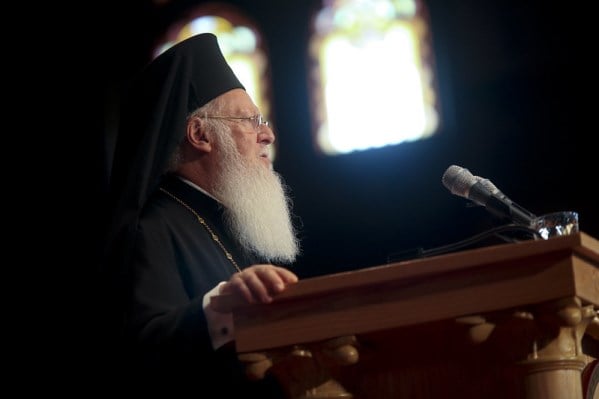
The Ecumenical Patriarch of Constantinople said Russian hierarchs would be accountable to God for their canonical transgressions.
Centre for American Progress
In a display of solidarity with the Orthodox Patriarch of Alexandria, the Ecumenical Patriarch of Constantinople heavily criticised the Russian Orthodox Church in a letter condemning its policy of expansion into Africa.
In the letter to Patriarch Theodoros II published by the Orthodox Times, Patriarch Bartholomew accused the Russian Orthodox Church of “ethnophyletism” – the instrumentalisation of the Russian Church for ethno-nationalist reasons.
“They shamelessly declare that they are Russians first and then Orthodox,” he said. “From the old days, they altered the ecclesiastical order that was delivered to them genuinely, the vestments, even the offikia [office] and traditions, to make it clear to everyone that they differ and excel.”
Ethnophyletism was declared an ecclesiological heresy in the Orthodox Church at the 1872 Council of Constantinople.
Bartholomew said he shared the anger and frustration of Patriarch Theodoros, who has been trying to push back the Russian Church’s expansionism in Africa which is traditionally under Alexandria’s jurisdiction. Russian hierarchs would be accountable to God for their canonical transgressions, Bartholomew said.
In 2019 the Patriarchate of Alexandria was one of the four Churches that recognised the autocephaly of the independent Orthodox Church of Ukraine (OCU), distinct from the Moscow-aligned Ukrainian Orthodox Church (UOC-MP).
In response, Patriarch Kirill of Moscow launched a campaign to expand his Church in Africa, corresponding to the Kremlin’s increasing interest in the continent. Many Orthodox clergy in Africa have been persuaded to leave the Patriarchate of Alexandria and join the Russian Orthodox Church, which can offer material reward.
In the letter, Bartholomew also criticised the spiritual backing Patriarch Kirill provided to Kremlin policy in Ukraine. “Today, they gladly bless the sacred weapons, the murderous ones, against the Orthodox Ukrainians who defend the territorial integrity of their country,” he said.
Bartholomew’s support for Ukraine recently extended to writing a preface to the Polish-language edition of a book of addresses by Major Archbishop Sviatoslav Shevchuk, head of the Ukrainian Greek Catholic Church. He described the book as “a daily conversation between a father and his children in the tragic times of the great war” and praised the Ukrainian Churches’ conduct.
“Churches have become centres of missionary activity: hearts of mercy, points of invincibility and, often, bomb shelters,” he said. “Every day, the clergy help soldiers and people who have lost their families and homes with prayer and care.”
Archbishop Shevchuk described the foreword as “a significant sign of support” and thanked Bartholomew for “his numerous manifestations of support for the suffering Ukrainian people”.
Despite declaring independence after Russia’s 2022 invasion, the UOC-MP has remained canonically subordinated to the Moscow Patriarchate. Lawmakers in Kyiv have proposed legislation – Draft Law 8371 – which would ban the Church if it does not sever any link that could be deemed Russian influence.
Since the Russian invasion, several high-ranking bishops of UOC-MP have been detained and prosecuted for aiding Russia, with 19 convicted by October 2023. Several dozen of the Church’s clergy, including bishops, remain under investigation on charges of state treason, collaboration and incitement of religious hatred.
At the end of July, several Ukrainian parliamentarians staged a protest demanding that, after repeated postponement, Draft Law 8371 be put to a vote. No vote took place then, but one was expected on the parliament’s return from recess later this month.
The UOC-MP has said the law would violate Ukrainian citizens’ freedom of religion, contradicting the European Convention on Human Rights and the Constitution of Ukraine.
Stay updated — add us as a preferred news source on Google:


Help us keep The Tablet’s voice independent, clear and far-reaching.
Founded in 1840, The Tablet is the leading independent English-language Catholic weekly, celebrated for great writing, astute analysis, brilliant arts and books reviews and trustworthy reporting from correspondents in Britain, Ireland, Rome and across the world.
Independent, high-quality journalism is at the heart of what we do. The Tablet does not have deep pockets and we are not funded by rich donors. If you appreciate our work please consider supporting The Tablet’s Development Fund. It only takes a moment and you can cancel at any time.
- Support with £5 per month
- Support with £10 per month
- Support with other amount.

MOST READ ARTICLES
-
1
Would the Church miss us?
-
2
Nicaraguan bishops visit Rome as Ortega regime tightens grip
-
3
Church from the 1950s receives £1 million government grant for new roof
-
4
Pope Leo thanks staff at Mass in Gemelli Hospital
-
5
Henri Nouwen: Christ’s acrobat
-
6
The technological paradigm, AI and the human person
FROM THE EDITOR'S DESK