Assisted Dying could lead to ‘a duty to die’


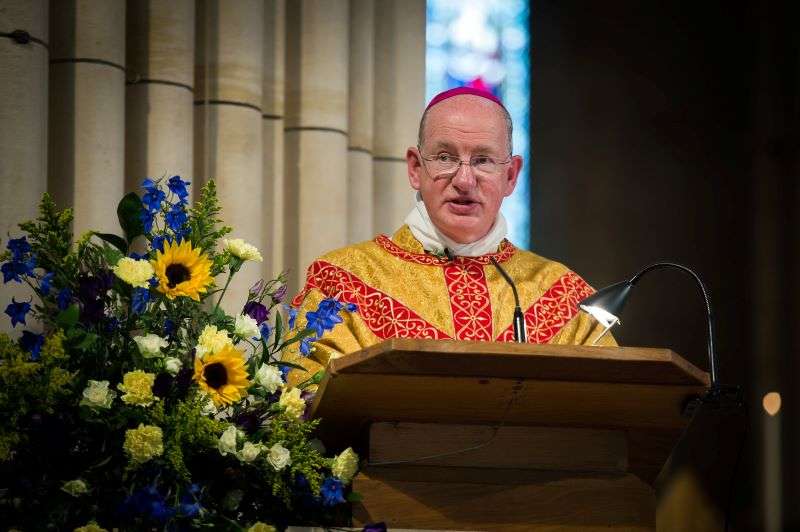
Bishop Richard Moth of Arundel and Brighton is urging Catholics to pray before the Blessed Sacrament before parliament debates Assisted Dying on 29 November
Marcin Mazur/cbcew.org.uk
Days before parliament votes on legalisation to allow Assisted Dying, Cardinal Vincent Nichols warned that a right to die could “all too easily” lead to vulnerable people feeling they have “a duty to die.”
The head of the Catholic Church in England and Wales’ remarks were printed in The Observer in a letter co-signed with 28 other faith leaders, including the Chief Rabbi, Ephraim Mirvis, Sarah Mullally, Bishop of London and representatives of the Sikh, Hindu, and Muslim communities.
They said: “Part of the role of faith leaders in communities is to provide spiritual and pastoral care for the sick and for the dying…Our pastoral roles make us deeply concerned about the impact the Bill would have on the most vulnerable, opening up the possibility of life-threating abuse and coercion. This is a concern we know is shared by many people, with and without faith.”
On Friday, MPs will vote for the first time on the Labour MP Kim Leadbeater’s Terminally Ill Adults (End of Life) Bill in the House of Commons. Bridget Phillipson, the Catholic-schooled education secretary said she would veto the bill, also opposed by Shabana Mahmood, secretary for Justice and Wes Streeting, the health secretary.
The Bishop of Arundel and Brighton said the “outcome” of the vote at the second reading of the bill was “by no means certain.” Richard Moth, chair of the social justice office of the Bishops’ Conference, has urged Catholics to pray on the morning of the reading on Friday 29, November, “ideally for a Holy Hour before the Blessed Sacrament.” In a pastoral letter read out in every parish in his diocese last weekend, Moth also invited the faithful to “redouble” their prayers “through fasting.”
Meanwhile, the two longest-serving MPs of the House of Common have jointly voiced opposition to the bill. Sir Edward Leigh, Conservative MP for Gainsborough, a Catholic engaged in politics for 41 years and the Labour MP for Hackney North and Stoke Newington, Diane Abbott, a politician of 37 years standing, penned a joint article in the Guardian voicing “two-fold” concerns about the bill, relating to its “process” and implementation.
They noted that when parliament last debated assisted dying in 2015 “a full seven weeks” elapsed between the introduction of the bill (by Labour MP Rob Marris) and the parliamentary debate. Friday’s debate will occur 18 days after the bill was introduced by Labour MP Kim Leadbeater.
Leigh and Abbott, Father and Mother of the House of Commons respectively, said the debate would occur in a “new parliament” with an “unprecedented number of new MPs,” many being “still relatively unfamiliar” with normal parliamentary procedure, “let alone” private members’ bills. “Parliament will have sat for just 12 weeks by the time MPs vote on what is, quite literally, a matter of life and death,” they said.
They expressed “suspicion that the pressure groups behind this proposed change have sought to take advantage of an inexperienced new parliament.” They also observed that pro-assisted dying campaigners “have successfully used high-profile celebrities to promote their cause,” despite evidence “from elsewhere” suggesting laws introducing assisted dying leave “vulnerable minorities” most at risk.
The Catholic Medical Association also urged MPs to oppose the bill which offers assisted dying to terminally ill adults with only six months left to live. Dr Mike Delany, president of the Association said the bill’s “conscientious objection clause” was “very weak,” explaining: “Any doctor who refuses to participate in discussions about assisted suicide will be required to refer the patient to another doctor who will. This means that any doctor, upon qualification, will be required by law to co-operate in the deliberate taking of the life of another human being: if not in person, by referral to another doctor. No Catholic doctor could do that in good conscience.”
Dr Dominic Whitehouse, a specialist in palliative care said the bill risked acting as “torpedo” for the “trusting bond between the doctor and patient.
The former Labour Prime Minister, Gordon Brown voiced opposition to the bill and called for an increase in palliative care funding instead. A leading Catholic ethicist has published evidence from across the globe that in countries where assisted suicide is legal, funding for palliative care diminishes.
David Jones, a professor of Bioethics at St Mary’s University, Twickenham, and director of the Anscombe Centre, Oxford said that funding for palliative care had increased by 25 per cent in recent years in European countries which had not legalised assisted suicide. In nations where it is legal, provision increased by eight per cent. Dr Whitehouse said funding for the country’s 200 hospices which serve 300,000 people, was patchy nationwide. The amount spent on such care could vary nationwide from £10.30 per head to 27 pence.
Stay updated — add us as a preferred news source on Google:


Help us keep The Tablet’s voice independent, clear and far-reaching.
Founded in 1840, The Tablet is the leading independent English-language Catholic weekly, celebrated for great writing, astute analysis, brilliant arts and books reviews and trustworthy reporting from correspondents in Britain, Ireland, Rome and across the world.
Independent, high-quality journalism is at the heart of what we do. The Tablet does not have deep pockets and we are not funded by rich donors. If you appreciate our work please consider supporting The Tablet’s Development Fund. It only takes a moment and you can cancel at any time.
- Support with £5 per month
- Support with £10 per month
- Support with other amount.

MOST READ ARTICLES
-
1
Archbishop of Cardiff-Menevia meets with other worldwide Catholic Church leaders to discuss liturgy
-
2
Let there be light
-
3
World Humanitarian Day: aid workers face a ‘crisis of protection’
-
4
Ruling allows French private hospitals limited exemption from assisted suicide
-
5
A tract for our times
-
6
The wisdom of the saints
FROM THE EDITOR'S DESK