Letters to the editor


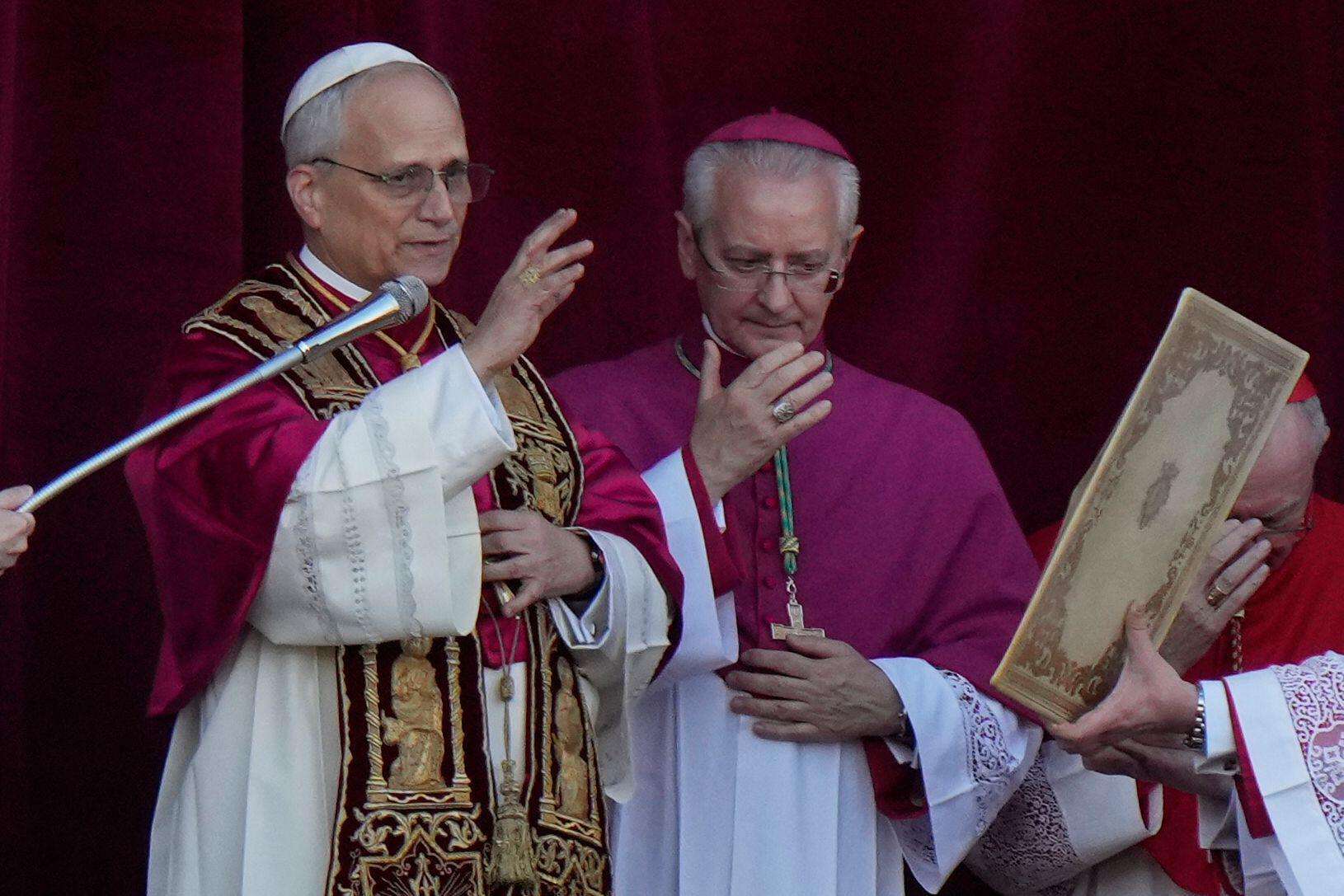
Topic of the week – an Augustinian pope for the ages
As we welcome and pray for Pope Leo XIV, the words of historian Christopher Dawson on the Saint of Hippo are prophetically relevant today. “He looked beyond the aimless and bloody chaos of history to the world of eternal realities from which the world derives all the significance which it possesses.
“His thoughts were fixed not on the fate of the city of Rome nor on the city of Hippo, nor the struggle of Romans and barbarians, but on those other cities which have their foundations in heaven and hell, and on the warfare between ‘the world rulers of the dark aeon’ and the princes of light.
“And in fact the age of St Augustine ended in ruin and though the Church of Africa in the service of which he spent his life was destined to be blotted out as completely as if it had never been he was justified in his faith. The spirit of Augustine continued to live and bear fruit.”
And so it is today, 1,600 years later. Jubilate Deo omnis terra, alleluia.
Peter Gerrard
Coolbawn, Co. Tipperary, Ireland
Laus Deo! We have a Pope who is determined to guard the Deposit of Faith, champion the cause of the poor and care for his entire flock. All this was clear from the moment Cardinal Prevost appeared on the balcony of St Peter’s, dressed in the traditional red mozzetta and white rochet and having chosen a papal name of huge significance.
The last Bishop of Rome called Leo was famous not only for his social teaching but also for his absolute determination to maintain the Catholic religion without the slightest deviation. It was Leo XIII’s 1896 encyclical Apostolicae Curae which declared Anglican ordinations “absolutely null and utterly void”, and even those of us not entirely convinced by its arguments cannot doubt the prayerful conviction with which it was issued.
Leo XIV can now bring together conservatives and liberals by following the example of his great predecessor: speaking out for the downtrodden and oppressed while showing kindness to traditionalists by removing the restrictions on the use of the old Latin Mass. He will also surely reverse the policy of appeasement towards the communist tyranny in China, which was the worst stain on the pontificate of Francis.
Clearly, the Holy Spirit moved the conclave to give us an Augustinian with a pastoral heart. In the words of Archbishop Wiseman’s hymn: “God bless our Pope, the great, the good.”
Francis Bown
London E3
Having been taught at Austin Friars, Carlisle, by Augustinian Friars I was so happy to hear of the selection of Robert Prevost, an Augustinian friar, as the new Pope. Two great events in the same year. The other being Newcastle United winning a domestic cup.
Gilio Moscardini
Consett, Co. Durham
Church injustices
An early consensus seems to be emerging that the papacy of Leo XIV will be focused on human rights, social justice and efforts to bring about peace in the world, and that he is expected to use his moral authority to hold leaders accountable.
What about the state of human rights and social justice within his own Church? It remains a place where, to offer just three examples: women do not have equality at any level in this patriarchal institution; the LGBTQ+ community are excluded from full participation and the Catechism labels homosexual acts as “contrary to the natural law”; and religious sisters in some orders live in conditions of modern slavery and coercive control.
When will our institutional leaders turn their attention to injustice within the Church? The time for waiting patiently to see justice done is over. I’m minded of Joan Chittister’s wise words: “If the people of God will lead, eventually the leaders will follow.”
Mary Varley
Stockport, Cheshire
Missing women
Pope Leo XIV has emerged from almost three weeks in exclusive masculine company, apart from the invisible ministry of nuns who fed, cleaned and laundered them. Of course, what should have been whispered to him (“A word in your ear, Holy Father”, 10 May) is: “Remember women.”
Until our current hierarchy realises what is missing, none of the neuralgic issues facing our Church stand a chance of moving forward fruitfully. And, even more vital, the full complement of dimensions to loving and following Christ remain confined.
Pope Leo has apparently expressed a veto on “clericalising women”. This is a common fear of the male collective that they will lose to feminisation. Yet the real call is to a holistic mutuality of ordained ministries.
Jesus gave us the parable of a woman mixing a tiny bit of yeast into a huge amount of flour (Matthew 13:33 & Luke 13:20-21), and it was all leavened through.
Until the scenes of massed ranks of men we have been treated to lately are leavened by the companionship of women, our Church will be failing in its possibilities.
Olive Powell
Manchester
Thank you, Michael Knowles, for your letter (“No role for women”, 3 May). Your words are so much more powerful coming from a man than a “strident” woman. Robert Harris, who wrote Conclave, said in a interview he found it strange that women are excluded from the priesthood and the election of a new pope.
“Can any sophisticated religion, with such a huge following, really go on and on into the future with such a secondary, demeaning role for women? I mean, it just seems odd. Would Christ really have wanted his word to be spread only by men?”
Holly Ball
Hereford
In the readings (12 May) we read of Peter’s spiritual experience which led him to accept the Gentiles into the Church. Let us pray that Pope Leo will undergo a similar revolutionary spiritual experience which will persuade him to open all the ordained ministries to women.
(Dr) Jacqueline Field Bibb
London N21
Positive publicity
Global media have paid tribute to Pope Francis, emphasising his dedication to peace, social justice, and environmental stewardship. It was great to hear people of all faiths, and none, highlight his unwavering support for the marginalised and his efforts to address global challenges like climate change. The Catholic Church has never had such publicity, most of it positive, and I would like to congratulate the BBC for its coverage. Equally, The Tablet.
However, we need to bear in mind that Pope Leo XIV is not only the successor of Pope Francis, but first and foremost the successor of St Peter and the 266 popes after him.
Tom Grufferty
Knock, Co. Mayo, Ireland
Christian leader
Your leading article (“A Pope for the World”, 10 May) sets out a clear case. But as a Methodist “outsider”, I wonder if it represents a backward step. It talks of the Bishop of Rome, the Pope, “leading and governing” the body of Christ in its mission. Do those two things have to be tied together?
Pope Francis was so attractive to many who are not Roman Catholics because he was seen as a leader in holiness, discipleship and mission with whom we could walk, talk, pray and work, even if we did not always agree, but not as a governor.
You quote the Anglican-Roman Catholic International Commission (Arcic) study emphasising that the papacy has to be balanced by the participation of the faithful in the deliberations and discernments of the Church. But you do not mention the Dicastery for Promoting Christian Unity’s 2024 study document The Bishop of Rome. Primacy and synodality in ecumenical dialogues and responses to the encyclical Ut unum sint.
I hope that my Catholic brothers and sisters are also reading, praying and responding.
Kenneth Howcroft
Lichfield, Staffordshire
Brother Leo
Much has been made, rightly, about Robert Prevost choosing the name Leo XIV as a possible tribute to Leo XIII and his work of inaugurating Catholic Social Justice theory and encouraging its practice.
Might another Leo also have been in the new Pope’s thoughts, one who might symbolically link his pontificate to that of Pope Francis? Near the end (1226) of St Francis of Assisi’s life, one of his most trusted followers was Blessed Brother Leo (d.1271).
Brother Leo opposed some of his contemporary Franciscan brothers, some of them in authority, who he believed were weakening the commitment to evangelical poverty that he had seen St Francis live.
Both Leos could be inspiring Leo XIV and his work.
Gerard Hore
Toowoomba, Queensland, Australia
Conclave languages
In the media coverage of the conclave, I don’t think I’ve seen any analysis of which languages are used by cardinals. Presumably Latin cannot be used extensively, except for prayers, and I understand that by no means all cardinals have good levels of fluency in Italian – or English, Spanish and French.
It would be interesting to know which languages were used, in both speeches and interaction among cardinals, and how they may have influenced the outcome.
Aidan Coveney
Exeter
English papabile
It is incorrect to say that Reginald Pole was the last Englishman to come near to being elected Pope. That honour belongs to Cardinal Henry Manning, Archbishop of Westminster from 1865-1892. He was a close friend of Pius IX and the dominant figure in the First Vatican Council of 1870.
When Pius IX died in February 1878, a group of cardinals suggested to Manning that he should put his name forward; he refused, on the grounds that the next pope had to be Italian. (It was the first conclave since Rome had been forcibly incorporated into the new Kingdom of Italy in 1870.)
He recommended Cardinal Pecci instead, who became Pope Leo XIII. Manning was also a great influence on the new pope’s social policy of condemning the exploitation of workers and promoting trade unions.
Russell Sparkes
London SW14
Love for Francis
I felt I had to thank Austen Ivereigh for the way he has shared his deep gratitude and love for Pope Francis which so many of us have experienced. Personally, I could deeply identify with all that he shared: the emotional upheaval of the death, the void in realising that Francis is no longer with us physically, and yet also the mysterious way that, “At this death, like no other, I could feel the weight lift.”
I am so grateful for the way that Francis as the true disciple enabled us to see and to experience the love of God through his compassion and mercy. Thank you, Austen, for articulating this. Thank you to The Tablet and your magnificent journalism. I am grateful that this has highlighted that good is stronger than evil.
Sister Teresa Brittain
Sisters of Sion, Manchester
Login
Please login to comment
0 Comments
Oldest

Help us keep The Tablet’s voice independent, clear and far-reaching.
Founded in 1840, The Tablet is the leading independent English-language Catholic weekly, celebrated for great writing, astute analysis, brilliant arts and books reviews and trustworthy reporting from correspondents in Britain, Ireland, Rome and across the world.
Independent, high-quality journalism is at the heart of what we do. The Tablet does not have deep pockets and we are not funded by rich donors. If you appreciate our work please consider supporting The Tablet’s Development Fund. It only takes a moment and you can cancel at any time.
- Support with £5 per month
- Support with £10 per month
- Support with other amount.

MOST READ ARTICLES
-
1
Pope returns to Vatican after hospital discharge
-
2
Diverse schools that are 100 per cent Catholic
-
3
Under endless skies
-
4
Battling confession fatigue
-
5
Nigerian bishop scorns suggestion of running in presidential election
-
6
Schismatic Spanish nuns strip contents of convent before eviction
FROM THE EDITOR'S DESK


