Dr Rowan Williams on the skills of survival – from ideology to practice


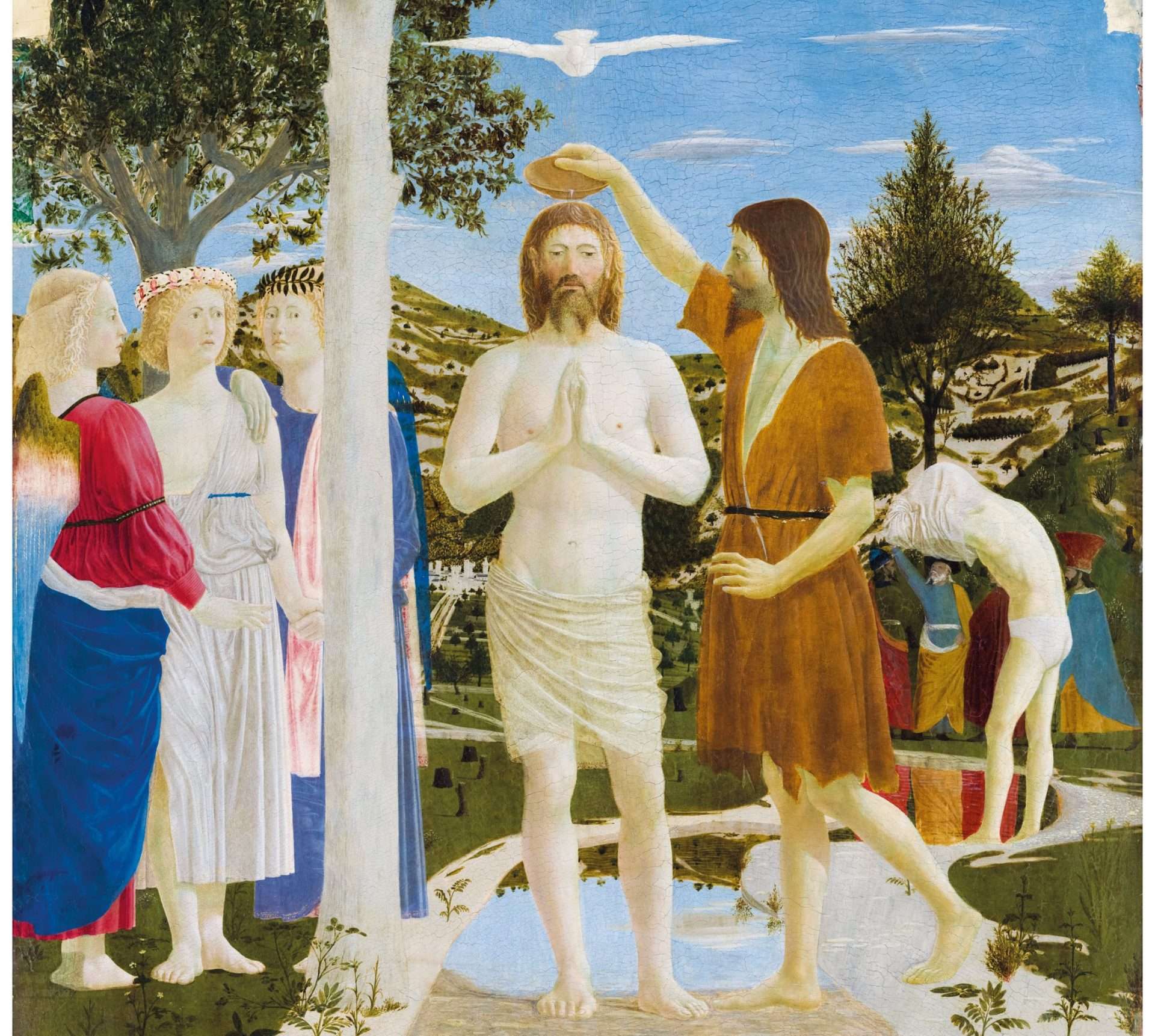
An ‘illumination’: Piero della Francesca, The Baptism of Christ, 1437-1445
ALAMY/INCAMERASTOCK
A Welsh poem, Y Gair (“The Word”), by the late Euros Bowen, a priest from the industrial valleys of South Wales, begins with a memorable phrase evoking the laying of the table for the Eucharist with what he calls a “carefree carefulness”, di-bryder bryder in Welsh.
This unanxious attention to what is in front of us is part of how we establish sacramental worship as a place of hospitality. Before anything else happens, the bread and the wine are placed on the clean linen that covers the table, and the invitation is issued. That’s where we begin, and we go back there, says Bowen, whenever we want to “prevent the word of grace becoming an ideology about Christ”. “Ideology” is not only a scheme imposed on the phenomena of experience, but a scheme that is imposed by somebody – by some power, some authority that seeks to present itself as legitimate, as credible, as obvious, as beyond challenge. Ideology, we might say, is how powerful people tell us that their power is the way things have to be. And what we can miss is that the people telling us what the world has to be like tend to be people who have a substantial interest in the world being as it is.
Get Instant Access
Continue Reading
Register for free to read this article in full
Subscribe for unlimited access
From just £37.50 quarterly
Print copy of The Tablet delivered directly to your door.
Complete access to all Tablet website content including all premium content.
Access to the weekly digital copy of The Tablet.
Full access to The Tablet’s archive – over 180 years of back issues.

Already a subscriber? Login

Help us keep The Tablet’s voice independent, clear and far-reaching.
Founded in 1840, The Tablet is the leading independent English-language Catholic weekly, celebrated for great writing, astute analysis, brilliant arts and books reviews and trustworthy reporting from correspondents in Britain, Ireland, Rome and across the world.
Independent, high-quality journalism is at the heart of what we do. The Tablet does not have deep pockets and we are not funded by rich donors. If you appreciate our work please consider supporting The Tablet’s Development Fund. It only takes a moment and you can cancel at any time.
- Support with £5 per month
- Support with £10 per month
- Support with other amount.

MOST READ ARTICLES
-
1
Pope returns to Vatican after hospital discharge
-
2
Diverse schools that are 100 per cent Catholic
-
3
Under endless skies
-
4
Battling confession fatigue
-
5
Nigerian bishop scorns suggestion of running in presidential election
-
6
Schismatic Spanish nuns strip contents of convent before eviction
FROM THE EDITOR'S DESK


