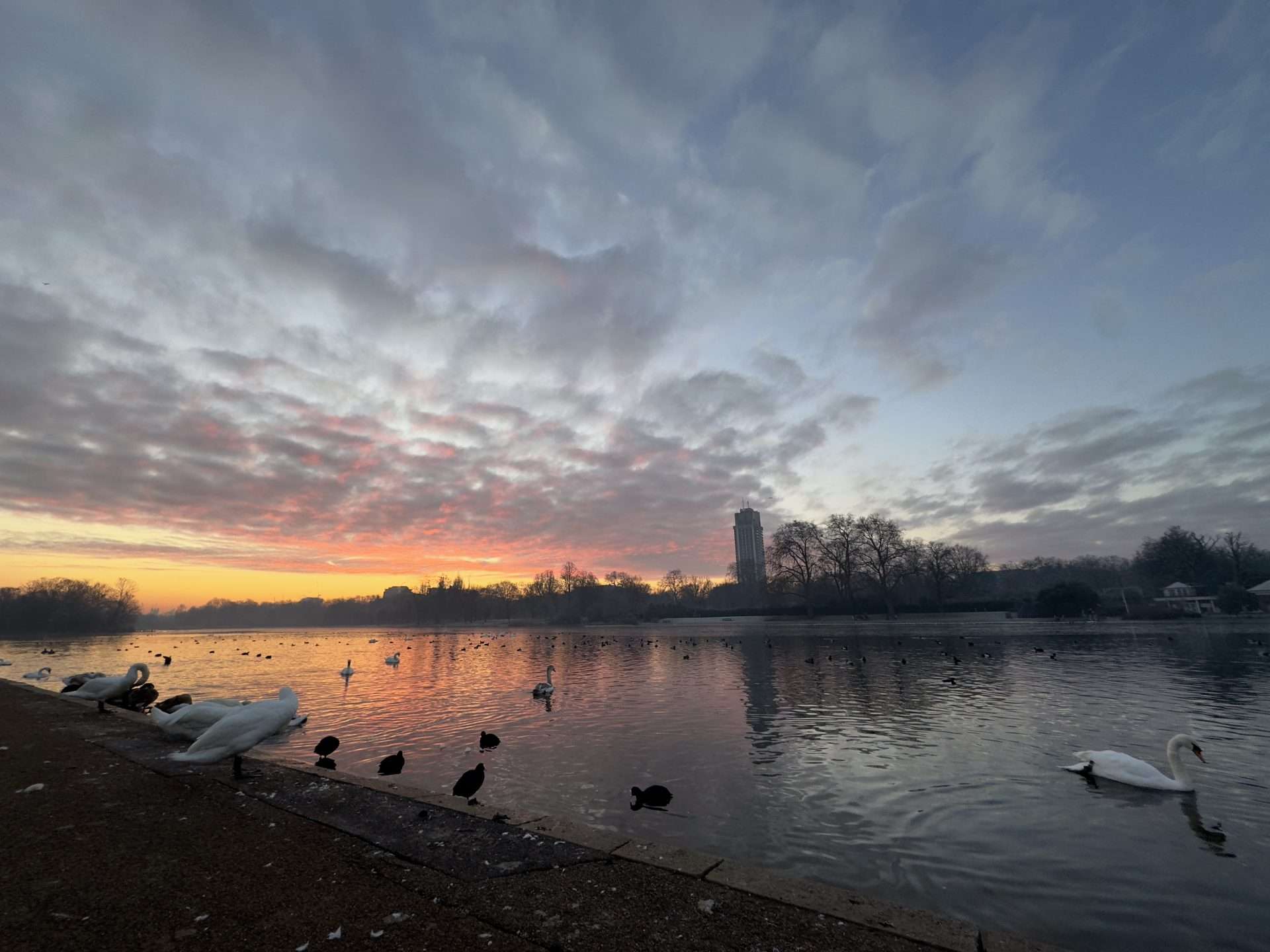
Sun dogs usually appear as a pair on either side of the real one


Christopher Howse’s notebook
I saw two suns one afternoon above the moors of Northumberland and thought I had lost the use of my faculties. The extra sun is called a parhelion or sun dog.
Sun dogs usually appear as a pair on either side of the real one, at 22 degrees’ distance. The other of the pair must have been hidden by mist that day, but the mock sun looked just as bright as the real one – whichever that was.
I found out about the phenomenon through the writing of Geoffrey Grigson, that systematic countryman. He referred to a careful drawing by the great Norfolk watercolourist John Sell Cotman inscribed: “A Representation of that curious & beautiful phenomenon the Parhelion as seen from the cliffs at Hunstanton.” The date he saw it was 5 July 1816 between 7 and 7.30 p.m.
My own experience was not a secret one, but even after I had discovered its name, few other people seemed to mention such a thing. It is quite possible to live in a city and never see one. Shakespeare knew of them, of course, and began Henry VI, Part Three with Edward IV exclaiming: “Dazzle mine eyes, or do I see three suns?”
I saw the full three again this summer in Hull, sitting beside Prince’s Dock outside Ask Italian. (I had fettuccine, thank you.) Flanking the setting sun there they were, slightly squashed on their inner sides.
The freshness of the sighting prompted me to bring it up when I was very kindly given a lift into distant Kent a couple of weeks ago by a conductor, who responded, “Ah. ‘Die Nebensonnen’.”
This is the twenty-third and penultimate song of Schubert’s sequence Winterreise, setting poems by Wilhelm Müller. Drei Sonnen sah ich am Himmel steh’n, it begins – “I saw three suns in the sky.” I have seen it suggested that the three suns seen by the walker in the sequence were first identified as the parhelion phenomenon in 1993 by Harold Heiberg, a music professor from Texas. That seems very extraordinary. What’s a poet to do if the reader doesn’t recognise the reality on which he bases his metaphor?
As with most things, I wasn’t really aware of the warfare at the time. But when I was reading English Language and Literature at St John’s College, Oxford in the mid-1970s, one of my two tutors, John Carey, well known as a book reviewer for the Sunday Times, was deeply hostile to an enthusiasm of my other tutor, Tom Shippey.
Shippey liked J.R.R. Tolkien’s work, a crime in the Carey camp. Not only that, he knew about it, understanding the names that Tolkien derived from Old English, for example. I think that when Shippey was a consultant on Tolkien for Mastermind, the poor contender with that special subject scored no points, ignorant of the word Ent being Old English for “giant” and so on.
Shippey was to write Tolkien: Author of the Century, deeply shocking to the Careyites, but undoubtedly a reasonable evaluation.
I was reminded of this culture war by a piece in the TLS by D.J. Taylor, whose own book on Tolkien comes out this month. “Carey, who retained bitter memories of Tolkien’s Oxford lectures and a degree course weighted against modern literature,” he wrote, “simply loathed him.”
Taylor plucks out a judgment by E.P. Thompson that is particularly wide of the mark on Ronald Reagan’s defence of American involvement in Vietnam, supposedly derived “from too much early reading of The Lord of the Rings” and featuring “the genial white wizardry of Gandalf figures such as Henry Kissinger”. Saruman might have been more like it than Gandalf, but perhaps Thompson didn’t know the difference.
It’s goodbye to five fat volumes of Littré’s dictionary. The contents are available online, I have no room, and the books are no great beauties. And yet…
They were once the property of André Turquet (1868-1940), the poet who ran Scoones’, a crammer in Garrick Street for applicants to the diplomatic service. A portrait of him by John Mansbridge lies between the pages, as does a print of Edmond Rostand, signed by him in 1898, the year of his great success with the play Cyrano de Bergerac. I bought them for £14.
If I had a tower, like Montaigne, they could stay. But they must go out into the cold world that doesn’t want printed dictionaries any more.
Christopher Howse is an assistant editor of The Daily Telegraph.
Login
Please login to comment
0 Comments
Oldest

Help us keep The Tablet’s voice independent, clear and far-reaching.
Founded in 1840, The Tablet is the leading independent English-language Catholic weekly, celebrated for great writing, astute analysis, brilliant arts and books reviews and trustworthy reporting from correspondents in Britain, Ireland, Rome and across the world.
Independent, high-quality journalism is at the heart of what we do. The Tablet does not have deep pockets and we are not funded by rich donors. If you appreciate our work please consider supporting The Tablet’s Development Fund. It only takes a moment and you can cancel at any time.
- Support with £5 per month
- Support with £10 per month
- Support with other amount.

MOST READ ARTICLES
-
1
Pope Leo diagnosed with lung cancer after operation
-
2
Breaking up … for now
-
3
The future lies with the laity
-
4
A tiny gem
-
5
Archbishop bars Catholics from firing squad for US military execution
-
6
Thousands arrested as Delhi locked down for protest over voter roll scandal
FROM THE EDITOR'S DESK