Our trustworthy saviour


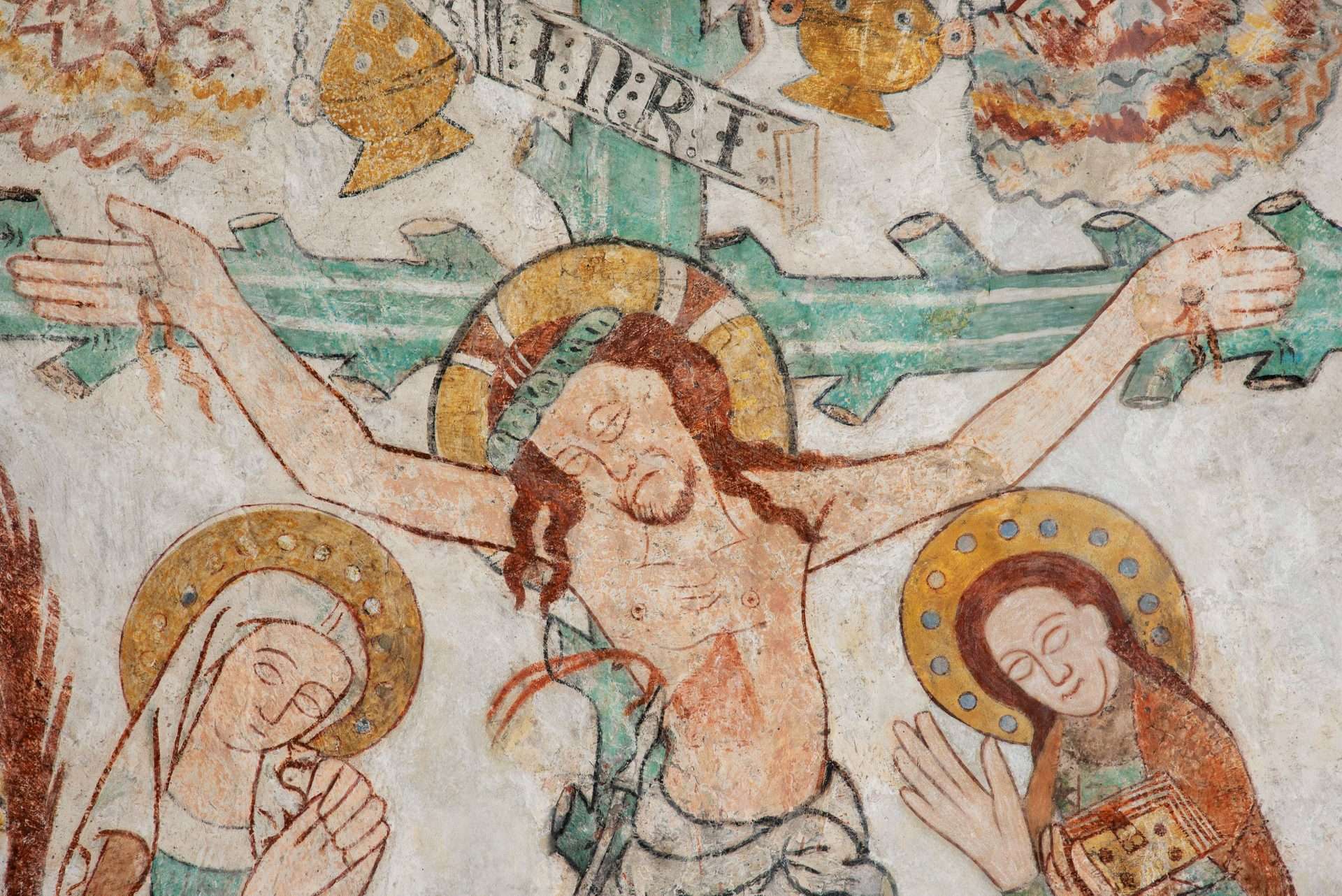
Christ on the Cross – a mural in Skibby Church, Denmark
photo: Alamy, Stig Alenäs
For Morgan, the human condition is marked by a combination of suffering and wrongdoing
Trust in Atonement: God, Creation and Reconciliation
TERESA MORGAN
(EERDMANS, 359 PP, £30.99)
Tablet bookshop price £27.89 • tel 020 7799 4064
The doctrine of the atonement is at the root of the Christian faith. Our liturgies, prayers and hymnody express deep convictions about the work of Christ in the lives of his followers. An intense focus on the Crucifixion is often evident. Yet this devotional intensity is sometimes beset by doubt and uncertainty around the precise terms of expression. So-called “theories” of the atonement present major challenges, and not only for our Jewish and Muslim neighbours who regard this aspect of Christianity as offering an implausible solution to a pseudo-problem. Why does God need the death of Jesus to forgive our sins? Could not forgiveness and reconciliation be achieved by God’s mercy alone? Does the language of satisfaction and redemption belong to another era? Is there too little reference to the life and teaching of Jesus prior to his death? How many Christians of our acquaintance can we describe as “deified”?
Teresa Morgan is an Anglican priest and former Oxford classicist who now holds a chair at Yale Divinity School. In this latest work, she draws upon her earlier studies of the concept of faith in order to view the atonement from a fresh perspective. She advances an understanding of the work of Christ in terms of faithfulness. This involves a triangular set of relationships between God, Christ and ourselves. Though the Greek concept pistis is often translated as “faith”, this notion is much broader than mere belief states. She proposes that we think instead of “trust”. Our relationships to other people together with our sense of self are based upon fundamental attitudes and practices of trust. We rely on others to be trustworthy whether at home, in the workplace, in church, or society at large. Where there is a breakdown of trust, particularly through betrayal, our sense of identity is severely disrupted. Our relationships to others, to God and to the world then become disordered and badly in need of repair. For Morgan, the human condition is marked by an inextricable combination of suffering and wrongdoing. Both are causes of distrust. Here she draws upon research with survivors of abuse, trauma sufferers and prisoners, all of whom can experience in different ways a downward spiral of pain and alienation. Recovery depends upon the building of trust.
The work of Christ is God’s way of restoring trust. In the kingdom proclaimed and enacted by Jesus, both suffering and wrongdoing are overcome – here his life and ministry come into view. Trust is reinstated among us by God’s action. The death of Jesus is understood as his final and decisive act of faithfulness to God and to us. This is of significance on the vertical axis of our relationship with God, and horizontally in our relations with one another. In both cases, we are brought to “at-one-ment”. The power of the Cross resides in its capacity to inaugurate a new trustworthiness in our lives. God is faithful to Christ and Christ to God even to death, and both together are faithful to us in making provision for our restoration. Much attention is devoted to exegesis of key Pauline passages. The faith by which we are saved is not so much our own as the faith of Christ (pistis Christou). His faithfulness to God and to others is what reverses the effects of suffering and wrongdoing. With its array of images and motifs, the New Testament describes the crucified Jesus as our trustworthy saviour.
Describing her approach as therapeutic, Morgan considers how survivors of abuse may have their lives turned around by acknowledgement of God’s faithfulness in Christ and the growth of trust that can emerge on this soil. She is also honest about the limitations of these possibilities. Her most adventurous chapter concerns the ways in which the wider creation can be enhanced by the atoning work of Christ. Noting recent studies of animal behaviour that point to instances of altruism, empathy and spite, she considers ways in which trust is important for all organic forms of life. How this might be restored among species that cannot read or hear the story of Jesus is not altogether made clear, though Morgan gestures towards some hopeful resolution for a world in which harmony and peace are achieved holistically. “In this generation, it is perhaps Christ the grain of wheat, the gentle gorilla, the brave elephant, the mediating macaque, the exemplary lily and the self-giving fir tree that have the most to teach us about our right relationship with God.”
The most likely objection to her approach is that it reduces the work of Jesus to exemplary significance. Its power resides in a capacity to awaken within us a realisation that we can live in more trustworthy ways. Though she does not use the binary classification of objective and subjective theories of atonement, critics will view her position as a reprise of the latter. Morgan is aware of this challenge and, as I read her, she offers two types of response. First, God actually does something for us in sending Christ to live faithfully “to the point of death”. Our recovery is primarily the action of God, though this is also a secondary human work of faith. She also points to ways in which the generation of trust amid breakdown and betrayal can be accomplished more effectively where someone accompanies us along the way. In thinking of Christ as one who walks with us in our struggles, we are immeasurably strengthened. “Christ leads me through no darker rooms than he went through before” (Richard Baxter). Morgan handles this with sensitivity and realism, though her account might have been enhanced by a more integrated treatment of the Resurrection – her tendency to describe this as “an added grace” seems insufficient – and more explicit reference to the action of the Spirit in the Christian life. Though I suspect that she would not dissent from much of this, she remains reluctant to overstress Christus victor in the face of suffering and trauma. “Even committed Christians sometimes feel closer to the disciples on Easter Saturday than on Easter Sunday.”
These queries notwithstanding, Teresa Morgan’s study is a major contribution to a subject of central Christian concern. Her presentation of the atonement through the lens of trust makes sense of a plethora of images that are otherwise difficult to integrate with any degree of coherence. For this reviewer at least, she offers a persuasive account that is scripturally based, intellectually robust, theologically constructive and pastorally informed. Her book ranks alongside the best recent work in the field.
Login
Please login to comment
0 Comments
Oldest

Help us keep The Tablet’s voice independent, clear and far-reaching.
Founded in 1840, The Tablet is the leading independent English-language Catholic weekly, celebrated for great writing, astute analysis, brilliant arts and books reviews and trustworthy reporting from correspondents in Britain, Ireland, Rome and across the world.
Independent, high-quality journalism is at the heart of what we do. The Tablet does not have deep pockets and we are not funded by rich donors. If you appreciate our work please consider supporting The Tablet’s Development Fund. It only takes a moment and you can cancel at any time.
- Support with £5 per month
- Support with £10 per month
- Support with other amount.

MOST READ ARTICLES
-
1
Pope returns to Vatican after hospital discharge
-
2
Diverse schools that are 100 per cent Catholic
-
3
Under endless skies
-
4
Battling confession fatigue
-
5
Nigerian bishop scorns suggestion of running in presidential election
-
6
Schismatic Spanish nuns strip contents of convent before eviction
FROM THE EDITOR'S DESK