Get your two scents’ worth


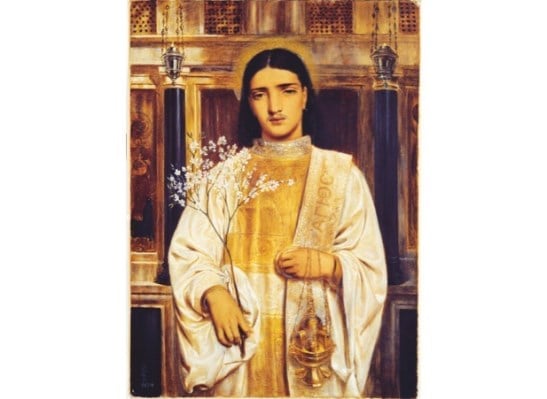
A Saint of the Eastern Church, by Simeon Solomon, is accompanied by the smells of incense and spicy wood
Birmingham Museums
WHAT DOES A PAINTING smell like – and what does its scent tell us about its creator and its production? At the Barber Institute in Birmingham, this question is centre stage in its new exhibition, “Scent and the Art of the Pre-Raphaelites” (to 26 January). The curatorial team have worked with perfumiers to create an olfactory dimension for some of the paintings on show – including A Saint of the Eastern Church by Simeon Solomon (1867-68). The resulting perfume is all incense and spicy wood: musky overtones, a hint of sweetness.
One sniff, and suddenly you are at the centre of a nineteenth-century liturgy. In the 1860s, Solomon attended St Alban’s Church of England in Holborn, central London, where in 1867 the priest was charged with “censing things and persons” – a charge effectively of being too Roman. Perhaps the scent created for the exhibition is reminiscent of the smell Solomon encountered while worshipping there: the organisers presumably hope so.
The show is curated by Christina Bradstreet, who has spent more than two decades researching scent and nineteenth-century art: she says a “period nose” is essential for a proper understanding of the Pre-Raphaelites and the Aesthetic Movement. Bradstreet says that portrayals of scent in these paintings touched on everything from disease and public health to Anglican liturgical debates, immigration and female emancipation.
“All smell is disease,” says one quote adorning the walls of the gallery; it comes from Edwin Chadwick, England’s first public health commissioner in 1846, and it illustrates the widespread belief in the miasma theory of contagion. Miasma held that disease spread invisibly through the air from the smells arising from decomposing matter. Florence Nightingale fully subscribed to miasma. Further weight was added to the danger of foul smells by the daily 400,000 tonnes of sewage pumped into the Thames, swelled by the invention of the WC, together with the 100,000 tonnes of horse manure deposited on the capital’s streets.
At the Barber, Puig’s AirParfum machine, the size of a slim watercooler, dispenses scented dry air molecules which do not overload the senses or environment, allowing visitors to view scented, or scent-free.
Jennifer Powell, director of the Barber, explains that each of the final scents dispensed through AirParfum technology are the result of around five iterations, with the aim of not just conveying a solo smell, but the painting’s atmosphere. “In A Saint of the Eastern Church, it was very important to Gregorio Sola (Puig senior perfumer) to capture not just incense, but the old wood smell of the church,” she says.
THE TWO SCENTS selected for John Everett Millais’ The Blind Girl (1856) capture the rain-soaked pasture and overhead double rainbow, and the scent of the girl’s hard- wearing Linsey-woolsey shawl. Personally I would have liked a sourer smell for The Blind Girl’s wet shawl than Sola’s “white cotton accord” with woody notes, and camphor to denote the patched old clothes. But the green notes of fresh cut grass and wet willow bark for the pasture and rainbow scent were delightful. Rainbows were associated with God’s covenant, and their petrichor smell signified this promise to Victorian Christians. Bradstreet says The Blind Girl’s red hair and blindness may allude to post-famine Irish immigration, and the ophthalmia caused by malnutrition. We know the town in the background is Winchelsea, because the painting started as a landscape. Millais added a figure modelled on his wife Effie, and then replaced her with two models posing as the Blind Girl and her little sister snuggling into the shawl. The photographic realism of the grass in the foreground, and the blade between the Blind Girl’s chapped red fingers, combined with deep sniffs of the meadow smell, make it tempting to be lulled into treating the work as documentary, rather than a carefully reworked composition, designed to evoke sentiment.
John Stanhope’s Thoughts of the Past, 1859, illustrates scent’s moral connotations, drawing on the Thames’ Great Stink in the summer of 1958. The central female figure wears a man’s oversized blue dressing gown, and has flowing red hair, kinked as if just unplaited, tugging on a handful pensively. A strip of lace curtain with smuts cannot hide the view of the corrupt, dirty Thames through the window, dominating the left-hand plane. Coins on the table and a man’s walking stick at her feet signal her livelihood as a sex worker, with violets in the bottom right-hand corner as a reminder of a more wholesome, possibly bucolic, former life.
In the less well-known Eleanor Fortescue-Brickdale’s The Lover’s World, 1905, spiritual renewal is portrayed as a flowery fantasy, with tiny fairies swinging gold thuribles around the feet of the central female figure, dressed in a medieval-style Lincoln green tunic. This can be read as nature’s power to mark the threshold between things visible and unseen, a role previously monopolised by the Church. The artist called the beauty and mysticism of the natural world “Nature’s High Mass”.
The Barber’s show is saved from predictable moralising by the high number of women artists. Evelyn De Morgan’s iridescent, violet-hued Medea (1889) gives a more compassionate reading of the betrayed wife. And Anna Alma-Tadema’s Whistler-like London Fog, after 1906, shows scent’s transition from narrating a story to portraying a mood.
THERE IS something in the air about art and scent. Earlier in the year, Kew hosted Mat Collishaw’s solo show “Petrichor”, examining our relationship with nature using AI and theatrical illusions. The title came from the earthy smell following a rain shower. Coined by Australian scientists in 1964, Petrichor describes the mixed scent of ozone molecules, plant bacteria and plant oils released by raindrops. Last December Christie’s “Old Masters, New Era” presented Ships in Distress Off a Rocky Coast, a seventeenth-century seascape by Dutch artist Julius Porcellis, with scent elements inspired by the scene for an enhanced emotional dimension. In 2022, the Prado in Madrid exhibited Jan Brueghel the Elder’s Sense of Smell (1617-1618) with the option of inhaling four associated scents: Allegory evoking a bouquet of flowers, Gloves capturing leather perfumed with amber from a 1696 formula, Fig Tree directing focus towards the fruit tree and Orange Blossom adding dimension to the depicted distilling apparatus. Christina Bradstreet’s Scented Visions: Smell in Art 1850-1914 was published in the same year.
Research carried out by the Prado in 2022 found that filling the air with scent around its Brueghel and Rubens collaboration Sense of Smell increased viewing time from 32 seconds to 13 minutes in the case of that artwork. Jennifer Powell thinks the same could be true more widely, and that scent dispensers will boost the offering in other museums and galleries – perfume manufacturers, ever nosing for a new market, are on the case. In the future of art, scent is getting stronger.
Login
Please login to comment
0 Comments
Oldest

Help us keep The Tablet’s voice independent, clear and far-reaching.
Founded in 1840, The Tablet is the leading independent English-language Catholic weekly, celebrated for great writing, astute analysis, brilliant arts and books reviews and trustworthy reporting from correspondents in Britain, Ireland, Rome and across the world.
Independent, high-quality journalism is at the heart of what we do. The Tablet does not have deep pockets and we are not funded by rich donors. If you appreciate our work please consider supporting The Tablet’s Development Fund. It only takes a moment and you can cancel at any time.
- Support with £5 per month
- Support with £10 per month
- Support with other amount.

MOST READ ARTICLES
-
1
Pope returns to Vatican after hospital discharge
-
2
Diverse schools that are 100 per cent Catholic
-
3
Under endless skies
-
4
Battling confession fatigue
-
5
Nigerian bishop scorns suggestion of running in presidential election
-
6
Schismatic Spanish nuns strip contents of convent before eviction
FROM THE EDITOR'S DESK


