A restored Resurrection: Rubens returns to Antwerp Cathedral


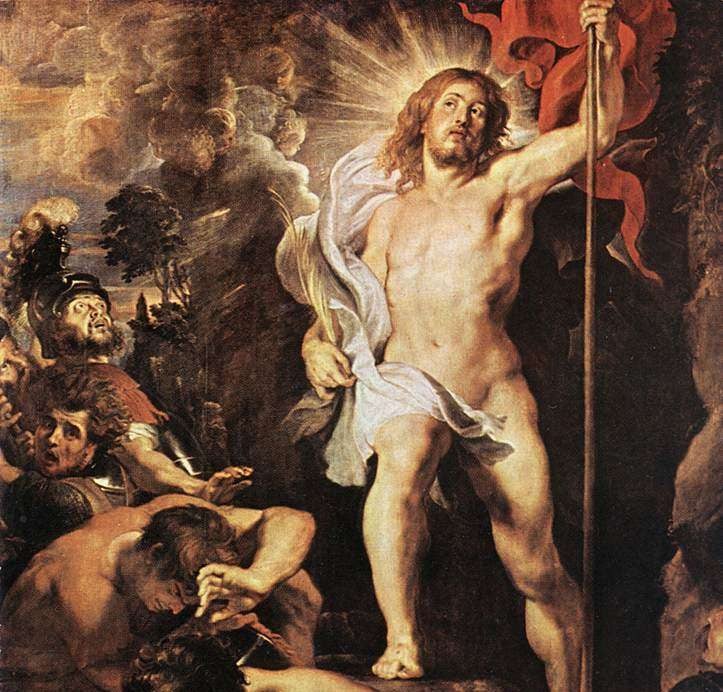
The Resurrection of Christ
Public Domain
The Resurrection of Christ should be back on the wall of the cathedral for which it was painted in time for Easter. And there’s more of his work and that of other masters of the Low Countries in a rural UK setting this spring.
In a side chapel of Antwerp Cathedral, two angels are waiting. Usually the angels are hidden: they’re the panels of a Rubens triptych, not visible when the doors are open. But when I visited recently, the panels were closed, so despite heavy scaffolding in front of them, the angelic figures were all that was visible of the masterpiece. The centrepiece of the work has been removed for restoration: but, fittingly, the cathedral authorities hope it will be returned in time for this weekend’s Easter celebrations. Fittingly, because the work that will be back is The Resurrection of Christ, painted between 1611-12: it shows a muscular Christ emerging – loin-cloth being cast aside, banner held high – from the tomb, blinding the guards with the luminosity of his new life-light. It’s a remarkable painting, with a fascinating history. Peter Paul Rubens (1577-1640) created it to reinforce Catholicism after two major iconoclastic upheavals, one in 1566 and another in 1581. The Beeldenstorms, as they were known (“statue storms”), were an outpouring of anti-Catholic destruction that were part of the Protestant Reformation.
Get Instant Access
Continue Reading
Register for free to read this article in full
Subscribe for unlimited access
From just £37.50 quarterly
Print copy of The Tablet delivered directly to your door.
Complete access to all Tablet website content including all premium content.
Access to the weekly digital copy of The Tablet.
Full access to The Tablet’s archive – over 180 years of back issues.

Already a subscriber? Login

Help us keep The Tablet’s voice independent, clear and far-reaching.
Founded in 1840, The Tablet is the leading independent English-language Catholic weekly, celebrated for great writing, astute analysis, brilliant arts and books reviews and trustworthy reporting from correspondents in Britain, Ireland, Rome and across the world.
Independent, high-quality journalism is at the heart of what we do. The Tablet does not have deep pockets and we are not funded by rich donors. If you appreciate our work please consider supporting The Tablet’s Development Fund. It only takes a moment and you can cancel at any time.
- Support with £5 per month
- Support with £10 per month
- Support with other amount.

MOST READ ARTICLES
-
1
Pope returns to Vatican after hospital discharge
-
2
Diverse schools that are 100 per cent Catholic
-
3
Under endless skies
-
4
Battling confession fatigue
-
5
Nigerian bishop scorns suggestion of running in presidential election
-
6
Schismatic Spanish nuns strip contents of convent before eviction
FROM THE EDITOR'S DESK


