Pope Leo prays for healing, justice and peace at Beirut blast site


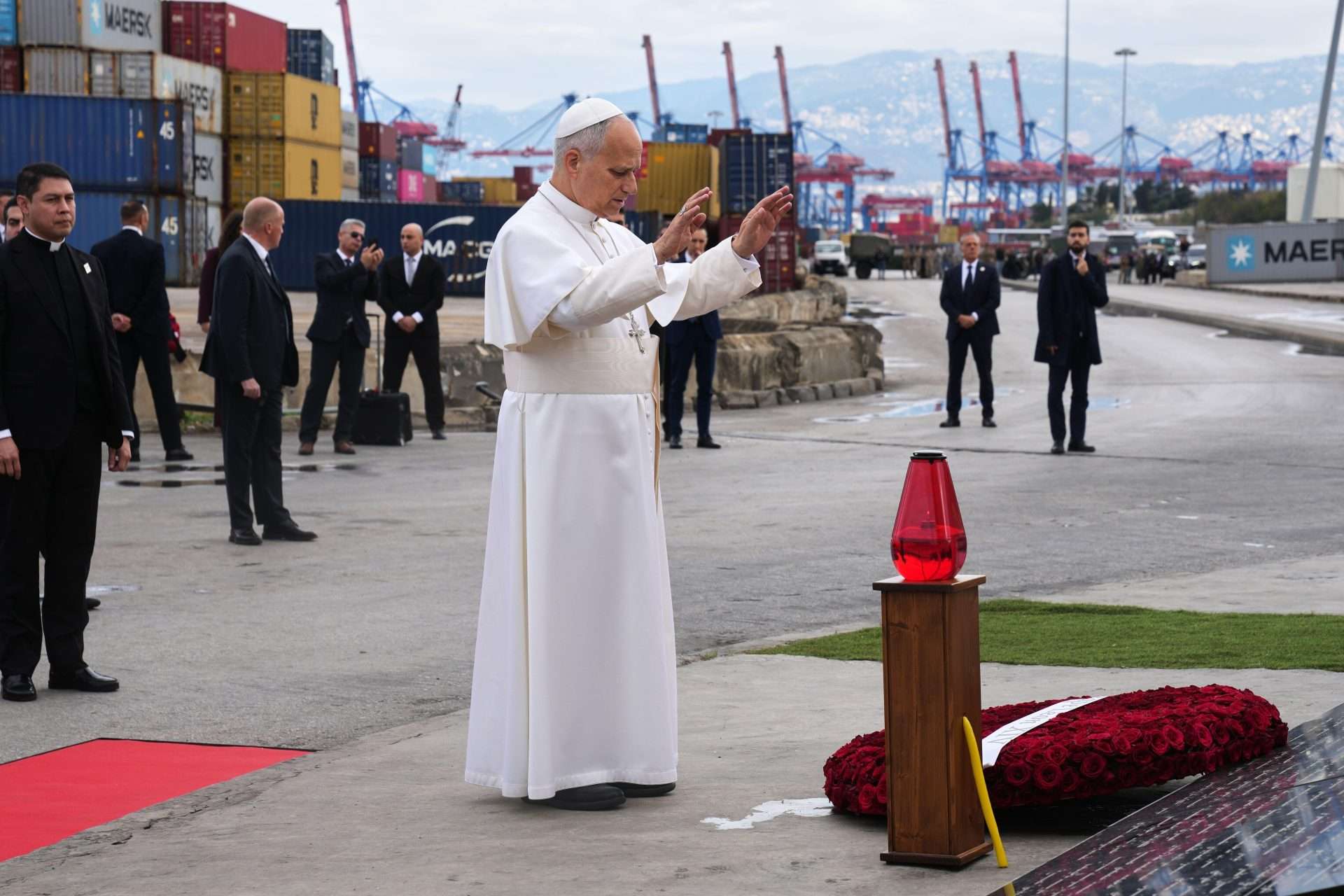
Pope Leo XIV prays at the site of the 2020 Beirut port explosion
Domenico Stinellis, Alamy
‘The path of mutual hostility and destruction in the horror of war has been travelled too long, with the deplorable results that are before everyone’s eyes. We need to change course, we need to educate our hearts for peace!’
Pope Leo XIV prayed before the ruins of the Beirut port explosion on Tuesday, the final morning of his visit to Lebanon, and placed a wreath in memory of the victims. He also met survivors of the 2020 blast and families of those killed.
The Pope lit a candle and laid down a wreath of red flowers at the site, and seemed at one point to hold back tears. Afterwards, he spoke with family members of victims, some of whom who were holding photographs of their relatives killed in the blast.
Lebanese Prime Minister Nawaf Salam greeted the Pope at the site. Five years after the 2020 explosion, one of the largest non-nuclear blasts in history, families of the 236 people killed and more than 7,000 wounded say they are still waiting for truth and accountability.
In a Mass earlier in the day attended by about 150,000 people at Beirut Waterfront, Pope Leo urged Lebanon to rise above violence and division: “Lebanon, stand up. Be a home of justice and fraternity. Be a prophetic sign of peace for the whole of the Levant.”
The liturgy closed the final day of his visit to a nation strained by intermittent political paralysis, economic collapse and persistent instability. The waterfront itself carries symbolic weight. Built on land reclaimed from the sea with rubble from the civil war, it has come to represent both loss and reconstruction.
In his homily, Pope Leo spoke of praise, hope, beauty and responsibility, calling for unity at a moment of national fracture. He acknowledged the burdens carried by the Lebanese people and said praise becomes difficult “when life is weighed down by hardship”. Lebanon, he added, has suffered “many problems” and “difficult situations” that leave people feeling powerless.
The Pope urged the country to rediscover gratitude. Lebanon, he said, is “the recipient of a rare beauty,” even though that beauty is often obscured by suffering. The country is also, he noted, a witness to how “evil, in its various forms, can obscure this splendour”.
From the open coastal space, he recalled biblical images of Lebanon. He then pointed to the nation’s present wounds: poverty, political instability, economic collapse and renewed fear after conflict. The Pope invited the faithful to look for “small shining lights in the heart of the night”.
Jesus, he said, gives thanks not for extraordinary signs but for the faith and humility of “little ones”. He spoke of the “small signs of hope” found in families, parishes, religious communities and lay people who remain dedicated to service and to the Gospel. These lights, he said, promise rebirth.
He urged the country not to yield to “the logic of violence” or the “idolatry of money”, and asked all Lebanese to work together. “Everyone must do their part,” he said.
Earlier in the day, Pope Leo met patients and caregivers at the De La Croix Hospital in Jal el Dib. “Your presence is a tangible sign of the merciful love of Christ,” he said. “Keep before your eyes the good you are able to accomplish. In God’s eyes, it is a great work. We cannot conceive of a society that races ahead at full speed while ignoring so many situations of poverty and vulnerability.”
At the Mass, he called for a “dream of a united Lebanon” where peace and justice prevail and where all recognise one another as brothers and sisters. At the end of Mass, the Pope offered a spontaneous prayer for peace in the region and the world, calling on “Christians of the Levant” to be “artisans of peace, heralds of peace, witnesses of peace”.
“The Middle East needs new approaches in order to reject the mindset of revenge and violence. To overcome political, social, and religious divisions, and to open new chapters in the name of reconciliation and peace. The path of mutual hostility and destruction in the horror of war has been travelled too long, with the deplorable results that are before everyone’s eyes. We need to change course, we need to educate our hearts for peace!”
Stay updated — add us as a preferred news source on Google:


Help us keep The Tablet’s voice independent, clear and far-reaching.
Founded in 1840, The Tablet is the leading independent English-language Catholic weekly, celebrated for great writing, astute analysis, brilliant arts and books reviews and trustworthy reporting from correspondents in Britain, Ireland, Rome and across the world.
Independent, high-quality journalism is at the heart of what we do. The Tablet does not have deep pockets and we are not funded by rich donors. If you appreciate our work please consider supporting The Tablet’s Development Fund. It only takes a moment and you can cancel at any time.
- Support with £5 per month
- Support with £10 per month
- Support with other amount.

MOST READ ARTICLES
-
1
Pope returns to Vatican after hospital discharge
-
2
Diverse schools that are 100 per cent Catholic
-
3
Under endless skies
-
4
Battling confession fatigue
-
5
Nigerian bishop scorns suggestion of running in presidential election
-
6
Schismatic Spanish nuns strip contents of convent before eviction
FROM THE EDITOR'S DESK