Pope Francis’ prayer for peace renewed in Jerusalem and London


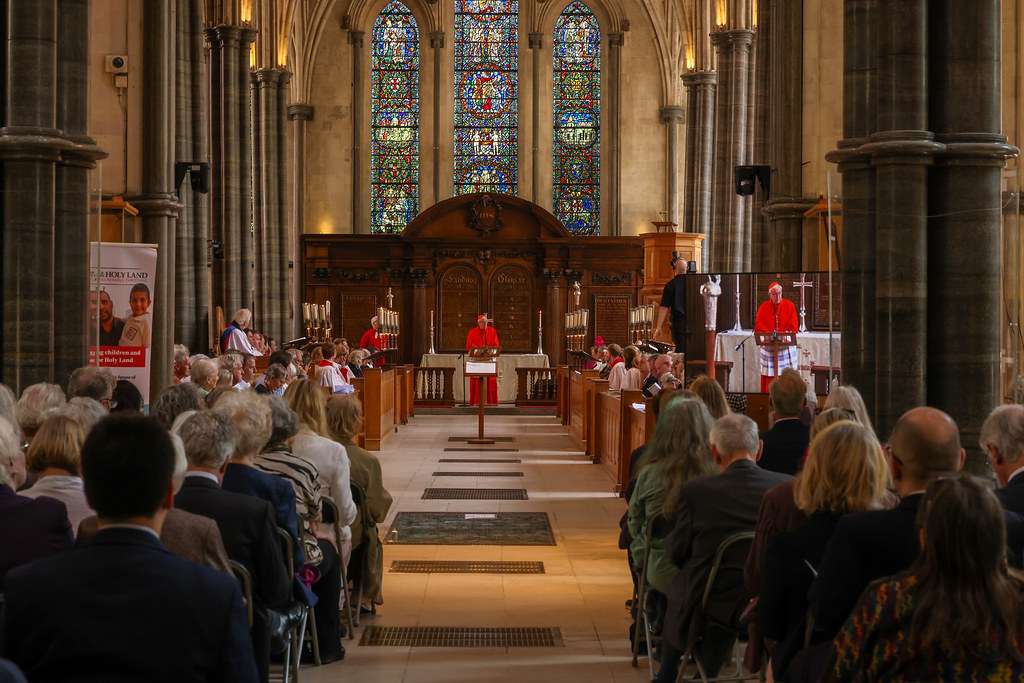
Cardinal Vincent Nichols read out the message from Pope Francis, sent to the organisers four days before his death.
George Reynolds / Friends of the Holy Land
A prayer service was broadcast simultaneously in the Temple Church and the Co-Cathedral of the Holy Name of Jesus to mark the anniversary of the first Council of Nicaea
The late Pope Francis renewed his prayers for “an immediate cessation of the current conflict” in the Holy Land in a message to an ecumenical service held simultaneously in London and Jerusalem.
The message, delivered on 17 April, four days before his death, and signed by the Vatican’s secretary of state Cardinal Pietro Parolin, addressed the service on Tuesday in the Temple Church in London and the cathedral of the Latin Patriarchate of Jerusalem to mark 1,700 years since the first Council of Nicaea.
“By bringing together church leaders and members of the faithful from various traditions, this commendable initiative bears eloquent witness to the rich religious tapestry that characterises the land of our saviour’s birth, and it also calls attention to the enduring desire for peace held dear by its citizens today,” Pope Francis said.
The Archbishop of Westminster Cardinal Vincent Nichols read the message in the Temple Church, built in 1163 on the model of the rotunda of the Church of the Holy Sepulchre in Jerusalem and consecrated by the Latin Patriarch of Jerusalem Heraclius in 1185. It is now run by the Church of England as a royal peculiar (subject to the direct jurisdiction of the monarch) and hosted the service organised by the ecumenical charity Friends of the Holy Land.
Cardinal Nichols led the service in London alongside other church leaders, including the Anglican Bishop of Southwark Christopher Chessun, while the apostolic nuncio to Great Britain Archbishop Miguel Maury Buendía also attended.
Bishop Havkim Manukyan of the Armenian Orthodox Church in the UK and Ireland introduced the recitation of the Nicene Creed, formulated at the council in 325 AD. The text recited at the service excluded the clauses regarding the Holy Spirit (notably the filioque clause) which are disputed between Eastern and Western Churches.
The Latin Patriarch of Jerusalem Cardinal Pierbattista Pizzaballa led the service in Jerusalem, at the Co-Cathedral of the Most Holy Name of Jesus, alongside the Greek Patriarch Theophilus III and the Anglican Archbishop Hosam Naoum.
In the sermon, which like the rest of the service was on simultaneous broadcast in both locations, Cardinal Pizzaballa said Nicaea remained “an indispensable point of reference” for all Churches, since when “everyone who believes in Christ has spoken the same words in all churches and nourished his faith with the same expressions”.
“The person of Jesus has never ceased to fascinate the world,” he said. “And from the beginning, various hypotheses and proposals about the identity of the Son of God followed and multiplied, all arising from the attempt to reconcile the disturbing figure of Jesus, the Son of God and God, with the small human mind.”
Cardinal Pizzaballa said the council, “in a religious, cultural and political context that was no less problematic than today”, coined “a new terminology capable of including in human words, as much as possible, the mystery of the Incarnation”.
He said these words united the Churches “even in our smallness”, despite “our small and large infidelities that have wounded the one body of Christ, the Church”.
“Not infrequently, we have given ourselves over to our logic of power rather than to serving the mystical body of Christ,” he said, while Churches continue to struggle today in the face of “the political complexities and the logic of worldly power, which subjugate entire peoples” and the “epochal” challenges of modernity.
“And in this context, as the one Church of Christ, we are all called to give an answer to the questions that people are asking today, to respond to the needs, desires and concerns of today’s man,” Pizzaballa said. “There is only one way to give concreteness and vitality, understanding and credibility to these expressions that are seemingly distant from the lives of people today: witness.”
In his welcome to the service, Pizzaballa recalled “that weak but always courageous voice of Pope Francis” appealing for peace in his final Urbi et Orbi message on Easter Sunday, and also the first words of Pope Leo XIV after his election: “Peace be with you!”
At the first general audience of his pontificate on Wednesday, Pope Leo said that the situation in Gaza was “increasingly worrying and painful” after Israeli forces renewed their offensive while permitting only limited aid supplies to enter the territory.
“I renew my heartfelt appeal to allow the entry of dignified humanitarian aid and to put an end to the hostilities, the heart-rending price of which is being paid by children, the elderly and the sick,” the Pope said.
The parish priest of Gaza’s Holy Family Church, Fr Gabriel Romanelli IVE, said Pope Leo gave his community “a new encouragement to persevere” with his prayer for peace after his election, but warned “that hope might be lost” in Gaza as the situation worsens.
“People feel abandoned by everyone. They feel that only God still cares about their fate,” Fr Romanelli told Vatican News, recalling the importance of Pope Francis’ nightly calls with his parish. “The closeness of Pope Francis was the closeness of the entire Church. And we continue to feel that closeness with Pope Leo.”
In a statement on Thursday, Bishop James Curry, an auxiliary in the Archdiocese of Westminster and the bishops’ conference’s lead for the Holy Land, offered prayers for Fr Romanelli’s parish.
“It is a humbling inspiration to all of us outside the conflict zone to witness their strength of faith in the Risen Christ, and how they continue to lead a humble sacramental life despite the incredible hardship and distress they are facing,” he said, calling conditions “a humanitarian disaster” and demanding the release of all remaining hostages held by Hamas.
“Desperately needed aid supplies must be allowed into Gaza to be urgently distributed to civilians. The human cost is intolerably high with tens of thousands of weary, regularly displaced people threatened with starvation. We need an immediate ceasefire to end the suffering,” said Bishop Curry, who also attended the service at the Temple Church on Tuesday.
He welcomed the commitment of the Prime Minister Sir Keir Starmer, alongside the leaders of Canada and France, to find “a long-term political solution” to the crisis in the region.
“It is important not to lose sight of the legitimate right of Palestinians to self-determination. The Church has consistently advocated for a two-state solution to enable Palestinians and Israelis to live side by side in peace.”
‘Drip-feed’ aid to Gaza is ‘political tool’, says Cafod
Israel and Gaza – the irresistible case for a ceasefire
Stay updated — add us as a preferred news source on Google:


Help us keep The Tablet’s voice independent, clear and far-reaching.
Founded in 1840, The Tablet is the leading independent English-language Catholic weekly, celebrated for great writing, astute analysis, brilliant arts and books reviews and trustworthy reporting from correspondents in Britain, Ireland, Rome and across the world.
Independent, high-quality journalism is at the heart of what we do. The Tablet does not have deep pockets and we are not funded by rich donors. If you appreciate our work please consider supporting The Tablet’s Development Fund. It only takes a moment and you can cancel at any time.
- Support with £5 per month
- Support with £10 per month
- Support with other amount.

MOST READ ARTICLES
-
1
Pope returns to Vatican after hospital discharge
-
2
Diverse schools that are 100 per cent Catholic
-
3
Under endless skies
-
4
Battling confession fatigue
-
5
Nigerian bishop scorns suggestion of running in presidential election
-
6
Schismatic Spanish nuns strip contents of convent before eviction
FROM THE EDITOR'S DESK


