‘Simon, son of John, do you love me?’


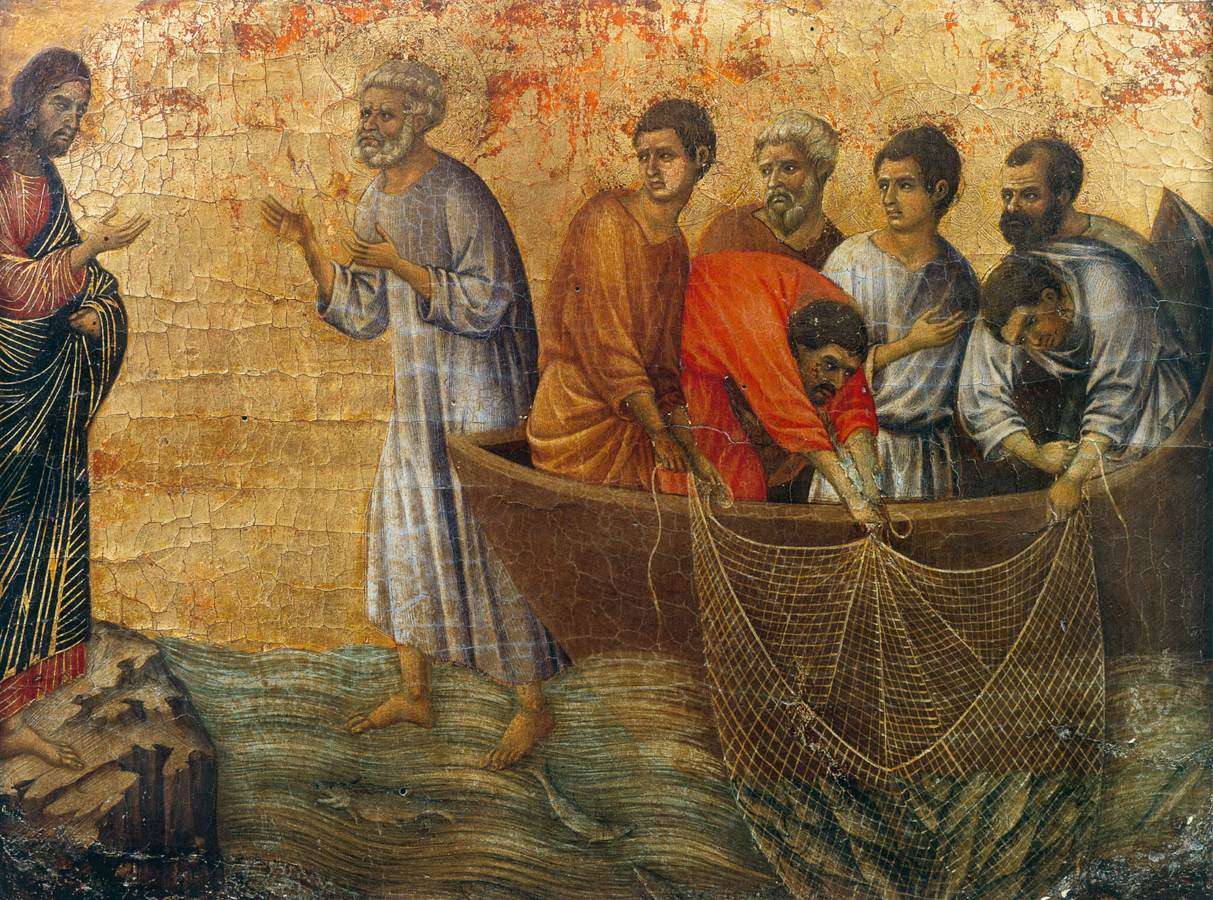
"Appearance on Lake Tiberias, c.1308, Duccio di Buoninsegna
Wikimedia Commons
EASTER 3C | 4 MAY 2025 | JOHN 21:1-19
John employs all manner of metaphor and symbolism throughout his richly theological gospel but he concludes it, significantly, with this heart rending encounter between the risen Christ and Peter, an encounter which he clearly believes key to the whole gospel, both his own text and the Good News, as such.
Only days earlier, Peter had adamantly disavowed three times all knowledge, let alone love, of Jesus, in a cowardly denial which Jesus himself had predicted, despite Peter’s earlier protestations of undying loyalty. Now, sitting next to him on the shore of the Sea of Galilee, in the half light of dawn, Jesus asks him three times: “Simon Peter, do you love me?”
Against the background of Peter’s denials, Jesus’ question may seem like a challenge to him to recant his former cowardice. But something much more personal and heartfelt is meant. Far from testing him, Jesus is seeking reassurance that, despite Peter’s earlier rejection, Jesus’ love for him is reciprocated. Jesus is, in effect, asking Peter, “Are we still friends: do you still love me?” Rendering him painfully vulnerable, as it does any of us when we we profess our love for another person, Jesus’ question makes clear beyond any doubt how much Peter’s love means to him.
Significantly, Peter, perhaps recalling that all his previous protestations have proven false, doesn’t explicitly protest his love in response: rather, he makes appeal to Jesus’ knowledge and love of him: “Lord, you know everything, you know I love you.” It’s his trust in Jesus’ knowledge and love for him, in other words, rather than his own protestation, that reaffirms their friendship and heals their relationship.
John clearly believes that the question Jesus addresses to Peter, “Simon, son of John, do you love me?” is to be heard by each of us in our own name. As with Peter, Jesus seeks reassurance that our friendship with him means as much to us as it does to him. John clearly believes that everything hangs on our response; but even more crucial for the sense and shape of our lives is the assurance we ourselves receive from the knowledge conveyed in Jesus’ question that God’s love for us is utterly certain and unconditional.
John’s emphasis on the personal character of God’s relationship with us is a characteristic of his gospel that has deservedly earned him the moniker, ‘The Mystical Evangelist’, and nowhere is it more explicit than in this affecting exchange between Jesus and Peter. At the heart of John’s gospel is the conviction that God entered our world as a human being so that we might relate to him, and he to us, in a fully human way, that is, as friends: “No longer do I call you servants, for the servant does not know what his master is doing; but I have called you friends, for all that I have heard from my Father I have shared with you.” (John 15:15)
“There is nothing on this earth more to be prized than true friendship…it is the source of the greatest pleasure in this life”, says Aquinas. As friends share their lives, so God, again according to Aquinas, shares with us not only his life, but his happiness, as yet and inevitably experienced in this life imperfectly, but finally and completely fulfilled in heaven.
In the light of the gospel, then, our primary relationship to God is not that of creature to creator, a relationship which cannot but be one of servant to master, but that of friends. Friendship, however, as Aquinas (and Aristotle before him) says, can exist only between equals. The astonishing truth at the heart of Christian faith is that we enjoy equality with the Father because we share, by God’s gift, Christ’s own life, the life he shares with the Father and the Holy Spirit, the life of selfless love. Friendship with God is thus made possible even in this life. In Heaven, however, we will experience perfect happiness in the fullness of friendship with God and one another.

Help us keep The Tablet’s voice independent, clear and far-reaching.
Founded in 1840, The Tablet is the leading independent English-language Catholic weekly, celebrated for great writing, astute analysis, brilliant arts and books reviews and trustworthy reporting from correspondents in Britain, Ireland, Rome and across the world.
Independent, high-quality journalism is at the heart of what we do. The Tablet does not have deep pockets and we are not funded by rich donors. If you appreciate our work please consider supporting The Tablet’s Development Fund. It only takes a moment and you can cancel at any time.
- Support with £5 per month
- Support with £10 per month
- Support with other amount.

MOST READ ARTICLES
-
1
Pope returns to Vatican after hospital discharge
-
2
Diverse schools that are 100 per cent Catholic
-
3
Under endless skies
-
4
Battling confession fatigue
-
5
Nigerian bishop scorns suggestion of running in presidential election
-
6
Schismatic Spanish nuns strip contents of convent before eviction
FROM THE EDITOR'S DESK


