News Briefing: Church in the World


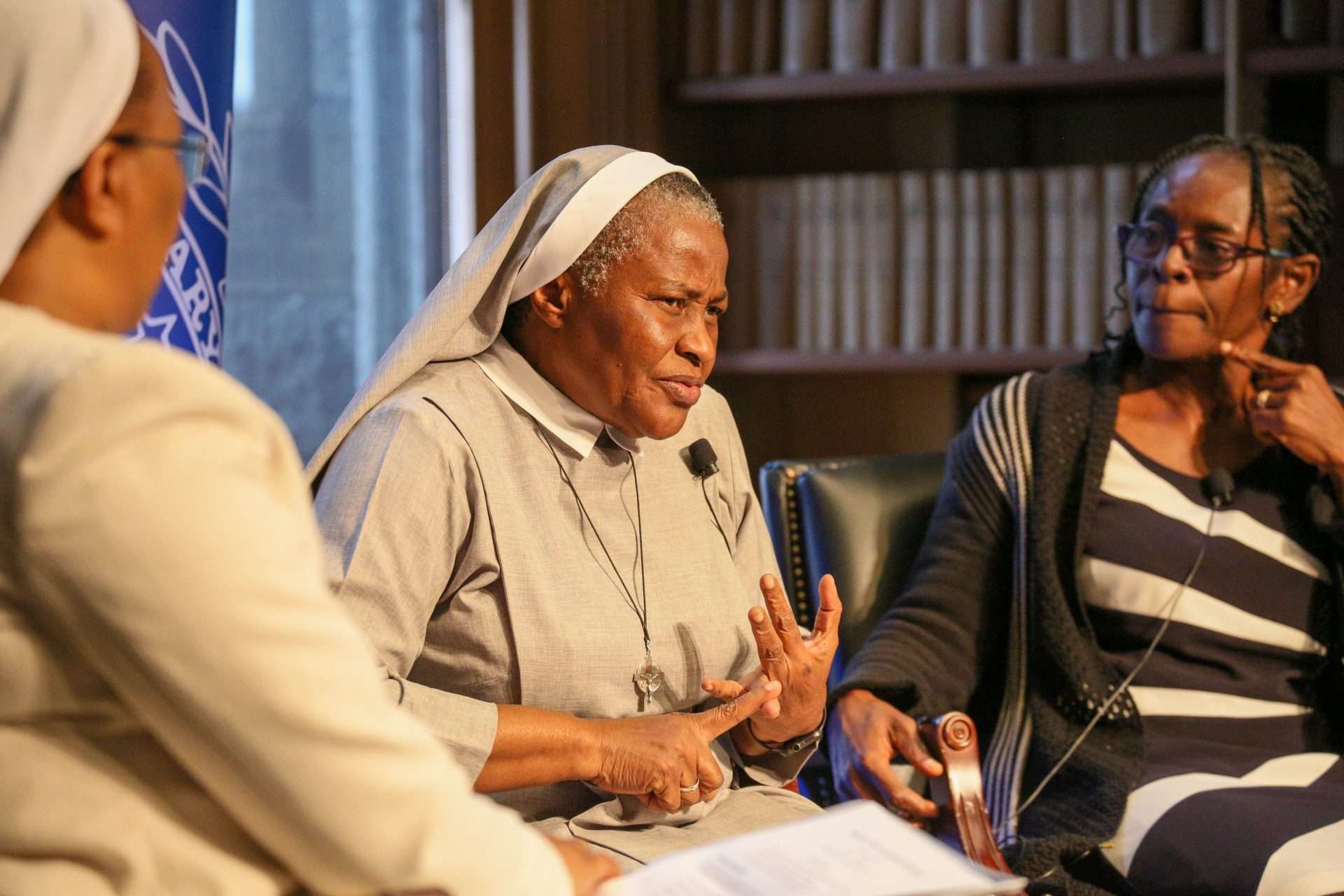
Sr Francisca Ngozi Uti HHCJ, the 2024 Opus Prize laureate, speaking at Georgetown University last year.
Berkeley Center / flickr | Creative Commons
A Polish priest died in hospital on 9 November six days after he was attacked in a suspected robbery. Fr Lech Lachowicz, a 72-year-old parish priest in Szczytno, suffered shocking injuries when a man armed with an axe broke into his presbytery, according to police, who arrested a 27-year-old man.
Last weekend Archbishop Józef Górzy of Warmia presided at the funeral for Fr Lachowicz, who over 30 years in the parish had built both the Church of St Brother Albert and its presbytery.
An artificial intelligence (AI) study found that the Church in Germany was forgetting simple truths like human dignity and “love thy neighbour”. Researchers used AI to analyse 700,000 internet comments on the Church, concluding that the hierarchy often appears too split and inward-looking to appeal to young people.
“The study shows that users want a culture of forgiveness, reconciliation and love,” said Fr Elmar Nass, a professor at the Cologne College of Catholic Theology. Instead, he said, they find more concern with fundamental discussions and politics.
“Trenches are being dug,” Nass told the KNA agency. “One gets the impression that the Church is more or less like a political parliament with different parties.”
The study said the idea of human dignity was considered underdeveloped. “Human dignity was mentioned strongly as a topic overall. But it is viewed more in the context of the violations it causes,” Nass said. ”Perhaps we as a church and theology need to place the Christian idea of dignity more at the centre of our preaching.”
Reform vital if Church is to survive, says German synod response
German bishops debate Synodal Path future after Synod final document
A German politician appealed for a Christmas pause in the country’s surprise early election campaign so people can go to church and be with their families.
Carsten Linnemann, the general secretary of the Christian Democrats (CDU), said there should also be no campaigning at the traditional Christkindlmärkte (Christmas markets) that liven up the dark evenings in Advent with booths selling everything from gingerbread to seasonal ornaments.
“People would just shake their heads,” he said, if they found back-slapping politicians among the merry makers. “I go to church at Christmas. And we are all together with our families,” he told the weekly Bild am Sonntag, adding that politics could resume on 1 January.
German elections normally take place in warmer months, but the governing coalition of Social Democrats, Greens and Free Democrats fell apart in a bitter row in early November, triggering news elections scheduled for 23 February.
The Vienna-based Observatory on Intolerance and Discrimination against Christians in Europe recorded widespread harassment of Christians in its report for 2023, published on 15 November.
It identified 2,444 anti-Christian hate crimes documented by police and civil society in 35 European countries, including 232 personal attacks on Christians, such as threats and physical violence. The figures include data requested from governments, which found 1,230 anti-Christian hate crimes recorded by 10 European governments in 2023, up from 1,029 recorded by governments in 2022. Civil society groups reported incidents from 26 European countries.
The report was published ahead of the International Day for Tolerance on 16 November, which was established in 1996 by the United Nations. It was produced in cooperation with the Organisation for Security and Co-operation in Europe and its Office for Democratic Institutions and Human Rights.
An investigation has claimed that hundreds of alleged violations of assisted suicide laws in Canada over the course of several years have not been reported to law enforcement.
Alexander Raikin, a visiting fellow in bioethics at the Ethics and Public Policy Centre in Washington, DC, suggested last week that a quarter of MAID (Medical Assistance in Dying) providers in Ontario may have violated the criminal code. Since the legalisation of assisted suicide in 2016, it has become an increasingly common cause of death. Canadian government statistics for 2022 indicated that MAID was the sixth-leading cause of death, with 13,241 “MAID provisions” reported that year.
The Canadian Association of MAID Assessors and Providers “recognises the need for oversight” of MAID, including measure to ensure it “maintains the public trust and provides accountability for the delivery of MAID against the legislative framework and safeguards”.
Assisted dying and the importance of evidence
A group of nurses working for the Ascension network of Catholic hospitals protested outside the plenary meeting of the United States Conference of Catholic Bishops, calling for higher wages and increased staffing to provide better care to patients.
Inside the meeting venue in Baltimore, nurses passed out leaflets and tried to engage bishops in conversation as they boarded the elevators to their rooms. “Appropriate staffing is the difference between life and death,” Lisa Watson, a nurse from Wichita, Kansas, told the protesters. “As a Catholic, I pray that the community, the bishops and the entire Catholic Church will join together and fight this Goliath with us. Our patients deserve better and our nurses deserve better.”
In 2019, the chief executive of Ascension Health Anthony Tersigni resigned after it was disclosed he had made as much as $17 million per year in salary. The Ascension network, like most Catholic hospitals, were founded by women religious but turned over in recent years to lay experts who often command large salaries.
Mexico’s Catholic bishops met President Claudia Sheinbaum on 13 November to discuss “the defence of life at all stages” and “the violent situation that affects various regions of the country”. They urged her to “build bridges of dialogue that promote national unity, an indispensable element to achieve the peace and integral development that our country yearns for”.
Sheinbaum thanked the bishops for the invitation to “discuss building peace and the development of the country among all sectors”. The bishops endorsed the federal government’s efforts to address the social causes of criminal violence in Mexico but emphasised the need to implement “more effective strategies for the disarmament of crime gangs and the protection of our communities”.
Since Sheinbaum took office on 1 October there have been 3,175 killings in Mexico, including a Catholic priest shot dead last month. There were 199,621 killings during her predecessor’s six-year term, making it the most violent six-year administration in Mexico’s modern history. The bishops also voiced concern at “the poverty that afflicts so many” and offered further collaboration in the provision of education and the “integral formation of the new generations”.
Mexico’s first female president urged to create ‘a place of peace’
Mexican bishop asks new president to meet mothers of ‘disappeared’
Caritas organisations and diocesan representatives joined a march for climate justice in Quezon City last Saturday, the Global Day of Action for Climate Justice, as the sixth typhoon in less than a month made landfall on the Philippines, killing eight people causing serious floods.
At a Mass before the demonstration, speakers emphasised the moral imperative of climate action. Around 4,000 marchers gather to call for a Climate Emergency Declaration and for policy reforms, specifically a just transition to renewable energy, and measures to mitigate climate-induced disasters. “There is no climate justice without the Rights of Nature!” declared one of the church banners.
Cardinal Pietro Parolin defended the Vatican’s provisional agreement with the Chinese government on the appointment of bishops, insisting “there is no contradiction between being authentically Chinese and good citizens and being Christians”.
The Holy See’s secretary of state was speaking to reporters in Rome on 15 November at a conference dedicated to the Jesuit missionary Matteo Ricci. He said that Ricci, who brought the Catholic faith to China in the seventeenth century, had persuaded its rulers that Christians could be loyal citizens.
The provisional agreement, whose terms remain secret, was extended for another four years in October, despite allegations that the efforts of the Chinese Communist Party to “sinicize” religion could compromise the Church. Cardinal Parolin said that “the major global problems of today can only be addressed if we are united”, adding that he was pleased Chinese bishops had attended the Rome assembly of the Synod on Synodality.
“Sinicisation is not going to go away,” Cardinal Stephen Chow told the conference. “It is here, so we need to engage in dialogue.”
Mixed responses to renewal of Vatican-China deal
Parolin plans to renew China deal following ‘method of Costantini’
Archbishop Linus Neli of Imphal – the capital of India’s north-eastern Manipur State – warned of escalating violence against Christians over the past month. “We’re praying for normal and peaceful life,” he said.
Last week 11 members of the Christian-majority Kuki tribal people were shot dead in Jiribamm, in a clash a group of the largely Hindu Meitei people. Police described the dead Kuki as “militants”, a claim challenged by the Forum of Tribal Leaders who said the incident was a deliberate attack against volunteers patrolling their village after a tribal woman was killed. Kuki groups blocked access to the state’s hill regions in protest, while the authorities imposed a curfew with shops and pharmacies closed.
Violence between Kuki and Meitei, who respectively make up 41 per cent and 53 per cent of Manipur’s 3.2 million people, has blighted the state for the past 18 months.
Why the global community must hold India to account for atrocities in Manipur
US religious freedom report spotlights persecution in India
Faith communities in Pakistan joined a campaign to address severe air pollution in Lahore and other cities. Lahore, Pakistan’s second-largest city and the capital of Punjab province, ranks among the world’s most polluted cities.
Schools and public buildings have been closed for weeks in several parts of the region, and medical professionals report increased respiratory illnesses, lung conditions, and allergies linked to poor air quality and smog. The provincial government has set up a “smog war room” to tackle severe pollution.
Faith initiatives in Lahore encouraged the community to engage in sustainable practices such as using public transport, car sharing and switching to cleaner energy sources.
Zambia’s Catholic bishops said they were “gravely concerned by the turnover of arrests of opposition politicians” by government security forces.
In a statement marking the sixtieth anniversary of Zambian independence, the bishops said that “arrests of a political nature that fall within the realm of the exercise of democratic rights” threatened the country’s future. “We urge the authorities to accept the existence of the opposition and respect their duty to hold the government to account and to desist from criminalising political speech and debate,” they said.
Two kidnapped Nigerian priests were released earlier this month. On 7 November, kidnappers released Fr Thomas Oyode, the rector of the Immaculate Conception Minor Seminary School in Agenegabode, after 11 days in captivity. Fr Emmanuel Azubuike of St Theresa’s Church in Imo State was freed in the early hours of 11 November, six days after he was seized near the Alaiyi community in Obollo while on his way back home from an assignment. Bishop Mathew Hassan Kukah of Sokoto has described the persistent kidnapping of priests by criminal groups as “an epidemic”.
Sr Francisca Ngozi Uti HHCJ, founder of the Centre for Women Studies and Intervention, received the $1 million Opus Prize for humanitarian work. The Abuja-based centre works with communities in Nigeria to discourage practices such as genital mutilation and underage marriage which harm women and girls, and promotes female education.
“I accept this award on behalf of all the women, girls and men who have partnered with us to bring about positive change in their lives and communities,” said Uti at the award ceremony at Santa Clara University in California. “I remember especially the women and girls who have endured hardship, and are now striving to rebuild their lives.”
Caritas Africa called for major reform to the global financial system to lift the debt burden from African countries.
In a statement following a series of meetings organised by the International Monetary Fund (IMF) and The World Bank Group in late October, Lucy Afandi Esipila, the Regional Executive Secretary of Caritas Africa, said it was inherently unjust for the continent to be struggling to repay its debts at “exorbitant interest rates”. She said the debt burden was “unprecedented, characterised by an overwhelming accumulation of debt”.
According to ONE Data and Analysis, a consultancy that tracks Africa’s economies, the continent owed $655.6 billion to external creditors as of 2022, and will have to pay $89.4 billion to service this debt in 2024. It said 20 low-income countries in Africa (57 per cent of those assessed) face or are at risk of debt distress.
“The architecture of this debt has evolved, resulting in an increasing number of foreign debt sources, including private and bilateral creditors such as China,” said Esipilia. “Currently perceived as a liquidity issue, African economies are accumulating loans while allocating a significant portion of their limited internal revenues to servicing debts with exorbitant interest rates.”
She echoed Pope Francis’ argument that developed nations need to cancel Africa’s debt, not as a matter of charity but “a matter of justice”.
African bishops appeal for debt relief ahead of Jubilee year
Pope joins calls for ‘climate justice’ at COP29
In his homily last Sunday for the World Day of the Poor, Pope Francis called on Catholics to recognise God’s presence in the suffering of the poor and to act with hope and compassion in the face of injustice.
Before the Mass, he blessed 13 symbolic keys representing global efforts to house homeless people through the Vincentian “13 Houses” project inspired by the charitable legacy of St Vincent de Paul, who in 1643 used a royal bequest to establish 13 homes for street children in Paris. The keys represented homes built in 13 countries, including Syria, Cambodia, and Senegal.
Pope Francis also asked Church institutions and religious congregations in Rome to celebrate the Holy Year 2025 by offering a home to someone in need. Later, he hosted 1,300 of Rome’s poor and homeless at a lunch in the Vatican.
The Pope invited dioceses across the world to begin an annual commemoration of “saints next door” in the 2025 Jubilee. In a letter published last Saturday, he said 9 November – the Feast of the Dedication of the Lateran Basilica – could become an occasion “to rediscover or perpetuate the memory of extraordinary disciples of Christ who have left a living sign of the presence of the Risen Lord”. He said it was an opportunity outside the liturgical calendar to commemorate local saints and blessed as well as “everyday holiness” in the community.
Pope Francis proclaims Year of Jubilee themed around ‘hope’
Stay updated — add us as a preferred news source on Google:


Help us keep The Tablet’s voice independent, clear and far-reaching.
Founded in 1840, The Tablet is the leading independent English-language Catholic weekly, celebrated for great writing, astute analysis, brilliant arts and books reviews and trustworthy reporting from correspondents in Britain, Ireland, Rome and across the world.
Independent, high-quality journalism is at the heart of what we do. The Tablet does not have deep pockets and we are not funded by rich donors. If you appreciate our work please consider supporting The Tablet’s Development Fund. It only takes a moment and you can cancel at any time.
- Support with £5 per month
- Support with £10 per month
- Support with other amount.

MOST READ ARTICLES
-
1
Archbishop of Cardiff-Menevia meets with other worldwide Catholic Church leaders to discuss liturgy
-
2
Let there be light
-
3
World Humanitarian Day: aid workers face a ‘crisis of protection’
-
4
Ruling allows French private hospitals limited exemption from assisted suicide
-
5
A tract for our times
-
6
The wisdom of the saints
FROM THE EDITOR'S DESK