Ukraine sustained by prayers since invasion, say cardinal and Caritas


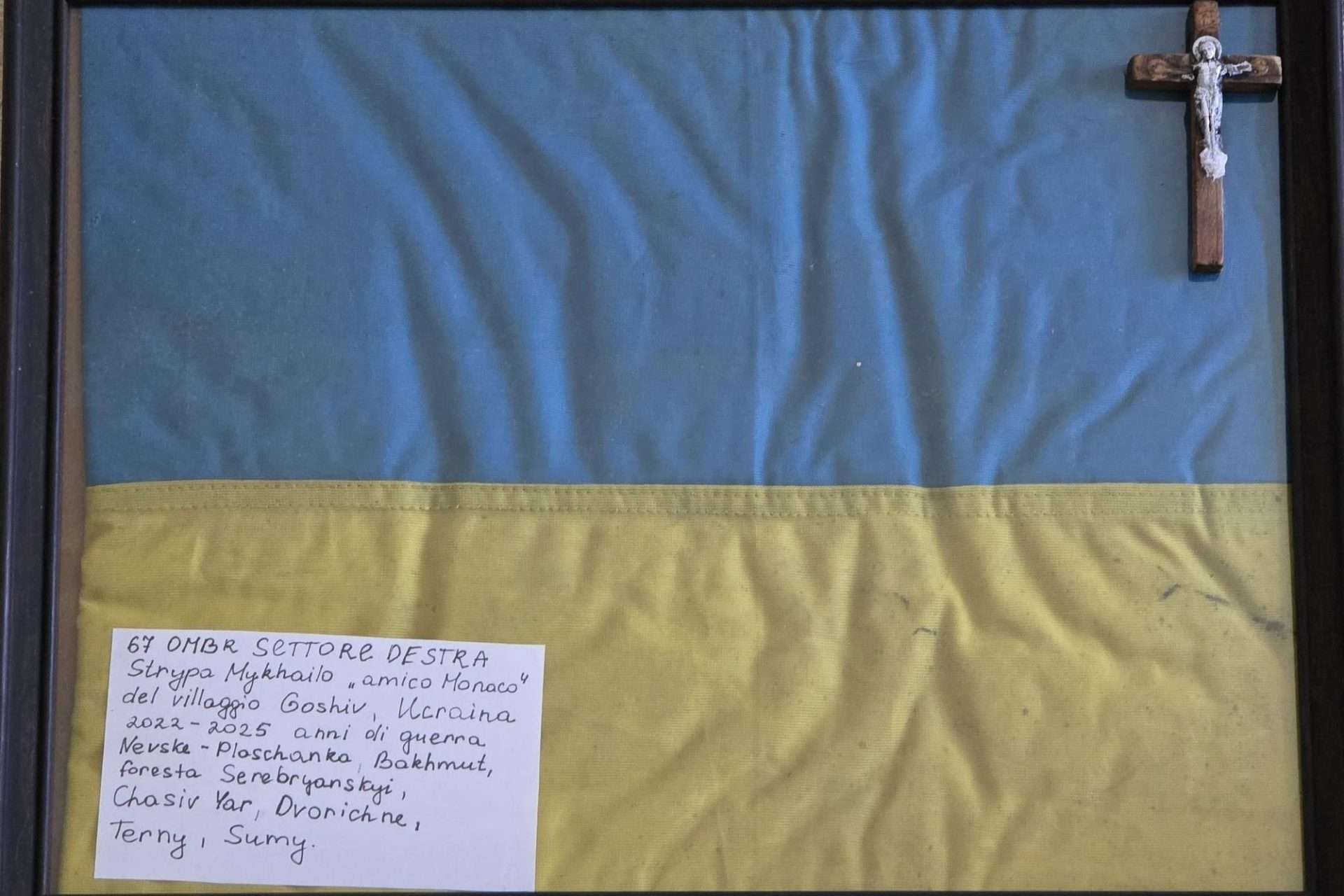
Mykhailo Strypa carried the flag and crucifix in his body armour through three years of service with the Ukrainian army.
The UGCC Department for Information
‘When you see resilience in Ukraine, it’s not just us – it’s built obviously on the grace and mercy of God, but also on the prayers and support of the people around us.’
Cardinal Mykola Bychok presented Pope Leo with a flag and a crucifix carried by a Ukrainian soldier through three years of fighting the Russian invasion.
Mykhailo Strypa, who served in Nevske, Ploshchanka, Bakhmut, Serebrianske, Chasiv Yar, Dvorichne, Terny and in the Sumy region between 2022 and 2025, entrusted them as a gift to Pope Leo asking that he “never cease to be a voice of truth in this war”, according to the Ukrainian Catholic Eparchy of Saints Peter and Paul of Melbourne, which Bychok leads.
The cardinal presented them to Pope Leo during the general audience on 24 June before the start of the extraordinary consistory, with a testimony from Strypa of his prayers during combat.
A week earlier, Pope Leo had mourned the “many innocent victims, rescuers killed and churches and cultural heritage sites devastated by fire” at his general audience following large-scale Russian airstrikes on Kyiv and elsewhere the previous weekend.
“I stand in solidarity with those mourning their loved ones, with the wounded, and with those who, amid the violence, courageously continue to serve life,” he said. “Let us ask the Lord to open paths of dialogue, to extinguish hatred and to make a just and lasting peace possible.”
Earlier that month, Ukrainian speakers at the World Apostolic Congress of Mercy in the Lithuanian capital Vilnius had emphasised the importance of prayer and support from around the world for sustaining Ukrainians after the invasion.
“In that first year of the full-scale invasion, it felt as if not only all of Ukraine, but all of Europe and all of the world were Caritas,” said Tetiana Stawnychy, president of the Caritas Ukraine, during the congress on 7-12 June.
“When you have an attack of this magnitude, there’s no single person, no single organisation, no single country that can withstand it on their own,” she said. “And when you see resilience in Ukraine, it’s not just us – it’s built obviously on the grace and mercy of God, but also on the prayers and support of the people around us.”
Discussing the challenges for Ukraine after the fighting has stopped, Stawnychy said mental health support was Caritas’ primary concern.
“For example, all of our Caritas staff that are going out into the field are now being trained in first psychological aid, because they might be going out to repair a home, or to restore water supply, but encounter people, who might have had some kind of traumatic experience. So, for them to be able properly to encounter a trauma, and to direct the conversation correctly,” she told The Tablet.
The Ukrainian government is also working on mental health, including through First Lady Olena Zelenska’s “How are you?” campaign which encourages people to check with one another, because the longer war lasts, the harder it comes for the society to keep up “this level of solidarity and empathy that we had since the beginning of the crisis”, Stawnychy said. “So, you need to more intentionally keep that as your focus.”
She described the work of the network of resilience centres built by the Ukrainian government through the help of Caritas’ institutional donors. “Psychological stabilisation centres is a better word, they are working throughout Ukraine, via coordination between the local government, NGOs and the national government”, she said.
The second major problem after the war will be the restoration of infrastructure, especially the housing, which in Ukraine was “part of the social safety net”, Stawnychy said.
“Salaries in Ukraine are not built around paying rent, so an average person has to own their housing. The last statistic shows that more than 3 million homes have been destroyed, so there’s over 4 million people who need a housing solution”, she explained, adding that another focus will be social protection system, because there will be more people in need.
Since the beginning of the full-scale invasion in 2022, civilian infrastructure including energy and water supplies have been constant targets for Russian strikes, with one of the most memorable being the blowing-up of Kakhovka Dam in 2023 resulting in a massive ecological disaster.
Olha Sydii, coordinator of the Caritas Ukraine programme WASHinWAR, said they had launched it as an international advocacy and awareness campaign to draw attention to the impact of war on water resources, critical infrastructure and rights to safe water.
“When we came up with the idea of WASHinWAR, we understood that it’s important to communicate with the external world in the visualised way, to show how the war impacts the water resources, so we asked the famous Ukrainian photographers who are reporting about the war to share relevant pictures which they want to bring to the world, to the decision-makers, to the charity foundations, to the media, to the social institutions, to universities, so people would know more about the impact of war to the environment,” she told The Tablet.
This collaboration resulted in a travelling photo exhibition “Water in the Fire of War”, which was opened in Vilnius during the World Congress of Mercy.
Since February 2022, more than 1,500 water infrastructure facilities have been destroyed or severely damaged across Ukraine, including dams, pumping stations, treatment plants and pipelines. The total length of damaged water supply and sewage network is over 37,900km. Direct losses to water utilities have reached US$11 billion.
“WASHinWar campaign stresses three aspects: ecological, humanitarian and human rights, because it’s about disrupting people’s right to a basic need of water,” said Sydii. “At the same time, we try to raise awareness of other nations about the national preparedness, emergency preparedness, because nowadays we understand that the future is unpredictable, so it’s very important to think about the safety from this perspective as well.”
The WASHinWAR cluster of the Caritas Ukraine are working for solutions which would ensure sustainability for communities beyond the humanitarian response to water crises.
“When you are doing the water distribution in an emergency situation, it helps for the first three months, but then you need to have a stable access to that settlement and stable funding to come there,” Sydii said.
“Eventually, people become dependent on those international or Ukrainian NGOs coming and bringing water, that’s why WASHinWAR is also showing the importance of finding those sustainable solutions that would build the capacity of local communities to rely on their own resources.”
Joy amid sorrow: two weeks in Ukraine
Operation Interflex and hope beyond the violence in Ukraine
Stay updated — add us as a preferred news source on Google:


Help us keep The Tablet’s voice independent, clear and far-reaching.
Founded in 1840, The Tablet is the leading independent English-language Catholic weekly, celebrated for great writing, astute analysis, brilliant arts and books reviews and trustworthy reporting from correspondents in Britain, Ireland, Rome and across the world.
Independent, high-quality journalism is at the heart of what we do. The Tablet does not have deep pockets and we are not funded by rich donors. If you appreciate our work please consider supporting The Tablet’s Development Fund. It only takes a moment and you can cancel at any time.
- Support with £5 per month
- Support with £10 per month
- Support with other amount.

MOST READ ARTICLES
-
1
Pope returns to Vatican after hospital discharge
-
2
Diverse schools that are 100 per cent Catholic
-
3
Under endless skies
-
4
Battling confession fatigue
-
5
Nigerian bishop scorns suggestion of running in presidential election
-
6
Schismatic Spanish nuns strip contents of convent before eviction
FROM THE EDITOR'S DESK