Make wealth ‘a blessing for all’ says Pope in Equatorial Guinea


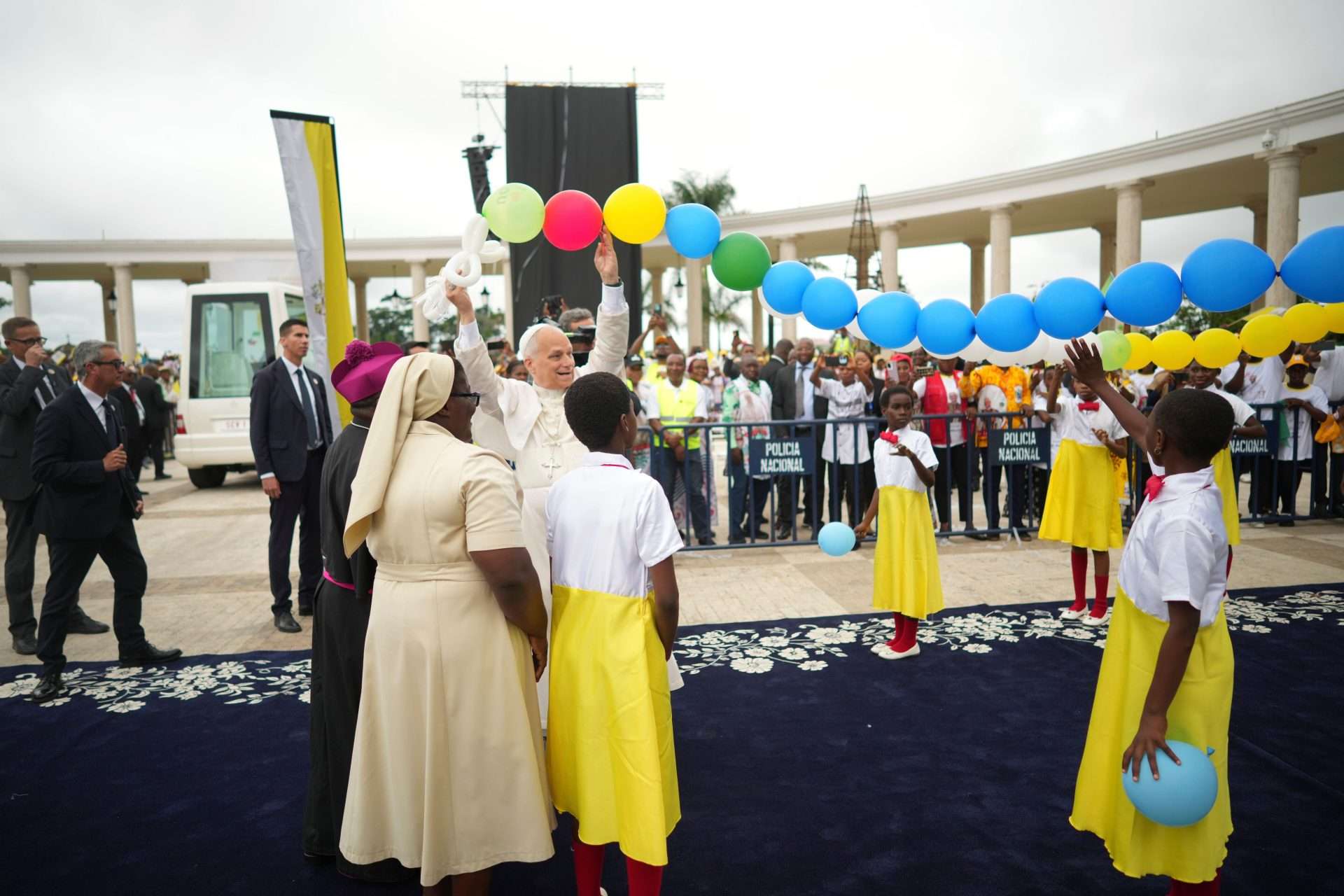
Leo greeted the tens of thousands of people gathered in front of the Cathedral of the Immaculate Conception to hear the Mass.
Andrew Medichini / Associated Press / Alamy
‘May the Lord help you to become a society in which everyone works ever more fully to serve the common good, bridging the gap between the privileged and the disadvantaged.’
Christians must “take the destiny of Equatorial Guinea into their own hands”, Pope Leo said, as he marked 170 years of evangelisation in the country.
At a Mass in the Cathedral of the Immaculate Conception in Mongomo, Leo urged the estimated 100,000 present “to follow in the footsteps of the missionaries, pastors and laypeople who have gone before you”, whose work “made you protagonists in proclaiming the Gospel and bearing witness to the faith”.
He echoed the words of Paul VI on his visit to Uganda in 1969: “Africans, from now on you are missionaries to yourselves. The Church of Christ is well and truly planted in this blessed soil.”
“The future of Equatorial Guinea depends upon your choices,” Pope Leo continued, “it is entrusted to your sense of responsibility and to your shared commitment to safeguarding the life and dignity of every person.”
He said it was “necessary for all the baptised to feel that they are part of the work of evangelisation, and so become apostles of charity and witnesses to a new humanity”, taking part “in the integral development of this land, in its renewal and in its transformation”.
“The Creator has endowed you with great natural wealth: I urge you to work together so that it may be a blessing for all,” the Pope said.
“May the Lord help you to become a society in which everyone, each according to their respective responsibilities, works ever more fully to serve the common good rather than private interests, bridging the gap between the privileged and the disadvantaged.”
The cathedral consecrated in 2011 is the second largest Catholic church in Africa and one of several large-scale building projects in Mongomo, a city of 7,000 on Equatorial Guinea’s eastern border where its President Teodoro Obiang Nguema Mbasogo was born. During his visit to the city, Pope Leo opened the Pope Francis Technology School.
Obiang, who attended the Mass with his family, has governed Equatorial Guinea since a coup in 1979, first as chairman of a military council and as president since 1982. He has faced allegations of large-scale corruption, drawing on the country’s oil wealth while leaving more than half of its population in poverty.
Beforehand, Leo greeted the tens of thousands of people gathered in front of the cathedral to hear the Mass and blessed a foundation stone for a new church in Ciudad de la Paz, a new city in the centre of the country which Obiang designated its new capital in January, replacing Malabo.
After the Mass, the Pope presented the chalice used in the liturgy to the Catholic community in Mongomo. Pope Francis erected the Diocese of Mongomo in 2017, appointing Bishop Juan Domingo-Beka Esono Ayang CMF its first ordinary.
In his address to civic dignitaries on his arrival in Malabo on Tuesday, Leo said the construction of the new capital should “prompt every person to ask themselves which city they wish to serve”, referring to St Augustine’s The City of God.
He said the Church’s social teaching guided those “who seek to address the ‘new things’ that destabilise our planet and human coexistence, while prioritising, above all else, the Kingdom of God and his justice”.
“This is a fundamental dimension of the Church’s mission: to contribute to the formation of consciences through the proclamation of the Gospel, the provision of moral criteria and authentic ethical principles – all while respecting individual freedom and the autonomy of nations and their governments.”
Leo warned that “the proliferation of armed conflicts is often driven by the explanation of oil and mineral deposits” while “technologies often appear to be conceived and utilised primarily for warlike purposes”.
“God does not want this,” he said. “His holy Name must not be profaned by the will to dominate, by arrogance or by discrimination; above all, it must never be invoked to justify choices and actions of death.”
He continued: “In a world wounded by arrogance, people hunger and thirst for justice. It is necessary to encourage those who believe in peace and to dare to engage in ‘countercurrent’ politics – those which place the common good at their very centre.
“What is urgently needed is the courage of new visions and an educational pact that gives young people space and trust. The city of God – the city of peace – is indeed received as a gift from on high, the horizon toward which our every noble aspiration turns.”
Later that day Leo visited the Jean Pierre Olie Psychiatric Hospital, where he repeated a remark from the welcome by its director Prof Bechir Ben Hadj Ali: “A truly great society is not one that hides its weaknesses, but one that surrounds them with love.”
The Pope continued: “This is a principle of a civilisation with Christian roots, for in the course of human history Christ came to redeem and restore to full dignity those who suffer from the stigma of disability.
“However, the Saviour does not wish to, nor can he, save us without our cooperation, both on a personal and a social level. Therefore, he asks us to love our brothers and sisters not just in words, but also in deeds. A facility such as this, with God’s help and everyone’s commitment, can become a sign of the civilisation of love.”
Africa: cry, the beloved continent
Mother of Spaniard detained in Equatorial Guinea plans hunger strike for papal visit
Stay updated — add us as a preferred news source on Google:


Help us keep The Tablet’s voice independent, clear and far-reaching.
Founded in 1840, The Tablet is the leading independent English-language Catholic weekly, celebrated for great writing, astute analysis, brilliant arts and books reviews and trustworthy reporting from correspondents in Britain, Ireland, Rome and across the world.
Independent, high-quality journalism is at the heart of what we do. The Tablet does not have deep pockets and we are not funded by rich donors. If you appreciate our work please consider supporting The Tablet’s Development Fund. It only takes a moment and you can cancel at any time.
- Support with £5 per month
- Support with £10 per month
- Support with other amount.

MOST READ ARTICLES
-
1
Pope returns to Vatican after hospital discharge
-
2
Diverse schools that are 100 per cent Catholic
-
3
Under endless skies
-
4
Battling confession fatigue
-
5
Nigerian bishop scorns suggestion of running in presidential election
-
6
Schismatic Spanish nuns strip contents of convent before eviction
FROM THE EDITOR'S DESK