Looking back to the future


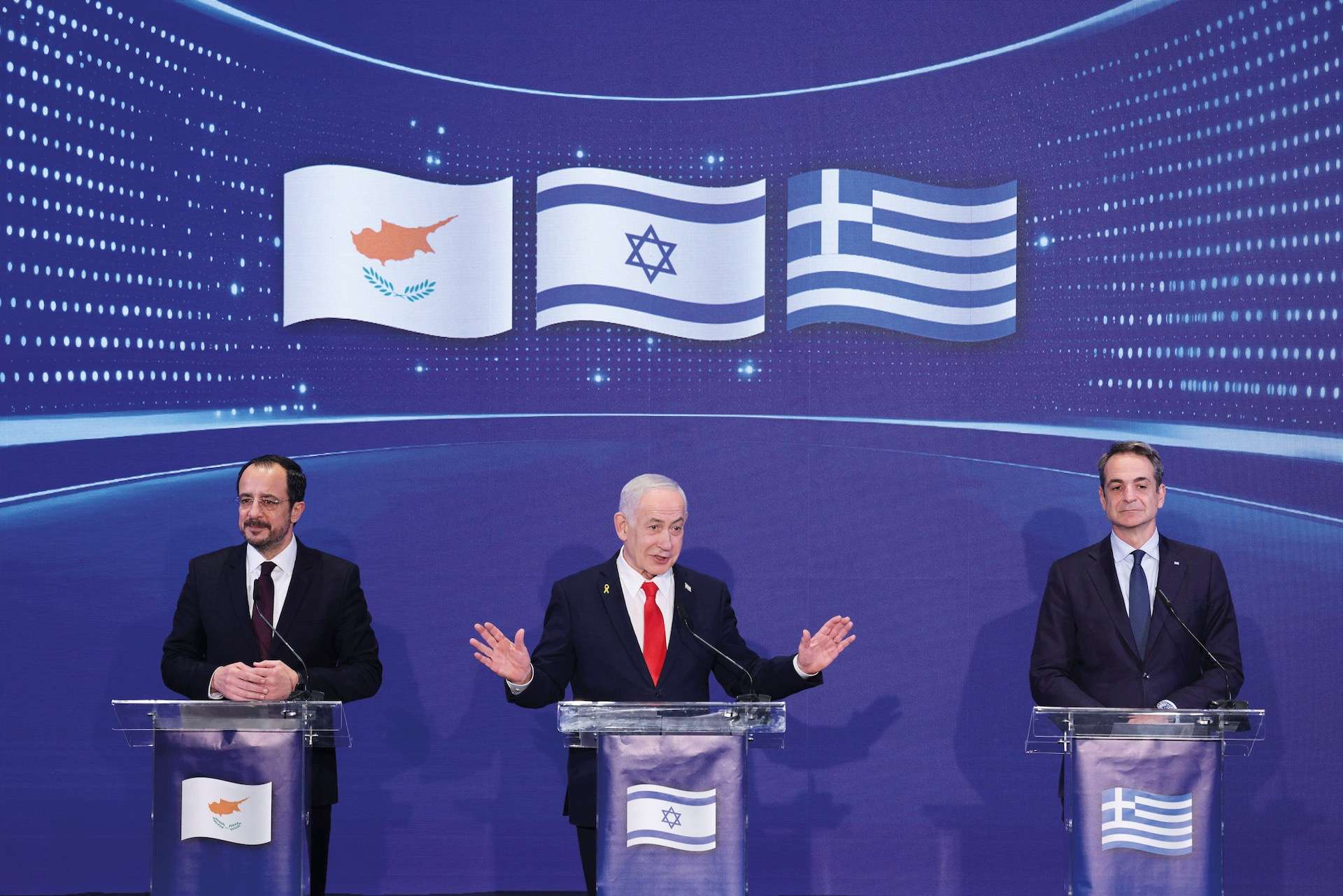
From left, Cypriot President Nikos Christodoulides, Israeli Prime Minister Benjamin Netanyahu and Greek Prime Minister Kyriakos Mitsotakis
Alamy/UPI, Abir Sultan
Catholic features in The Tablet – return of the Near East
Something peculiar is going on when Greece’s venerable newspaper of record, Kathimerini, devotes an entire page to a new cultural and geopolitical theory, under the headline (in self-consciously archaising language): “We belong to the East.”
People who know modern Greek history (as readers of that august broadsheet generally do) could instantly pick up the gentle irony. The paper was riffing on one of the defining sound bites of the constitutional order that was re-established in Athens half a century ago, after a nasty interlude of military rule. In June 1976, to be precise, Prime Minister Constantine Karamanlis told his cheering parliamentary supporters: “Greece – politically, militarily, economically and culturally – belongs to the West.”
Superficially at least, that programmatic statement has been borne out. For all the rockiness of the last five decades, including Andreas Papandreou’s flirtation with non-alignment and a financial crisis that brought Greece (and the eurozone with it) to the edge of the abyss, the country’s place in the western network of institutions seems unquestioned, and the current outbreak of war in the greater Middle East has only reaffirmed that basic alignment.
Get Instant Access
Continue Reading
Register for free to read this article in full
Subscribe for unlimited access
From just £37.50 quarterly
Print copy of The Tablet delivered directly to your door.
Complete access to all Tablet website content including all premium content.
Access to the weekly digital copy of The Tablet.
Full access to The Tablet’s archive – over 180 years of back issues.

Already a subscriber? Login

Help us keep The Tablet’s voice independent, clear and far-reaching.
Founded in 1840, The Tablet is the leading independent English-language Catholic weekly, celebrated for great writing, astute analysis, brilliant arts and books reviews and trustworthy reporting from correspondents in Britain, Ireland, Rome and across the world.
Independent, high-quality journalism is at the heart of what we do. The Tablet does not have deep pockets and we are not funded by rich donors. If you appreciate our work please consider supporting The Tablet’s Development Fund. It only takes a moment and you can cancel at any time.
- Support with £5 per month
- Support with £10 per month
- Support with other amount.

MOST READ ARTICLES
-
1
Archbishop of Cardiff-Menevia meets with other worldwide Catholic Church leaders to discuss liturgy
-
2
Let there be light
-
3
World Humanitarian Day: aid workers face a ‘crisis of protection’
-
4
Ruling allows French private hospitals limited exemption from assisted suicide
-
5
A tract for our times
-
6
Letters to the Editor of The Tablet
FROM THE EDITOR'S DESK