Belarusian bishops omit Ukraine from peace prayer appeal


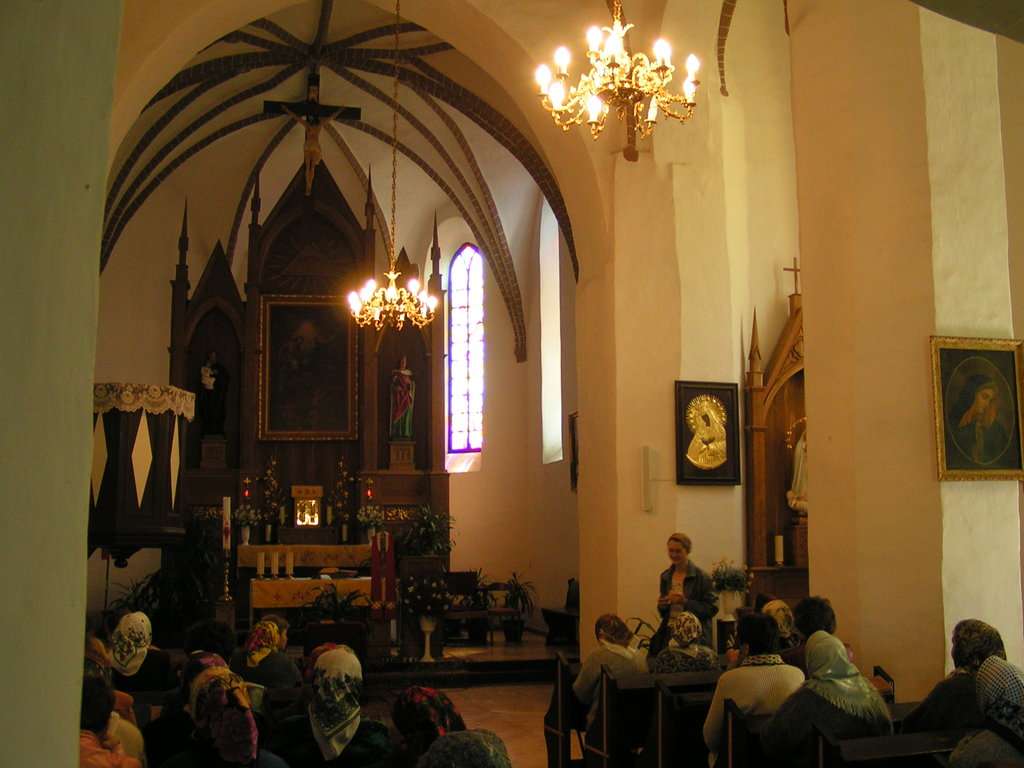
A Mass in Holy Trinity Catholic Church in Baranavichy, in the Brest Oblast of Belarus
Dzmitry Kamenda / flickr | Creative Commons
Pope Leo’s references to Ukraine and the Holy Land in his original appeal for prayer and fasting were also deleted from the Vatican News report that the bishops’ conference reposted on its website.
The response of the Catholic bishops and parishes of Belarus to Pope Leo’s call to pray and fast for peace omitted any mention of Ukraine or the Holy Land.
Archbishop Joseph Stanevsky of Minsk-Mogilev, head of the bishops’ conference, asked Catholics to support the Pope’s initiative on 22 August. However, in his message, Stanevsky quoted Pope Leo’s call without mentioning Ukraine or the Holy Land, according to the ecumenical civic organisation Christian Vision.
Although though the war in Ukraine is taking place just across the border, Stanevsky made a neutral call to all believers of Belarus “to pray for peace”.
The Pope’s references to Ukraine and the Holy Land in his original appeal were also deleted from the Vatican News report that the bishops’ conference reposted on its website.
“It is no coincidence that the Catholic Church in Belarus refused to pray publicly for peace in Ukraine. Even a single public mention of this country in Belarus can be dangerous,” said Fr Yury Roi, a Belarusian Orthodox priest who ministers to the parish of the Exarchate of the Ecumenical Patriarchate of Constantinople in Vilnius.
“Without a doubt, the hierarchy and believers of the Catholic Church in Belarus are against this war and pray for peace, but it is unsafe to make this prayer public,” said Fr Roi, who fled the Minsk regime after the crackdown on human rights in 2020.
“Living in a free world, it is difficult to imagine the atmosphere in an authoritarian state,” he told The Tablet. “It seems illogical and, in a sense, impossible to us that praying for peace could be reprehensible in any way. But this is authoritarianism, permeated with propaganda. It is like in Orwell’s book Nineteen Eighty-Four, where war is peace, and peace is war.”
Unlike in Russia, support for the war among the Belarusian population is minimal. However, Roi said some people accept Russian propaganda.
“Because the Belarusian Orthodox Church of the Moscow Patriarchate spreads the ideas of the ‘Russian world’, unfortunately, there are more supporters of Russia and its war among Orthodox Christians in Belarus. Some monasteries and parishes even collect financial and material support for the Russian occupiers in Ukraine.”
At the beginning of August, the Religious Information Service of Ukraine reported that, following a reprimand from Moscow, the Belarusian Orthodox Church added its affiliation with the Moscow Patriarchate to its official title. This was despite the consensus in Belarus reached over past decades to refer to the church without the cumbersome definition “of the Moscow Patriarchate”.
Fr Roi said that although the Belarusian Orthodox Church was always subordinate to the Moscow Patriarchate, its unadorned title implied at least a degree of independence.
It seems this irritated Moscow, which wanted its status reduced to that of an ordinary church district, but that attitude in turn has irritated some of President Aleksandr Lukashenko’s officials, who prefer to emphasise independence from Russia. Both sides have been putting pressure on Metropolitan Veniamin of Minsk.
“The situation has become somewhat comical: over the past month, the name of the Belarusian Church has been changed three times on the official website in order to find a version that would more or less suit everyone,” said Fr Roi. “But, by and large, the Belarusian Orthodox Church of the Moscow Patriarchate is now one of the main conduits of the ideas of the Russian world in Belarus.”
Prayer and fasting ‘can shape history’ says Ukrainian bishop
Orthodox priest becomes ‘He-Who-Must-Not-Be-Named’ after Belarus brands social media ‘extremist’
Stay updated — add us as a preferred news source on Google:


Help us keep The Tablet’s voice independent, clear and far-reaching.
Founded in 1840, The Tablet is the leading independent English-language Catholic weekly, celebrated for great writing, astute analysis, brilliant arts and books reviews and trustworthy reporting from correspondents in Britain, Ireland, Rome and across the world.
Independent, high-quality journalism is at the heart of what we do. The Tablet does not have deep pockets and we are not funded by rich donors. If you appreciate our work please consider supporting The Tablet’s Development Fund. It only takes a moment and you can cancel at any time.
- Support with £5 per month
- Support with £10 per month
- Support with other amount.

MOST READ ARTICLES
-
1
Pope returns to Vatican after hospital discharge
-
2
Diverse schools that are 100 per cent Catholic
-
3
Under endless skies
-
4
Battling confession fatigue
-
5
Nigerian bishop scorns suggestion of running in presidential election
-
6
Schismatic Spanish nuns strip contents of convent before eviction
FROM THE EDITOR'S DESK