News Briefing: Church in the World


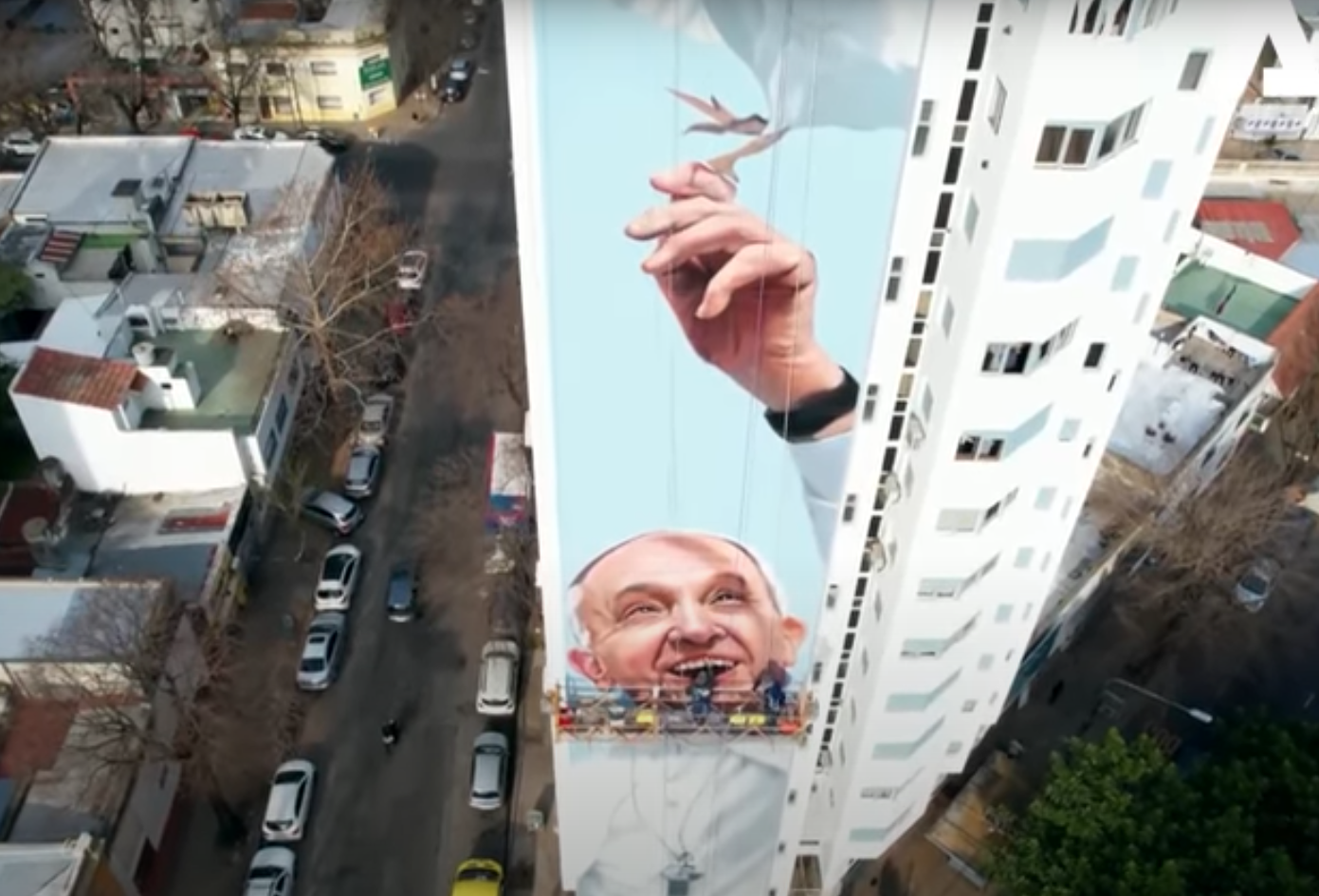
The Argentine artist Martín Ron painted the world’s largest mural of Pope Francis in La Plata.
APT / Youtube screenshot
Pope Leo announced the dates for the next World Youth Day in Seoul, 3-8 August 2027. Speaking at the Angelus on Sunday at Tor Vergata, east of Rome, where he had led a vigil and said Mass for an estimated one million pilgrims for the Jubilee of Youth, the Pope said that “the ‘pilgrimage of hope’ for young people continues and will take us to Asia”.
Before the Mass, Leo prayed for the young people of Gaza and Ukraine, and “of every land bloodied by war”.
He said the young pilgrims were “a sign that a different world is possible”, and in his homily told them the “fullness of life” did not depend on possessions but “has to do with what we joyfully welcome and share”. He spoke in Italian, Spanish and English in the course of the event.
Fr Richard Anthony D’Souza SJ was appointed to succeed his fellow Jesuit Br Guy Consolmagno as director of the Vatican Observatory.
Br Consolmagno, whose mandate expires on 19 September, said Fr D’Souza had “the vision and wisdom to carry the observatory forward during this time of rapid change in astronomical research, especially given his experience with space telescopes and advanced computational techniques”.
Born in Goa, D’Souza has been a staff member of the observatory since 2016 and superior of the Jesuit community there since 2022. A member of the International Astronomical Union (IAU), D’Souza’s research focuses the phenomenon of galaxy merging and its effects on the present-day properties of galaxies like the Milky Way.
He holds two degrees in Physics from the University of Heidelberg, while his doctorate in Astronomy explored the formation of galaxies. The IAU recently named an asteroid after him.
The Holy See’s secretary for relations with states Archbishop Paul Gallagher signed an agreement with the Italian government to build a solar energy plant on Vatican property outside Rome. The agrivoltaic plant at Santa Maria di Galeria will use solar panels to provide renewable energy for the Vatican City State – which is aiming for net-zero emissions by 20250 – while keeping the land in agricultural use. The project’s estimated cost was up to €100 million.
Italy Prime Minister Giorgia Meloni announced a joint campaign with Algeria to obtain UNESCO heritage status for sites in both countries linked to St Augustine.
“We want to celebrate the ties between Italy and Algeria with a project we both care a lot about – giving value to the places of St Augustine’s life in Italy and Algeria,” Meloni said last week, speaking alongside Algeria’s President Abdelmadjid Tebboune at the fifth Italian-Algerian intergovernmental summit.
She continued: “It is a project that we are keen to work on with great care, not only because of what it represents to our nations, but also because of its symbolic value, if we think of the fact that, among other things, the first Augustinian pope in the history of the Church sits on the papal throne today.”
Places linked in Algeria to Augustine include Souk Ahras, in north-eastern Algeria, where he was born in 353AD, and his former see at Annaba, then Hippo Regius, where he lived and served as bishop in 391-43. He earlier lived and taught in Rome and Milan.
The Archbishop of Madrid Cardinal José Cobo Cano suspended the board of directors of the Spanish association of religious Las Hijas del Amor Misericordioso (Daughters of Merciful Love, known as HAM) following an investigation by the Rota of the Apostolic Nunciature at the behest of the Dicastery for the Doctrine of the Faith.
The inquiry followed accusations against HAM of heresy, sexual and spiritual abuse and “sectarian” behaviour including separating young people from their families. Founded by a Jesuit in 1983 and approved as a public association of the faithful in 2007, HAM, which has 300 lay members, stands accused of recruiting vulnerable young women identified while it was running the Effetá and Emmaus retreats at the vanguard of “cool” Catholicism in Spain.
The suspension affects HAM in the Dioceses of Toledo and Getafe and the Archdiocese of Seville as well as Madrid, where Cardinal Cobo named Sr Pilar Arroyo extraordinary commissar of HAM for one year. She has been tasked with “accompanying, restructuring and reviewing various aspects of community life, and the sisters’ statutes, formation, apostolate and spiritual health”.
During this period, HAM may neither admit novices nor continue the formation of postulants or first year novices. The superior general of HAM, María Milagrosa Pérez Caballero, left her role after a vote by the Rota. The Spanish Civil Guard is also investigating an allegation of abuse linked to HAM.
A court on northern Spain ordered a community of Poor Clares who were excommunicated for their refusal to recognise any pope since the Second Vatican Council to surrender their convent.
A judge in Burgos, in the Spanish Basque country, said on 31 July that the nuns must leave the property in Belorado, but further conflict ensured when the Civil Guard and a representative of the Poor Clares province visited it to talk to five nuns in their eighties and nineties who were not part of the schism.
They found the elderly sisters were not there, but had been moved to another convent at Orduña, 100km away, where the local welfare authorities have been denied access to them. The conditions in this convent are described as appalling, with poor sanitary facilities, and the elderly sisters have said that they receive holy communion every two weeks.
The schismatic sisters have insulted Archbishop Mario Iceta of Burgos, who now has canonical authority over the two convents, calling him a “coward” for not coming to the Belorado convent himself and accusing him of cruelty towards the elderly sisters. The excommunicated group intend to appeal the court’s eviction order.
Notre-Dame de Paris was the most-visited monument in France before it was almost destroyed by fire, and only half a year after its reopening, the cathedral is on track easily to break the annual entries record by greeting 12 million people.
Its rector Mgr Olivier Ribadeau Dumas said the current average of 35,000 visitors per day meant it should reach that new annual total this year. “The emotion aroused by the fire is only matched by that aroused by the reopening,” he said of the cathedral, which averaged 11 million visitors before the April 2019 blaze.
This puts the cathedral far ahead of other Paris sights such as Basilica of Sacré Cœur (which had 9 million visitors last year), the Louvre (8.7 million), Versailles (8.4 million) and the Eiffel Tower (6.3 million).
Although it reopened to tourists in mid-December, work continues on the outside of the building restoring flying buttresses, replacing fire-damaged stones and preparing the towers for reopening in late September. Only heroic action by the Paris fire department saved the north tower from collapsing during the blaze, which could have brought down the western facade and possibly the whole cathedral.
Bishop Georg Bätzing of Limburg, the president of the German bishops’ conference, said there were “developments in our membership numbers that continue to fill us with concern” after it published the fifteenth edition of “The Catholic Church in Germany – Numbers and Facts 2024/25” on 30 July.
In 2024, more than 300,000 people left the Church in Germany, while only about 5,000 joined. There was a slight increase in income that year, primarily due to church tax being applied to capital gains tax, but a decline in purchasing power of at least 50 per cent predicted for the Church as a whole by 2060 “will have significant impacts on the work of the (arch)dioceses”.
It continued: “We don’t want to sugar-coat anything here and therefore provide all the figures, even those that are critical for us.”
Christian churches in Germany, whose combined membership makes up just under 50 per cent of the population, have a strong presence and are a strong voice, “pastorally, politically and socially”, the report said. “We show where we are present in public life and on what we spend the moneys that have been entrusted to us.”
Bätzing said the publication of these numbers was intended to open up space for dialogue, because “many of the numbers challenge us to think further”.
The head of the Ukrainian Greek Catholic Church criticised new legislation introduced to restrict the independence of Ukraine’s main anti-corruption bodies.
Describing corruption as “a crime against Ukraine, a moral sabotage of our state”, Major Archbishop Sviatoslav Shevchuk said that Law 12414 – which subjected the two corruption investigators to the president’s prosecutor-general during wartime – “stirred the conscience of Christian and responsible citizens” and “undermined the trust of the people in the government and of international partners in Ukraine”.
President Volodymyr Zelenskyy’s government, facing increasing internal opposition, introduced and passed the bill through parliament on 22 July, but after mass protests over the next three days parliamentarians voted through a bill to restore the investigators’ full independence. Archbishop Shevchuk thanked the young people who started the protests for leading Ukraine’s “moral revival”.
The Patriarchs and Heads of Churches in Jerusalem condemned “an unambiguous act of intimidation” by illegal settlers against Taybeh, the only Christian-majority town in the West Bank. The attack on 29 July followed a series of violent incursions over the past month.
In a statement after the latest attack, which saw vehicles burned and property vandalised, the Church leaders said that “official Israeli police statements reduced the matter solely to property damage, omitting the broader context of systematic intimidation and abuse”. They complained of a “prevailing climate of impunity, which undermines the rule of law and jeopardises co-existence”.
Speaking last week at a conference on peace initiatives, the apostolic nuncio to the United Nations Archbishop Gabriele Caccia said such attacks were “deeply concerning given that Christians in the region have long played a vital role as a moderating and stabilising presence”.
He affirmed the Holy See’s support for a two-state solution as “the only viable and equitable path toward a just and lasting peace”.
A Malawian bishop warned that socio-economic hardships and growing substance abuse was leading to more suicides among young people.
Bishop Alfred Mateyu Chaima of Zomba was speaking during the First National Congress on Children, part of the Pontifical Mission Societies’ Missionaries of Hope agenda. “Suicide is a sin according to God’s rules, which prohibit taking one’s own life,” he said.
Malawi is one of the poorest countries in the world and has suffered from recent cuts to global aid, leaving millions in worsening conditions. The country’s police recorded 153 suicides between January and March 2025, with the majority of the victims aged 20-39.
Bishop Chaima said young people must reach out for help from the Church and other people in the face of challenges than turn to suicide.
“We are fully committed to the growth of children’s faith. This must extend to priests, catechists and parents,” said Bishop Martin Mtumbuka of Karonga, president of the Malawian bishops’ conference.
A dedicated Cameroonian priest was honoured for sacrificing his life in service to the Diocese of Mamfe. The 37-year-old Fr Carol Tchinda Nguito drowned on 31 July while crossing a river during a pastoral visit.
Bishop Aloysius Fondong Abangalo of Mamfe said he died “in the line of duty, with his boots on”. He likened the sudden death to “a power outage at night”, where “one minute the light is shining … then, without the slightest warning, we are plunged into darkness”.
During the funeral Mass at St Joseph’s Cathedral, Bishop Abangalo emphasised that Fr Nguito’s life and death was a testimony of faithful service to God and His people. The bishop said the priest had transformed the newly created Christian community in Tabongkwa, turning what was once a spiritual darkness into a paradise of faith and community.
“He would always share his experiences and wish he had the capacity to conquer all the evil around him,” Bishop Abangalo said. Born in September 1986, Fr Nguito’s journey to priesthood was marked by extraordinary resilience and dedication. Having lost both parents at a young age, he shouldered the responsibility of raising his siblings, developing a sense of fatherhood early in life.
“He learned how to be a father as a small boy. He brought the experience of fatherhood into the priesthood and became a wonderful pastor,” Bishop Abangalo said. He recalled that as a student Nguito worked to provide for his needs – selling produce and apples – to support his formation.
The bishop used the occasion to encourage Catholics to embrace peace and forgiveness, saying: “Do not let the sun go down on your anger … You never know when He will come.”
The Archdiocese of Benin City denied claims by Senator Adams Aliu Oshiomhole, a former governor of Edo State in southern Nigeria, that the St Philomena College of Nursing Sciences is government-owned.
The archdiocese’s spokesman Fr Jude Orah insisted it fully owns the college, which was built, equipped, and funded through the sacrificial giving of the Church, labour of priests and religious sisters, goodwill of donors and modest service charges.
He said the clarification became necessary in response to “misleading statements” made by Senator Oshiomhole in a live broadcast on Arise News, a popular television station, where the Senator claimed that the college was “built, equipped, and owned and funded by Edo State Government 100 per cent”.
Fr Orah said the claim was “entirely false and should be disregarded” and said that St Philomena Catholic Hospital was founded in 1947 by the Sisters of Our Lady of Apostles. The archdiocese has sustained the institution through its resources and donations from benefactors, including a recent donation of ₦15 million from Mr Peter Obi, the 2023 presidential candidate of the Labour Party, who is a Catholic.
The archdiocese demanded that Senator Oshiomhole retract his statement and consult directly with them for accurate information in the future. Fr Orah emphasised the importance of truth and civic maturity, urging Nigerians to critically evaluate public statements and demand accountability for information disseminated in the public domain.
“The Archdiocese of Benin City believes that spreading false information can be damaging to the integrity of long-standing institutions like St Philomena Catholic Hospital. In light of this, the archdiocese has called on media organisations to fact-check every claim, especially those aired publicly, to prevent the spread of misleading narratives.”
Ghana’s bishops voiced “profound concern” at the suspension of the country’s chief justice as the government moved to curtail judicial independence. In a statement, the bishops called for an end to election violence ahead of national polls.
“We unequivocally condemn all forms of electoral violence,” they said, while describing the suspension in April of Chief Justice Gertrude Torkornoo – whose appeal was dismissed last week – as “a matter of profound national significance”.
The state attorney in Will County, Illinois, US dropped charges of misdemeanour battery against Fr Carlos Martins, one of the best-known exorcists in the United States.
The charges arose from a public event at which the priest made a joke about his baldness, comparing it to a student’s long hair. He held up the young woman’s hair, and pretended to start eating it.
The charge said the priest “knowingly without legal justification by any means made physical contact of an insulting or provoking nature with I.K., a minor, in that said defendant placed the hair of I.K. in his mouth”. If convicted, he could have faced up to a year in prison.
Dismissing the charges, the court noted that apart from this incident, “Fr Martins has never been charged with a crime, accused of a crime, accused of any allegations of impropriety with minors, nor subject to any form of canonical discipline as a priest”.
Nicaraguan police broke into the house of the former Sandinista leader Bayardo Arce at midnight on 30 July and arrested him. The authorities accused Arce of “illegal transactions and negotiations”.
Arce was one of the leaders of the 1979 Sandinista revolution alongside current President Daniel Ortega, whose increasingly authoritarian regime has turned on opponents, including Church leaders.
Opposition sources said Arce’s arrest was ordered by Ortega’s wife and co-president Rosario Murillo, who is concerned about the presidential succession as Ortega’s health declines.
An Argentine artist painted the largest mural in the world of Pope Francis in the city of La Plata, capital of the eastern province of Buenos Aires. The mural, 50 metres tall and 5 metres wide, depicts the late Pope looking upwards with a smile as the dove he holds in his hands begins to spread its wings.
Martín Ron told the Catholic news outlet ACI Prensa that the image, based on a photograph of Pope Francis was “very tender”, adding, “it says a lot because it connects with heaven, through all the symbolism of the dove within the Catholic faith”.
He added that “beyond the fact” Francis was Pope and “the most important person in Argentina”, he also had “the imprint of a pop idol – although the word ‘idol’ is, in this case, in question marks”. The mural was blessed on 26 July by the Archbishop of La Plata Gustavo Carrara in front of city officials.
Stay updated — add us as a preferred news source on Google:


Help us keep The Tablet’s voice independent, clear and far-reaching.
Founded in 1840, The Tablet is the leading independent English-language Catholic weekly, celebrated for great writing, astute analysis, brilliant arts and books reviews and trustworthy reporting from correspondents in Britain, Ireland, Rome and across the world.
Independent, high-quality journalism is at the heart of what we do. The Tablet does not have deep pockets and we are not funded by rich donors. If you appreciate our work please consider supporting The Tablet’s Development Fund. It only takes a moment and you can cancel at any time.
- Support with £5 per month
- Support with £10 per month
- Support with other amount.

MOST READ ARTICLES
-
1
Archbishop of Cardiff-Menevia meets with other worldwide Catholic Church leaders to discuss liturgy
-
2
Let there be light
-
3
World Humanitarian Day: aid workers face a ‘crisis of protection’
-
4
Ruling allows French private hospitals limited exemption from assisted suicide
-
5
A tract for our times
-
6
Letters to the Editor of The Tablet
FROM THE EDITOR'S DESK