Both virtue and forgiveness are given, not earned


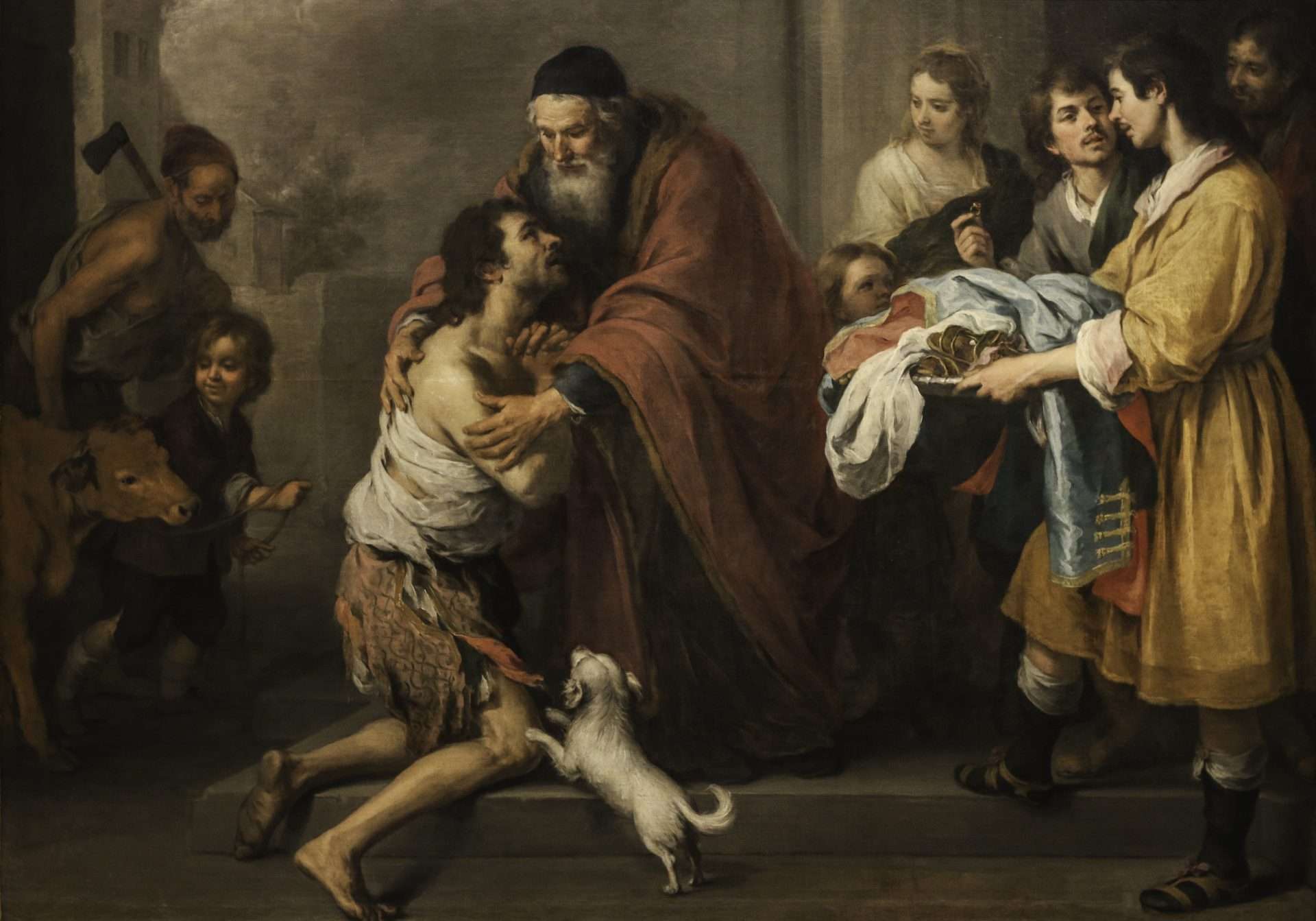
The Return of the Prodigal Son, by Esteban Murillo, 1667-70
Fr Lawrence Lew OP / Creative Commons
LENT 4 | 2025 | THE PRODIGAL SON | Luke 15:1-3, 11-32
The genius of the parables is that they address the hearer or reader on different levels and yet always manage, often in surprising and unexpected ways, to engage us personally. This parable of the prodigal son, one of the best known, is a perfect example of how they initially invite us to attend to the story as spectators, only to find that the parable is about us. The parable of the prodigal son is, on the surface, one of the most reassuring, but read carefully, it is also one of the most discomfiting.
It is universally referred to as the parable of the prodigal son, but it could just as accurately be called the parable of the prodigal father – prodigal, that is, with his generous, unconditional forgiveness – or, given that the behaviour of all three principals would have appeared bizarre, if not scandalous, to those who first heard the parable, the parable of the dysfunctional family.
The ostensible villain is the headstrong, younger son, who asks for his inheritance ahead of his father’s demise, a legally permissible but highly unusual and obviously hurtful request, tantamount to wishing his father dead. But it would also have seriously jeopardised the family fortune by alienating a third, to which, according to Deuteronomy, a younger son was entitled. Most of those who heard this story would have thought the lad deserved a sound beating for asking so brazenly and the father a reproof for acting so unwisely.
The younger son, having received his inheritance, proceeded to fritter it away. Notice that, despite the elder son’s imputation, there is no indication in the story that the younger son’s downfall has been due to debauchery. The word used to describe his conduct merely says that it was profligate. It can imply a riotous life, but not necessarily a dissolute one. Once having exhausted his funds, he turns in desperation to employment. It was bad enough that the wastrel should end up working for a gentile: but that he should earn his meagre keep by tending pigs would have appalled any pious Jew. But whatever the son had been up to in his exile from the family, he now runs out of options and decides, not out of sorrow, note, but necessity, to return home.
The father’s reaction on seeing him in the distance seems to us now natural, given the prospect of a touching reunion. But to his neighbours and house slaves, and to the first hearers of this parable, it would have seemed an outlandishly undignified way to behave, further proof that the father was out of his mind. He runs to meet him. Running was for children and slaves, not the head of a household. The Book of Ecclesiasticus (19:30) says: “A man’s manner of walking tells you who he is”; and in his discussion of the “great-souled man” Aristotle says in the Nicomachean Ethics (IV.3, 1125a) that great men never hurry. Running in public would definitely have been non decet.
So, on one level this parable is about the lavish nature of God’s generosity, seen in the father’s forgiveness of his wayward son, whose confession has not even left his lips before a ring is put on his finger and shoes on his feet. (That last detail would have definitively indicated that he’d been restored to the family: only slaves went barefoot.) But given the context in which the parable was told, it’s obvious that forgiveness is only one element in the story. What prompts Jesus to tell this parable is the Pharisees’ and Scribes’ sneering disapproval of his own enthusiastic association with unsavoury individuals, such as tax- collectors and prostitutes. The parable demonstrates that the Pharisees, despite having minutely observed the letter of the law, had fallen into the only two failings Jesus consistently condemns: self-righteousness and hypocrisy. Their conscientious attention to the detail of the Law had not brought them an inch nearer to God: on the contrary, their obsession with their own virtue had led them unwittingly to substitute an idol for God, a god made in their own image and likeness, as narrow and confining as their neurotic preoccupation with spiritual perfection. Religion had come between them and God; in fact, they had left Him out of consideration altogether.
And there is an even wider context, namely God’s liberation of Israel, referred to in the first reading from Exodus, and what St Paul has to say in the second reading: “anyone in Christ is a new creation … It is all God’s work.” It is a parable about coming alive, stressing that this is the work of grace not something earned or worked for.
But, as with all the parables, there is a sting in the tail. In the final scene, attention shifts to the elder brother. Ostensibly, the father had lost one son, the younger of the two, but it turns out that the elder son, for all his dutiful obedience, is far more seriously lost, because, unlike his younger brother, he doesn’t realise it. The failing of the elder brother is the most destructive and negative of all human reactions, namely, resentment. He begrudges his father’s generosity and fails completely to understand his reaction to his son’s return. For the elder brother, the idea of something being given freely, especially if undeserved, makes no sense.
In this regard, he exemplifies the failing of the Pharisees: he, like them, isn’t so much bad, as blind. He has fulfilled all his duties, kept his hands clean and his copy-book clear and yet something is profoundly wrong. The elder son is trapped in a mindset mesmerised by just deserts and condign punishment, that leaves no room for generosity and forgiveness.
Self-righteousness wasn’t, of course, the preserve of the Pharisee. This gospel was (and is) aimed at Pharisaism wherever and whenever it is found. The self-righteous – or the “entitled” – think they have earned and deserve everything they possess, even their vaunted virtue, by dint of hard work and effort, or by inheritance, that is, not even their own hard work and effort. The truth is that the virtue of the good and the forgiveness of the sinful are equally given, not earned.
And, finally, from a literary point of view, the parable ends oddly: in fact, it hasn’t a real ending at all. We’re deliberately not told whether the elder brother had a change of heart and went into the party. Rather, we’re meant to add the ending ourselves, because the ending concerns not just the elder brother, but each of us. That’s the sting in the tail. The reader is forced to ask: which of the two brothers am I? Am I, like the younger one, aware that I am in need – real need, not just pious need – of forgiveness? Or am I, like the respectable, law-abiding and dutiful elder brother, paralysed by a craving for approval, recognition and reward and blinded by resentment?

Help us keep The Tablet’s voice independent, clear and far-reaching.
Founded in 1840, The Tablet is the leading independent English-language Catholic weekly, celebrated for great writing, astute analysis, brilliant arts and books reviews and trustworthy reporting from correspondents in Britain, Ireland, Rome and across the world.
Independent, high-quality journalism is at the heart of what we do. The Tablet does not have deep pockets and we are not funded by rich donors. If you appreciate our work please consider supporting The Tablet’s Development Fund. It only takes a moment and you can cancel at any time.
- Support with £5 per month
- Support with £10 per month
- Support with other amount.

MOST READ ARTICLES
-
1
Pope returns to Vatican after hospital discharge
-
2
Diverse schools that are 100 per cent Catholic
-
3
Under endless skies
-
4
Battling confession fatigue
-
5
Nigerian bishop scorns suggestion of running in presidential election
-
6
Schismatic Spanish nuns strip contents of convent before eviction
FROM THE EDITOR'S DESK


