Pope Francis condemns US deportations ‘damaging human dignity’


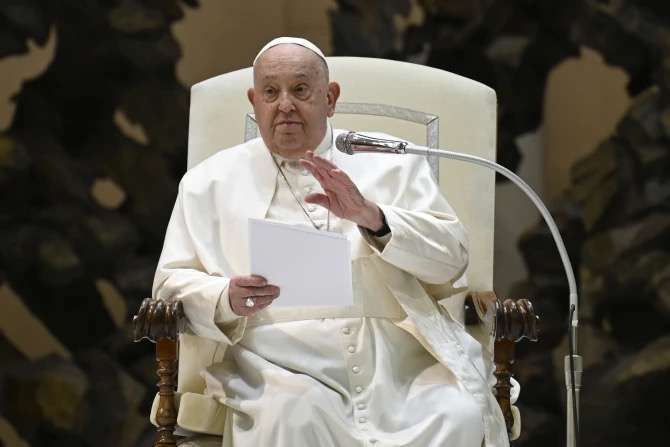
Pope Francis at his general audience in the Paul VI Hall on 5 February.
Vatican Media / CNA
‘This is not a minor issue: an authentic rule of law is verified precisely in the dignified treatment that all people deserve, especially the poorest and most marginalised.’
Pope Francis addressed the bishops of the United States on Tuesday about the mass deportation of unauthorised immigrants, urging Catholics to consider the justice of laws and policies in light of the dignity and rights of people.
In a letter published on 11 February, Francis said a “rightly formed conscience” would disagree with associating the illegal status of some migrants with criminality.
“The act of deporting people who in many cases have left their own land for reasons of extreme poverty, insecurity, exploitation, persecution, or serious deterioration of the environment damages the dignity of many men and women, and of entire families, and places them in a state of particular vulnerability and defencelessness,” he said.
“All the Christian faithful and people of goodwill,” the Pope continued, “are called upon to consider the legitimacy of norms and public policies in the light of the dignity of the person and his or her fundamental rights, not vice versa.”
Pope Francis wrote to the US hierarchy following controversial immigration measures under President Donald Trump’s administration, including the increased deportation of migrants, which numerous bishops have criticised.
The letter recognised the “valuable efforts” of the US bishops in their work with migrants and refugees and invoked God’s reward for their “protection and defence of those who are considered less valuable, less important, or less human”.
Asking Our Lady of Guadalupe to protect all those living in fear or pain due to immigration and deportation, he prayed for a society that is more “fraternal, inclusive, and respectful of the dignity of all” and exhorted Catholics and other people of goodwill “not to give in to narratives that discriminate against and cause unnecessary suffering to our migrant and refugee brothers and sisters”.
Francis emphasised that immigration laws and policies should be subordinated to the dignified treatment of people, especially the most vulnerable.
“This is not a minor issue: an authentic rule of law is verified precisely in the dignified treatment that all people deserve, especially the poorest and most marginalised,” he said.
“The true common good is promoted when society and government, with creativity and strict respect for the rights of all – as I have affirmed on numerous occasions – welcomes, protects, promotes, and integrates the most fragile, unprotected, and vulnerable.”
He said the just treatment of immigrants does not impede the development of policies to regulate orderly and legal migration, but “what is built on the basis of force and not on the truth about the equal dignity of every human being begins badly and will end badly”.
Church agencies warn ‘ruthless’ cuts to US foreign aid threaten lives
Catholic Charities USA urges Trump administration to ‘rethink’ freeze on NGO funding
In his letter, Pope Francis addressed the concept of ordo amoris – “ordered love” – recently invoked by Vice President J.D. Vance in defence of the administration’s policies.
“Christian love is not a concentric expansion of interests that little by little extend to other persons and groups,” Francis said. “In other words: the human person is not a mere individual, relatively expansive, with some philanthropic feelings! The human person is a subject with dignity who, through the constitutive relationship with all, especially with the poorest, can gradually mature in his identity and vocation.”
He continued: “The true ordo amoris that must be promoted is that which we discover by meditating constantly on the parable of the ‘Good Samaritan’, that is, by meditating on the love that builds a fraternity open to all, without exception.”
Francis pointed out the social doctrine of the Church, that even Christ experienced the difficulty of leaving his own land because of a risk to his life and of taking refuge in a foreign society and culture. “The Son of God, in becoming man, also chose to live the drama of immigration,” he wrote.
He cited a passage from Pope Pius XII’s apostolic constitution on the care of migrants Exsul Familia Nazarethana, which he called the Magna Carta of the Church’s teaching on migration: “The family of Nazareth in exile, Jesus, Mary, and Joseph, emigrants in Egypt and refugees there to escape the wrath of an ungodly king, are the model, the example, and the consolation of emigrants and pilgrims of every age and country, of all refugees of every condition who, beset by persecution or necessity, are forced to leave their homeland, beloved family, and dear friends for foreign lands.”
“Likewise,” Pope Francis commented, “Jesus Christ, loving everyone with a universal love, educates us in the permanent recognition of the dignity of every human being, without exception.”
The dangerous fallacies of Donald Trump
Stay updated — add us as a preferred news source on Google:


Help us keep The Tablet’s voice independent, clear and far-reaching.
Founded in 1840, The Tablet is the leading independent English-language Catholic weekly, celebrated for great writing, astute analysis, brilliant arts and books reviews and trustworthy reporting from correspondents in Britain, Ireland, Rome and across the world.
Independent, high-quality journalism is at the heart of what we do. The Tablet does not have deep pockets and we are not funded by rich donors. If you appreciate our work please consider supporting The Tablet’s Development Fund. It only takes a moment and you can cancel at any time.
- Support with £5 per month
- Support with £10 per month
- Support with other amount.

MOST READ ARTICLES
-
1
Archbishop of Cardiff-Menevia meets with other worldwide Catholic Church leaders to discuss liturgy
-
2
Let there be light
-
3
World Humanitarian Day: aid workers face a ‘crisis of protection’
-
4
Ruling allows French private hospitals limited exemption from assisted suicide
-
5
A tract for our times
-
6
The wisdom of the saints
FROM THE EDITOR'S DESK