Ukraine approves ban on Russian-linked Churches


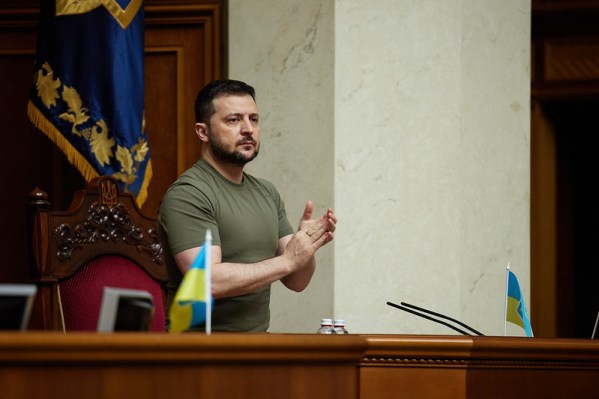
President Volodymyr Zelenskiy in the Ukrainian parliament in May 2022.
President of Ukraine
Ukraine’s parliament adopted a law restricting religious organisations affiliated or connected with Russia.
The Verkhovna Rada voted on Draft Law 8371 on Tuesday, passing it with a majority of 265 in favour and 29 against, bringing it to President Volodymyr Zelenskiy for approval.
The Ukrainian Orthodox Church (UOC), still canonically tied to the Russian Orthodox Church, was expected be the organisation most affected by the legislation.
Authorities in Kyiv have accused the Church, headed by 79-year-old Metropolitan Onufry, of being an extension of the Russian Orthodox Church. State officials have been working to reduce Moscow’s influence in Ukrainian society since Russia illegally annexed Crimea in 2014 and its proxy forces seized parts of the Donetsk and Luhansk regions.
Under the new legislation, religious organisations ruled by courts to have links with links Moscow would face a ban if they cannot sever them within nine months since the entry into force of the legislation.
A state body (the State Service of Ukraine for Ethnopolitics and Freedom of Conscience) and religious experts will conduct the assessments upon which courts will rule on termination of activities.
President Zelenskiy announced the legislation last week when he called for its adoption on national security grounds, to strengthen Ukraine’s “spiritual independence”.
“A draft law has been submitted to the Verkhovna Rada that can realistically guarantee that there will be no manipulation of the Ukrainian Church by Moscow,” he said. “This draft law should work and contribute to the unity of Ukraine, our true spiritual unity.”
Zelenskiy commended the parliament’s decision and said he would hold talks with representatives of the Ecumenical Patriarchate. His chief of staff Andriy Yermak responded to the vote in a social media post: “There will be no Moscow Church in Ukraine.”
On 16 August, the All-Ukrainian Council of Churches and Religious Organisations, representing different religious confessions across Ukraine, had endorsed the draft legislation.
The Russian Orthodox Church has repeatedly offered ideological support for Vladimir Putin’s invasion of Ukraine, most notably in the declaration in March from Patriarch Kirill of Moscow that it was a “Holy War”.
The UOC protested against the legislation, which it said was “persecution” designed to ban its operations. It adopted changes in its statutes soon after the Russian invasion in 2022, declaring independence from Moscow.
However, authorities in Kyiv accused its hierarchy of maintaining links to Moscow and supporting the invasion. More than 100 criminal proceedings have been launched against UOC clergy since the invasion, largely on national security charges.
Stay updated — add us as a preferred news source on Google:


Help us keep The Tablet’s voice independent, clear and far-reaching.
Founded in 1840, The Tablet is the leading independent English-language Catholic weekly, celebrated for great writing, astute analysis, brilliant arts and books reviews and trustworthy reporting from correspondents in Britain, Ireland, Rome and across the world.
Independent, high-quality journalism is at the heart of what we do. The Tablet does not have deep pockets and we are not funded by rich donors. If you appreciate our work please consider supporting The Tablet’s Development Fund. It only takes a moment and you can cancel at any time.
- Support with £5 per month
- Support with £10 per month
- Support with other amount.

MOST READ ARTICLES
-
1
Archbishop of Cardiff-Menevia meets with other worldwide Catholic Church leaders to discuss liturgy
-
2
Let there be light
-
3
World Humanitarian Day: aid workers face a ‘crisis of protection’
-
4
Ruling allows French private hospitals limited exemption from assisted suicide
-
5
A tract for our times
-
6
The wisdom of the saints
FROM THE EDITOR'S DESK