Do not blame Ukrainians, priest urges Poles after surviving knife attack


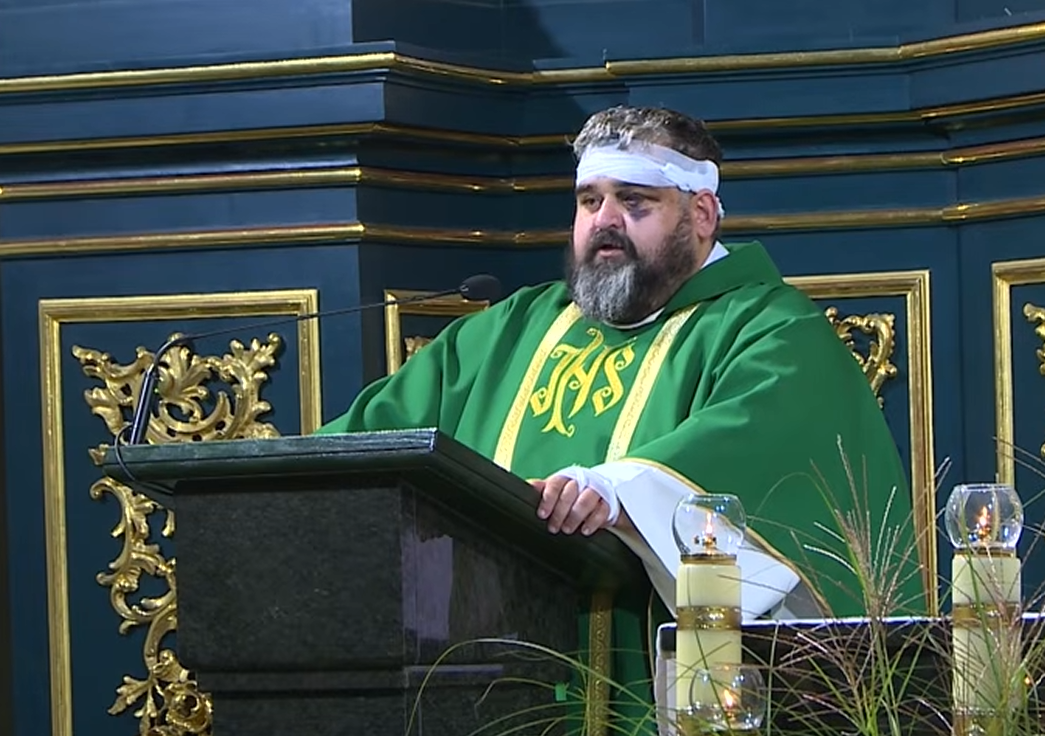
Fr Adrian Mantykiewicz was sufficiently recovered to celebrate Mass in the Benedictine Sisters’ abbey church on Saturday.
tvn24 / Youtube screenshot
Bishop Krzysztof Zadarko of Koszalin-Kołobrzeg said the attack at the Jarosław abbey must not become a pretext for inciting hatred and aggression against Ukrainians, which has been mounting for several months.
A priest who survived a knife attack by a Ukrainian man at a Benedictine abbey urged Poles not to blame the entire Ukrainian people for the assault.
Fr Adrian Mantykiewicz was preaching at a Mass on Saturday after the attack at the Benedictine Sisters’ abbey in Jarosław on 24 September, in which 72-year-old Fr Stanisław Zbojnowicz died and four people were injured.
Ukraine’s President Volodymyr Zelenskyy immediately condemned the attack, expressing his condolences for the victims and calling for a swift and thorough investigation into all the circumstances. His sentiments were echoed in statements from Poland’s Prime Minister Donald Tusk and President Karol Nawrocki.
The Catholic bishops of Ukraine also issue a statement, in which they condemned the crime, expressed their condolences to all the victims and their loved ones, and offered “prayers for eternal life for Fr Stanisław Zbojnowicz and for the speedy recovery of the injured priests and the faithful. Any such act of violence must be justly punished.”
Fr Mantykiewicz was sufficiently recovered to celebrate Mass on Saturday, still with bandages on his head and arm and visible bruising on his face.
“I would also like to ask you not to blame the people to whom our attacker belongs,” the priest said, referring to the 31-year-old Ukrainian national suspected of the assault. He also called for prayers for the attacker himself: “We must overcome the evil that occurred in our abbey with love and forgiveness.”
According to the Zaxid.net outlet, the 31-year-old Ukrainian national, named as Ihor M., intended to return to his homeland from Germany, where he had been living for several years, via the Korczowa-Krakovets crossing point near Jarosław. However, the border guards denied him entry because he lacked car insurance.
The vehicle was towed to Jarosław, where he went to retrieve it and arrange for insurance. However, according to Zaxid.net, the Ukrainian later “changed his mind” and headed to the town’s abbey, where he stole a kitchen knife and began attacking random people.
The abbey had been a refugee centre since the beginning of the Russian invasion in February 2022, housing hundreds of Ukrainians from across the border. A few of them still live there.
On 25 September, speaking in Warsaw ahead of the World Day of Migrants and Refugees, Bishop Krzysztof Zadarko of Koszalin-Kołobrzeg said the attack must not become a pretext for inciting hatred and aggression against Ukrainians, which has been mounting for several months.
“When we look at social media, we see that this incident has fuelled an outpouring of aggression and artificially incited hatred against Ukrainians,” the bishop said. “Shifting the responsibility for these events from one person to an entire ethnic or national group is an abuse and a scandal.”
Ukrinform reported that experts have diagnosed the suspect with mental disorders, such as “acute, polymorphic psychotic disorders”, as well as severe psychomotor agitation, impaired logical thinking and an inability to engage in coherent communication.
Małgorzata Taciuch-Kurasiewicz, spokesperson for the District Prosecutor’s Office in Przemyśl, said the suspect’s current mental state renders him unable to participate in procedural actions. “We certainly will not be conducting any actions involving the suspect, Ihor M., today or in the near future,” she said, adding that the prosecutor’s office will petition the court for his temporary detention.
In late August, the Permanent Council of the Polish Bishops issued an official statement condemning reports of growing aggression between Poles and Ukrainians. The statement highlighted the sharp contrasts of these hostile incidents with the profound solidarity and comprehensive humanitarian aid that Polish citizens and organisations have provided to Ukrainian refugees since February 2022.
“We appeal to believers and non-believers alike, and to all people of goodwill in Poland, to seek above all a spirit of reconciliation and Christian love in Polish-Ukrainian relations,” the statement said.
“We appeal for an honest historical dialogue so that the dark chapters of our shared history may be fully clarified. We also appeal to everyone not to fuel nationalistic sentiments directed against anyone. We further appeal to the state authorities to take more effective measures to prevent incidents motivated by national animosity, while ensuring that the law is respected by everyone residing in our country.”
The young people of Poland putting their lives on hold to help refugees from Ukraine
Nationalism and reconciliation in Poland and Germany
Stay updated — add us as a preferred news source on Google:


Help us keep The Tablet’s voice independent, clear and far-reaching.
Founded in 1840, The Tablet is the leading independent English-language Catholic weekly, celebrated for great writing, astute analysis, brilliant arts and books reviews and trustworthy reporting from correspondents in Britain, Ireland, Rome and across the world.
Independent, high-quality journalism is at the heart of what we do. The Tablet does not have deep pockets and we are not funded by rich donors. If you appreciate our work please consider supporting The Tablet’s Development Fund. It only takes a moment and you can cancel at any time.
- Support with £5 per month
- Support with £10 per month
- Support with other amount.

MOST READ ARTICLES
-
1
Pope returns to Vatican after hospital discharge
-
2
Diverse schools that are 100 per cent Catholic
-
3
Under endless skies
-
4
Battling confession fatigue
-
5
Nigerian bishop scorns suggestion of running in presidential election
-
6
Schismatic Spanish nuns strip contents of convent before eviction
FROM THE EDITOR'S DESK


