Leo puts pontificate under Marian protection on first anniversary


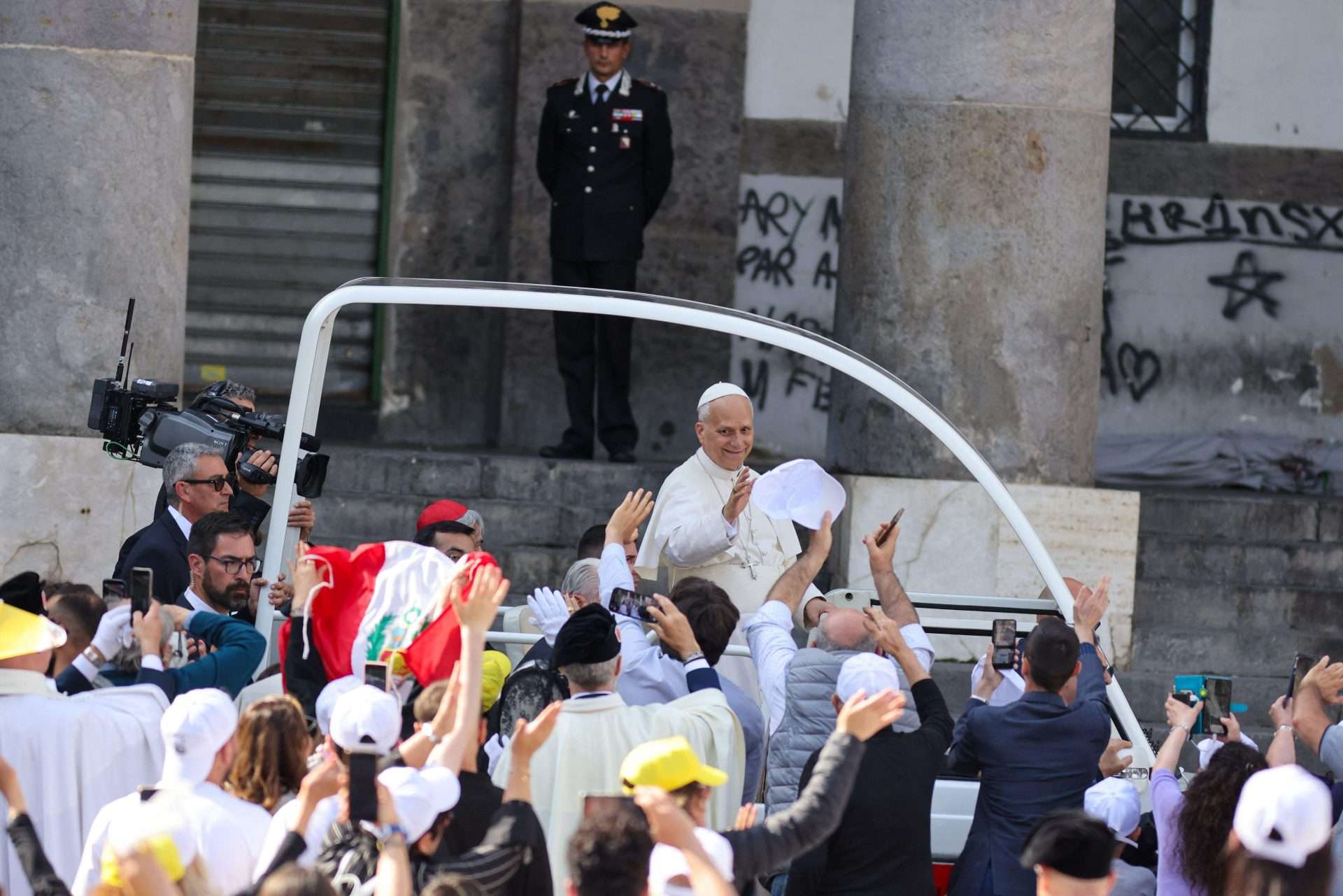
The Pope addressed a crowd of 50,000 in Piazza del Plebiscito at the conclusion of his visit to Naples.
Fabio Sasso / ZUMA Press Wire / Alamy
‘The wars still being fought in so many regions of the world call for a renewed commitment, not only economic and political but also spiritual and religious. Peace is born within the heart.’
Pope Leo marked the first anniversary of his election on a visit to Pompeii and Naples in southern Italy.
Preaching at a Mass at the Shrine of Our Lady of Pompeii on Friday, the Pope recalled that the conclave elected him on 8 May 2025, the Feast of Our Lady of Pompeii.
“So I had to come here, to place my service under the protection of the Blessed Virgin,” he said.
He noted that he chose his name in succession to Leo XIII, who wrote extensively on the Rosary, and that he himself canonised St Bartolo Longo – the “Apostle of the Rosary” who founded the shrine in the 1870s – on 19 October last year.
Earlier in the day, Leo addressed charitable organisations working at the sanctuary, reflecting on the saint’s emphasis on the inseparability of faith and charity.
“Here the ‘Temple of Faith’ and the ‘Temple of Charity’ support each other,” Leo said, calling the Rosary “the hidden engine that makes all the rest possible”.
In his homily at the Mass in square in front of the shrine, the Pope described the Rosary as a prayer that “arose and developed progressively in the second millennium, burying its roots in the history of salvation”.
“Generations of believers have been shaped and nurtured by this prayer, simple and popular and at the same time containing the highest mysteries and a treasure chest of the most essential Christian theology,” he said.
The Pope commemorated the Year of the Rosary called by St John Paul II on 16 October 2002 with the apostolic letter Rosarium Virginis Mariae, which introduced the Luminous Mysteries. John Paul II concluded the year the following October with a pilgrimage to Pompeii.
The letter, Leo said, had two particular intentions: “the family, which is affected by the weakening of marital bonds, and peace, endangered by international tensions and by an economy that prefers the arms trade to respect for human life”.
“The times have not improved since then,” he continued. “The wars that are still being fought in so many regions of the world call for a renewed commitment, not only economic and political but also spiritual and religious. Peace is born within the heart.”
Leo prayed for “an overflowing outpouring of mercy, touching hearts, calming resentment and fratricidal hatred, and enlightening those who bear special responsibilities of government”.
In Naples later that day, Pope Leo again emphasised the importance of social action as an expression of faith, urging the city’s clergy and Religious to show Christ’s “care” in response to “neglect”.
“In a city marked by inequality, youth unemployment, school dropouts and family instability, the proclamation of the Gospel cannot be separated from a concrete and supportive presence that involves everyone – priests, Religious, and laypeople alike,” he said during an audience in the Cathedral of the Assumption.
Afterwards, Leo addressed a crowd of 50,000 in Piazza del Plebiscito, praising the city’s beauty but warning that it was also experiencing a “dramatic paradox” of social inequality. He said it should not just be “a simple ‘postcard’ for visitors” but “a place to build a concrete peace, observable in people’s daily lives”.
“We know, in fact, that there can be no peace without justice, and that for justice to be authentic it cannot be separated from charity,” he continued.
“Brothers and sisters, Naples needs this jolt, this disruptive energy of goodness, the evangelical courage that makes it possible to renew all things.”
On first anniversary of election, Pope Leo XIV lauded as ‘clear and consistent’ voice for peace
Stay updated — add us as a preferred news source on Google:


Help us keep The Tablet’s voice independent, clear and far-reaching.
Founded in 1840, The Tablet is the leading independent English-language Catholic weekly, celebrated for great writing, astute analysis, brilliant arts and books reviews and trustworthy reporting from correspondents in Britain, Ireland, Rome and across the world.
Independent, high-quality journalism is at the heart of what we do. The Tablet does not have deep pockets and we are not funded by rich donors. If you appreciate our work please consider supporting The Tablet’s Development Fund. It only takes a moment and you can cancel at any time.
- Support with £5 per month
- Support with £10 per month
- Support with other amount.

MOST READ ARTICLES
-
1
Pope returns to Vatican after hospital discharge
-
2
Diverse schools that are 100 per cent Catholic
-
3
Under endless skies
-
4
Battling confession fatigue
-
5
Nigerian bishop scorns suggestion of running in presidential election
-
6
Schismatic Spanish nuns strip contents of convent before eviction
FROM THE EDITOR'S DESK


