WCCM Theme 2026: The Future of Religion (Recording)


Since human beginnings, religion and culture have been intertwined. At its best this means that the eternal can be felt in all the ordinary passages of human life. But too often religion has become over-absorbed in this-worldliness, in power-elites, resistance to change and even actively opposed to true human liberation. As we deal with the intense changes of the third millennium and struggle against our technological hubris even to remain human – what, if any, is the role of religion? Is it just the promotion of ‘self-development’ or merely a temporary escape from the stresses of a malfunctioning society?
Can the great religious families of humanity be true to their perennial wisdom and unite in their essence to realize human potential in transcendence. Are we in a new ‘axial age’ where religion itself is changing and expressing the next step in human evolution? Can the three elements of religion – intellectual, institutional and mystical – be rebalanced to birth a new world in which the best potential of humanity is celebrated and realized?
This year’s theme for the global family of WCCM offers opportunities for creative dialogue across faiths and cultures as well as for a deeper ecumenism. The online series of speakers on the theme throughout the year offers a unique fusion of original and deeply grounded thinkers concerning something on which humanity’s future depends.
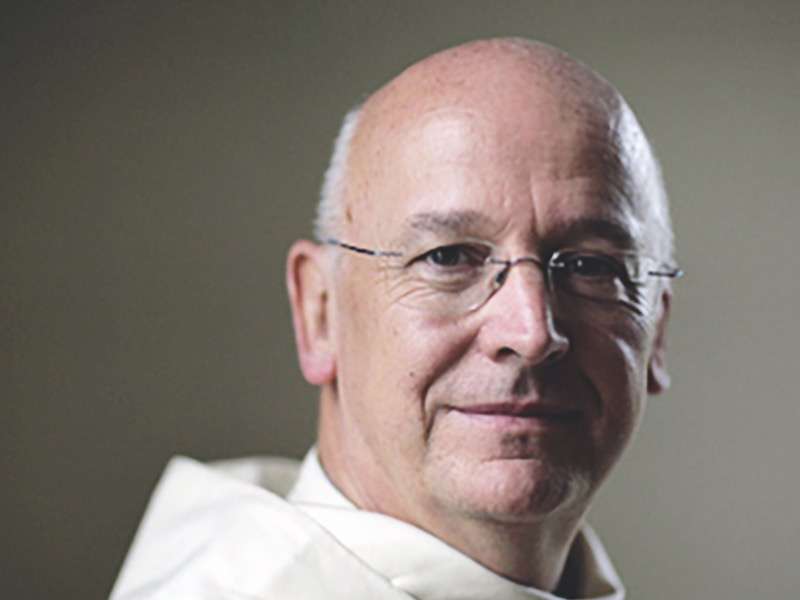
Speaker: Laurence Freeman OSB
Respondent: Sean Hagan
What is the future role of religion? In his talk, Fr Laurence Freeman will explore whether the three elements of religion – intellectual, institutional and mystical – can be rebalanced to birth a new world in which the best potential of humanity is celebrated and realized.
Within WCCM, our own contribution to this question is to understand the role of contemplation: that at the heart of every religion there is a contemplative or mystical dimension. Without a properly developed mystical dimension, the other two elements hijack the project of religion. The deep source of authentic religion must always be the mystical. It is the personal and collective experience of God, of ultimate reality, and of the meaning and purpose of all things.
Back to Basics: Exploring the Point of Nothingness
Speaker: Tim Shriver
Respondent: Laurence Freeman
Tim will explore the relationship between meditation, the experience of Murton’s point of nothingness, and the emergence of a future grounded of religious experience.
Speaker: Dr Iain McGilchrist
Respondent: Marco Schorlemmer
Our civilisation cannot survive without a return to spiritual values, and those values will not flourish without embodiment in the form of a religion. Since the Enlightenment, we have comprehensively misunderstood the nature of religion, and neglected the vital importance of nurturing the spiritual life. This has to do with a shift in the history of ideas, ultimately reinforced by changes in brain function over this period.
Encountering Nothing in Everything That Is
Speaker: Elliot R. Wolfson
In this lecture, I will explore the encounter with nothingness that may be elicited the kabbalah, the Jewish mystical tradition, but I will also draw comparatively from Christian, Islamic, and Buddhist sources. Without reducing the rich diversity that colors these respective paths of spiritual disciplines, it is still possible to identify a common denominator that celebrates rather than flattens multiples facets of the truth. To think the nothing is the vantage point whence we deduce the hypothesis that the irrational is a constituent facet of the rational in the manner that the nonconceptual is an integral aspect of the conceptual. Inexorably, the modality of thought, which provides the speculative scaffolding of the edifice of a mystical religion, is a thinking that surpasses the periphery of thinking, a thinking that leads consciousness to think the unthought. Contrary to a commonly held opinion, the unthought is not what is inherently unthinkable; it is rather the essential thought that is boundlessly thinkable, that is, the thought that must be continuously rethought and therefore is prevented from ever becoming an object that is no longer underway to being thought. The unthought is thus the mystery that pervades all thought as the capacity to be thought unremittingly in the curvature of time.
Speaker: Sheikh Kabir Helminski
Respondent: Murshida Amat-Un-Nur
What purpose could religion have greater than connecting the human being with the Source of Life, with a reality greater than the reality constructed by human ego? The ego has little access to the dimension of experience which is truly sacred. Instead, it builds a false edifice of beliefs, inherited customs, and judgments. Religion fails when it is merely the servant of social custom and power. Human beings long for an experience of the sacred, beyond mere emotional stimulation and dogmatic beliefs. The path to human awakening and spiritual maturity lies in an objective knowledge of spiritual reality, of the nature of the self, and the self’s need for communion with that greater Reality.
Emphasizing Compassion in Times of Uncertainty
Speaker: Matthieu Ricard
The future of religion may well rest on the shared cultivation of wisdom and compassion. If religious traditions can sincerely reaffirm the call to love, to care for others, and to refrain from harm, they will remain deeply relevant. Such an orientation must be grounded in genuine inner transformation. In an uncertain and fragile world, religions will retain their meaning to the extent that they offer individuals the means to tame destructive mental states — such as hatred, greed, and pride — and to foster solidarity through a clear recognition of our common humanity. Altruistic love and compassion, which lie at the very foundation of all religious traditions, provide the common ground where they can meet and work together. From a Buddhist perspective, interreligious harmony is therefore not merely desirable but a profound necessity, essential for collaborating toward a more humane and compassionate world.
From Ideology to Practice: Religious Integrity as “Doing the Truth”
Speaker: Rowan Williams
I want to think about the difference between religion as primarily theory and description of the world, and religious or spiritual practice as the finding of a place within the world by work on oneself and one’s relation with what lies beyond the ego, the liberation of awareness of self and environment.
Bishop Rowan Williams has recently retired as Master of Magdalene College, Cambridge, and before that was Archbishop of Canterbury from 2002 to 2012. He has written widely on theology, spirituality and literature, and his most recent books include Candles in the Dark and (with Mary Zournazi) Justice and Love: A Philosophical Dialogue. He has a long history of engagement with WCCM.
To purchase the recording of any of these events, please click here

Help us keep The Tablet’s voice independent, clear and far-reaching.
Founded in 1840, The Tablet is the leading independent English-language Catholic weekly, celebrated for great writing, astute analysis, brilliant arts and books reviews and trustworthy reporting from correspondents in Britain, Ireland, Rome and across the world.
Independent, high-quality journalism is at the heart of what we do. The Tablet does not have deep pockets and we are not funded by rich donors. If you appreciate our work please consider supporting The Tablet’s Development Fund. It only takes a moment and you can cancel at any time.
- Support with £5 per month
- Support with £10 per month
- Support with other amount.

MOST READ ARTICLES
-
1
Pope returns to Vatican after hospital discharge
-
2
Diverse schools that are 100 per cent Catholic
-
3
Under endless skies
-
4
Battling confession fatigue
-
5
Nigerian bishop scorns suggestion of running in presidential election
-
6
Schismatic Spanish nuns strip contents of convent before eviction
FROM THE EDITOR'S DESK


