Churches secure limited Holy Sepulchre access for Easter liturgies


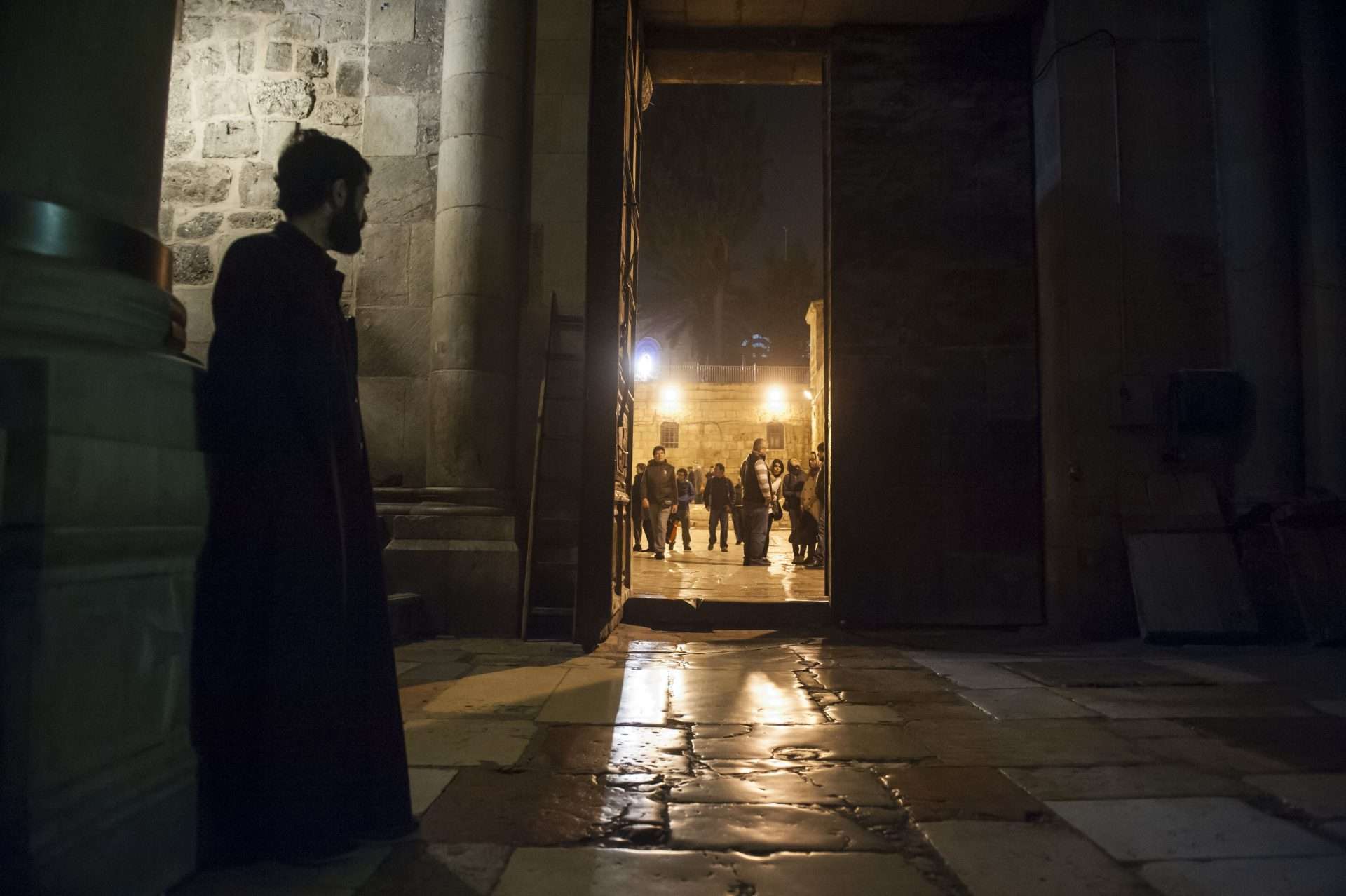
Entrance to the Church of the Holy Sepulchre
Catholic Church in England and Wales / Mazur
‘Especially in times of hardship and conflict, such as those presently endured, safeguarding the freedom of worship remains a fundamental and shared duty.’
Israeli authorities confirmed that local Church leaders would have access to the Church of the Holy Sepulchre for Holy Week after preventing Catholic clergy from celebrating Mass there on Palm Sunday.
The Latin Patriarch of Jerusalem Cardinal Pierbattista Pizzaballa and the Custos of the Holy Land Fr Francesco Ielpo OFM published a joint protest on Sunday after police barred them from entering the church that morning.
They insisted that their liturgy without any public gathering would not breach security rules introduced due to the threat of Iranian rocket attacks on the city. Religious and political leaders around the world condemned the police action as a violation of religious freedom.
On Monday, the Latin Patriarchate of Jerusalem and the Custody of the Holy Land issued another joint statement to “confirm that the matters concerning the Holy Week and Easter celebrations at the Church of the Holy Sepulchre have been addressed and resolved in coordination with the relevant authorities”.
“In agreement with the Israel Police, access for representatives of the Churches has been secured in order to conduct the liturgies and ceremonies and to preserve the ancient Easter traditions at the Church of the Holy Sepulchre,” they said.
The statement said that because “existing restrictions on public gatherings remain in force” the Churches would “ensure that the liturgies and prayers are broadcast live to the faithful in the Holy Land and throughout the world”.
“We wish to emphasise that religious faith constitutes a supreme human value, shared by all religions, Jews, Christians, Muslims, Druze and others,” it continued. “Especially in times of hardship and conflict, such as those presently endured, safeguarding the freedom of worship remains a fundamental and shared duty.”
The patriarchate and the Custody thanked Israel’s President Isaac Herzog “for his prompt attention and valued intervention”, as well as other officials “who acted swiftly to convey their firm positions, many of whom personally reached out to express their closeness and support”.
Herzog said he called Cardinal Pizzaballa on Sunday to express “great sorrow” at the incident and to confirm his “unwavering commitment to freedom of religion for all faiths and to upholding the Status Quo at the holy sites of Jerusalem”.
Israeli police issued a statement after the incident saying the Palm Sunday Mass could not take place because Jerusalem’s “Old City and the holy sites constitute a complex area that does not allow access for large emergency and rescue vehicles, which significantly challenges response capabilities and poses a real risk to human life in the event of a mass casualty incident”.
That evening, Israel’s Prime Minister Benjamin Netanyayhu announced that he had directed the Jerusalem authorities that Pizzaballa “be granted full and immediate access to the Church of the Holy Sepulchre” so that he “may hold services as he wishes”.
This followed international protests including from Spain’s socialist Prime Minister Pedro Sanchez, who called the police action “an unjustified attack on religious freedom”, and Italy’s conservative Prime Minister Giorgia Meloni who said it was “an offence not only to the faithful, but to any community that respects religious freedom”.
The Italian foreign ministry summoned the Israeli ambassador to explain the incident while the French President Emmanuel Macron demanded respect “for all religions” in Jerusalem.
The US Ambassador to Israel Mike Huckabee, an avowed Christian Zionist, said the police action was “an unfortunate overreach already having major repercussions around the world”.
“Home Front Command Guidelines restrict any gatherings to 50 people or less,” he wrote on social media, referring to the wartime security restrictions. “The four representatives of the Catholic Church [on Palm Sunday] were well below that restriction.”
Pope condemns ‘scandal’ of war as Jerusalem cancels Palm Sunday procession
Stay updated — add us as a preferred news source on Google:


Help us keep The Tablet’s voice independent, clear and far-reaching.
Founded in 1840, The Tablet is the leading independent English-language Catholic weekly, celebrated for great writing, astute analysis, brilliant arts and books reviews and trustworthy reporting from correspondents in Britain, Ireland, Rome and across the world.
Independent, high-quality journalism is at the heart of what we do. The Tablet does not have deep pockets and we are not funded by rich donors. If you appreciate our work please consider supporting The Tablet’s Development Fund. It only takes a moment and you can cancel at any time.
- Support with £5 per month
- Support with £10 per month
- Support with other amount.

MOST READ ARTICLES
-
1
Archbishop of Cardiff-Menevia meets with other worldwide Catholic Church leaders to discuss liturgy
-
2
Let there be light
-
3
World Humanitarian Day: aid workers face a ‘crisis of protection’
-
4
Ruling allows French private hospitals limited exemption from assisted suicide
-
5
A tract for our times
-
6
The wisdom of the saints
FROM THE EDITOR'S DESK