In Jerusalem’s Old City, an ancient Armenian community fears for its future


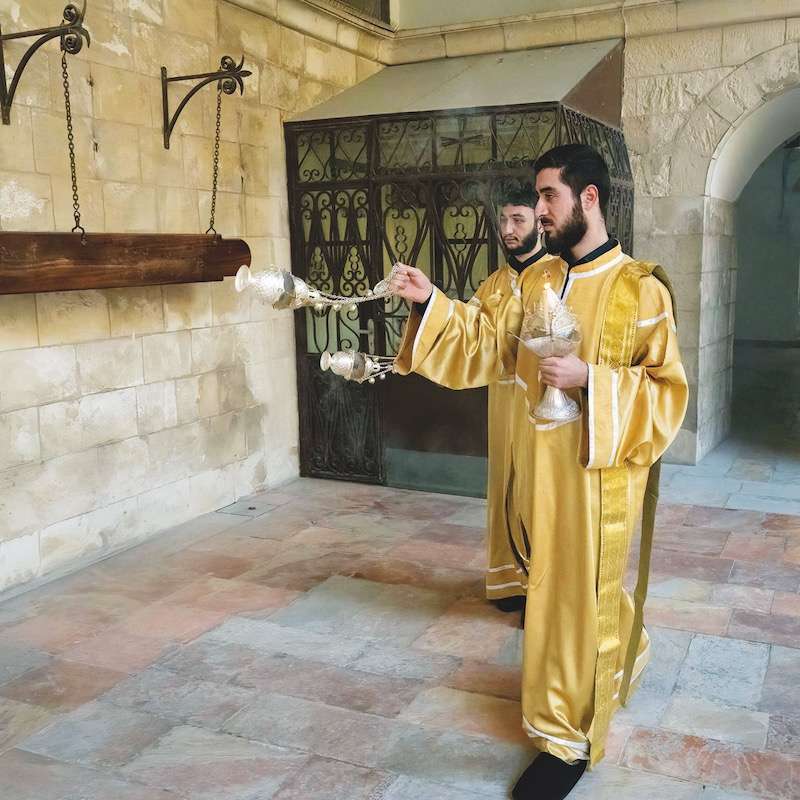
Armenian priests swing burning thuribles outside St James’s Cathedral in Jerusalem
Alamy, Moshe Einhorn
The jewel in the crown of the 220-acre Armenian Quarter is St James’s monastery, now at the centre of a storm that touches on identity, history, politics, memory and dignity.
“I’m Armenian.” “Oh, you’re Albanian? I was in Tirana recently and I liked it a lot! By the way, do you all still speak Aramaic?”
To say that I was gobsmacked would not be much of an exaggeration. I’d never before been asked if I spoke the language of Jesus. And who would wish to have their identity and heritage so summarily swept away by such erroneous assumptions, even if they were made innocently by a momentary acquaintance I had met at a conference?
Misunderstandings are not uncommon. Few in the UK have heard of the Armenians, despite the fact that there are an estimated 10 million of us. Three million reside in the Republic of Armenia itself; there is a vast diaspora, quite different culturally, with large communities in Russia, the US, France, Australia, Georgia, Iran, Lebanon, Syria, Argentina and Canada. One of the oldest communities in the diaspora is in Jerusalem, where some 2,000 Armenians live, largely centred around the Armenian Quarter in the Old City. The first recorded Armenian pilgrimage to the Holy Land was in the early fourth century. The jewel in the crown of this small geographical space – just 220 acres – is St James’s monastery, which houses the Armenian Apostolic Church’s Jerusalem Patriarchate, a school that teaches Armenian, English, Arabic and Hebrew, a seminary, a library, a museum housing precious manuscripts and rare artefacts, and a cemetery.
Get Instant Access
Continue Reading
Register for free to read this article in full
Subscribe for unlimited access
From just £37.50 quarterly
Print copy of The Tablet delivered directly to your door.
Complete access to all Tablet website content including all premium content.
Access to the weekly digital copy of The Tablet.
Full access to The Tablet’s archive – over 180 years of back issues.

Already a subscriber? Login

Help us keep The Tablet’s voice independent, clear and far-reaching.
Founded in 1840, The Tablet is the leading independent English-language Catholic weekly, celebrated for great writing, astute analysis, brilliant arts and books reviews and trustworthy reporting from correspondents in Britain, Ireland, Rome and across the world.
Independent, high-quality journalism is at the heart of what we do. The Tablet does not have deep pockets and we are not funded by rich donors. If you appreciate our work please consider supporting The Tablet’s Development Fund. It only takes a moment and you can cancel at any time.
- Support with £5 per month
- Support with £10 per month
- Support with other amount.

MOST READ ARTICLES
-
1
Pope returns to Vatican after hospital discharge
-
2
Diverse schools that are 100 per cent Catholic
-
3
Under endless skies
-
4
Battling confession fatigue
-
5
Nigerian bishop scorns suggestion of running in presidential election
-
6
Schismatic Spanish nuns strip contents of convent before eviction
FROM THE EDITOR'S DESK