Why Advent is for a lifetime, not just one month


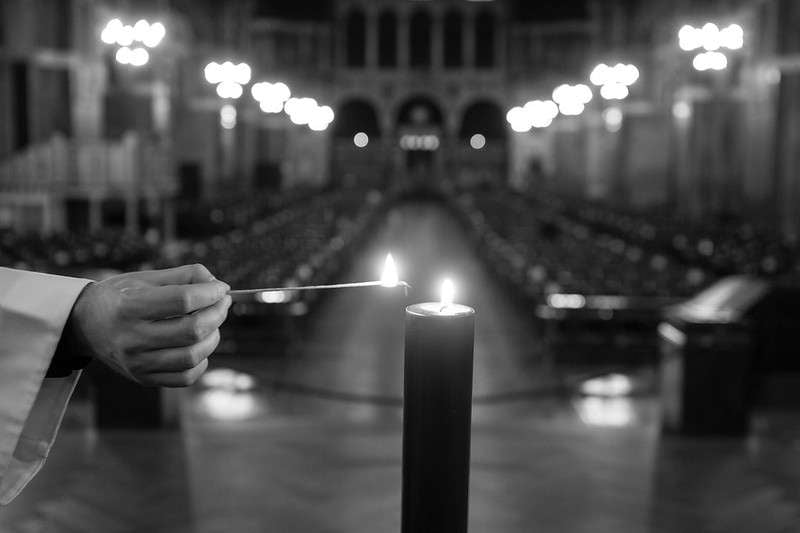
To repent, or to reposition ourselves vis à vis our ultimate goal, namely, the God who is perfect happiness, is to change our whole modus operandi by giving grace a chance
© Mazur/cbcew.org.uk
SECOND SUNDAY OF ADVENT | 8 DECEMBER 2024
LUKE 3:1-6
The contrast in the opening verses of today’s gospel between, on the one hand, a rollcall of power and status – Emperor, Governor, Tetrarch, Pontiff – and, on the other, the stark, ascetical figure of John the Baptist, is drawn deliberately by Luke, in order to make crystal clear from the very beginning of his Gospel that the Good News originates not in the palaces of potentates or places of learning, not even in places of worship, but in the wilderness; and not only the outer wilderness of the desert, but the inner wilderness, the inner recesses of ourselves. Both are demanding places, where cherished illusions are impossible to sustain: solitude makes a nonsense of them all, especially our masks and camouflages. In complete solitude, we cannot but be conscious of the gap between what we’ve become by our own free choices and what we were made to be by God’s choice.
In the solitude of our inner wilderness, we’re forced to come to terms with ourselves as we are, as opposed to how we’d like to be or how we’d like others to think we are. Little wonder that for many, solitude is unbearable, something to be avoided at all costs. But, however painful or discomfiting, it is only by entering the wilderness within that we are enabled to acknowledge not just the truth about ourselves, but Truth Itself. In that inner wilderness, we have no choice but to acknowledge and confront our needs, weaknesses, temptations and failings. But it is precisely in that honest confrontation that we encounter God, because it is only in that primal act of honesty that are our hearts are prised open, so that God, in his infinite courtesy, may make his presence felt, precisely in the space that to us might seem like emptiness. The book of Revelation expresses it exquisitely: “Behold, I stand at the door, and knock. If anyone shall hear my voice, and open the door to me, I will come in to him, and will sup with him, and he with me.” (Rev 3:20)
That’s the invitation that John the Baptist vicariously offered to those who, doubtless out of sheer curiosity, came out to the wilderness of Judea to see and hear him. He invited them to enter their own inner wilderness, to “prepare a way for the Lord”, to repent, in other words. Repentance inevitably involves clearing away a lot of clutter that would hinder God’s entering in: first and foremost, of course, our sins. But it also involves shedding our precious illusions, none more than the crippling illusion of selfsufficiency, expressed nowhere more damagingly that in the drive within all of us to be in control. The first step in repentance is to give up our futile struggle to be in control at all costs, both of our own lives and those of others, the poisonous fruit of which is anxiety. Anxiety, along with petty mindedness and a failure of imagination, lies at the root of most of our sins. Counterintuitively, much of our time and nervous energy is spent, consciously or unconsciously, seeking to calm anxiety by securing control. Seeking total control, however, ineluctably distorts our judgment about everything, including ourselves, but especially about others. Hence our tendency to rate ourselves and others by the degree of control we, or they, manifest in titles, position, power and possessions. In such a situation so inimical to genuine human flourishing, everyone becomes a rival, friendship becomes impossible. Little surprise, then, that our Lord tells us again and again, in the Sermon on the Mount, for instance, about the utter futility of seeking always to be in control and the concomitant anxiety: “Do not be anxious about what you shall eat and drink and wear…which of you by being anxious can add one cubit to his span of life?” (Matt 6:25) Instead, he tells us to seek first the Father’s kingdom and goodness, and all anxiety will fall away.
To repent, or to reposition ourselves vis à vis our ultimate goal, namely, the God who is perfect happiness, is to change our whole modus operandi by giving grace a chance, rather than supplanting it in a bid for power and control. (Wasn’t it a bid for power and control that happened in the Garden of Eden?) In practical terms, then, to repent is, first and foremost, to give up being anxious about tomorrow and, instead, to trust in God’s all-encompassing providence. Think of the difference it would make if we truly trusted: no longer would we feel the need to horde our possessions and fight all comers to keep them; no longer would we fret about our reputation and do anything to preserve it; no longer would we need to win every argument or get our own way in everything. Instead, we would rejoice and relax in true freedom, the freedom of God’s sons and daughters, at home in his creation, safe in his hands and secure under his providence. One of the oldest parts of the Mass in the Roman Rite is the prayer after the Our Father to be delivered not just from all evil but also from all anxiety (ab omni perturbatione), “as we await the blessed hope and the coming of our Saviour, Jesus Christ”: a perfect prayer for Advent, as long as you remember that Advent lasts all our life.

Help us keep The Tablet’s voice independent, clear and far-reaching.
Founded in 1840, The Tablet is the leading independent English-language Catholic weekly, celebrated for great writing, astute analysis, brilliant arts and books reviews and trustworthy reporting from correspondents in Britain, Ireland, Rome and across the world.
Independent, high-quality journalism is at the heart of what we do. The Tablet does not have deep pockets and we are not funded by rich donors. If you appreciate our work please consider supporting The Tablet’s Development Fund. It only takes a moment and you can cancel at any time.
- Support with £5 per month
- Support with £10 per month
- Support with other amount.

MOST READ ARTICLES
-
1
Nicaraguan bishops visit Rome as Ortega regime tightens grip
-
2
Would the Church miss us?
-
3
Vatican confirms Pope’s Latin America travel plans despite operation
-
4
Restless statelessness
-
5
Word from the Cloisters
-
6
Church from the 1950s receives £1 million government grant for new roof
FROM THE EDITOR'S DESK


