The Resurrection – a conviction rooted in experience


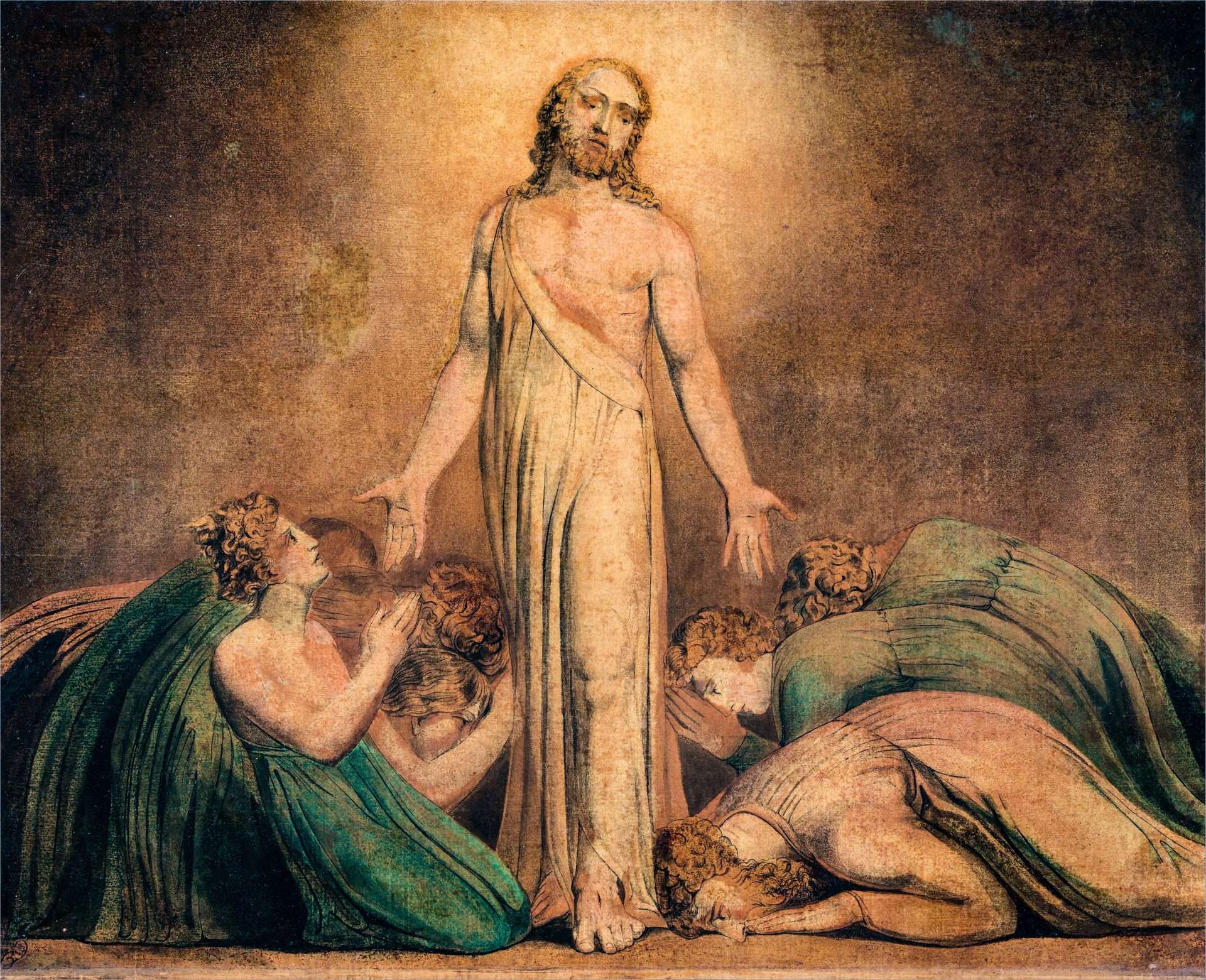
William Blake, Christ Appearing to the Apostles after the Resurrection, watercolour painting over pen and ink 1795-1805
incamerastock / Alamy Stock Phot
EASTER SUNDAY 2025
The Resurrection is not a doctrine crafted by theologians, but a conviction rooted in experience, the personal experience of those who, having with their own eyes seen Jesus crucified and buried, came face to face with him, spoke with him, ate with him, touched him, and knew with certainty that he had passed through death and was alive. Death had not been his end and, they concluded, since we are ‘in Christ’, neither will it be ours. By living and dying in our flesh, God has infused even death with his love so that, now, the resurrection, the mystery of love overcoming death, is faith’s core, hope’s anchor, and love’s fulfilment.
The resurrection, however, is dismissed by some as a wish-fulfilling fantasy rather than the mystery at the heart of our existence. Significantly, many who are of that mind find little in life that is authentically mysterious: genuinely perplexing, perhaps, but not permanently and by definition impenetrable to human understanding. And yet mystery pervades our lives: not just things we don’t yet understand, but things that we will never understand, that will remain for ever beyond the reach of our minds because they are so intimate to our existence and so profoundly presupposed to, rather than the object of, our understanding. The more we apprehend about the little that we have come to understand, the more mysteries multiply. All the things we value most in life fall under this rubric. Nowhere do we sense mystery more than in the experience of our shared nature as rational animals possessed of intellects fashioned to seek truth and wills fashioned to seek goodness.
Reasoning beings as we are, we are nevertheless beyond the reach of rational analysis alone. We are ‘revealed’ fully only in love, the deepest of all mysteries in this life and the ultimate mystery that accounts 2 for our existence and existence as such. That ultimate mystery, whom we name ‘God’, and in whose image and likeness we have been made, is also revealed fully only in “the love that is in Christ Jesus”. (Romans 8:39) If you find both the fact of existence and the experience of love a mystery and a miracle, as any enquiring mind and functioning human heart surely must, then the Resurrection is no more or less a mystery and miracle. It alone affords us ultimate reassurance, conveyed in all the accounts of Jesus’ appearances after his resurrection. On each occasion, he greets his disciples in the same way: “Do not be afraid”. If we need not fear either death or dying, what else in this life can strike fear in us, whether for ourselves or those we love? Jesus died and was buried and is now risen.
His risen body is the nucleus of a new world, a world that transcends and is more real than the world we know now. (Maria Boulding) Death is no longer a menacing shadow, but our “entrance into a more perfect light and life” (Olivier Clément), the beginning of God’s new creation. For those who have died in Christ and now live with his life, death is already behind us. “You have died, and your life is hidden with Christ in God. When Christ, who is our life appears, you also will appear with him in glory.” (Colossians 3: 3-4) The resurrection has freed us both to live fully in the present, which is God’s presence, in hopeful and faithful love, and to look to the future, in this life and beyond, with unshakeable confidence and trust.

Help us keep The Tablet’s voice independent, clear and far-reaching.
Founded in 1840, The Tablet is the leading independent English-language Catholic weekly, celebrated for great writing, astute analysis, brilliant arts and books reviews and trustworthy reporting from correspondents in Britain, Ireland, Rome and across the world.
Independent, high-quality journalism is at the heart of what we do. The Tablet does not have deep pockets and we are not funded by rich donors. If you appreciate our work please consider supporting The Tablet’s Development Fund. It only takes a moment and you can cancel at any time.
- Support with £5 per month
- Support with £10 per month
- Support with other amount.