The deep and irrepressible delight of Christmas


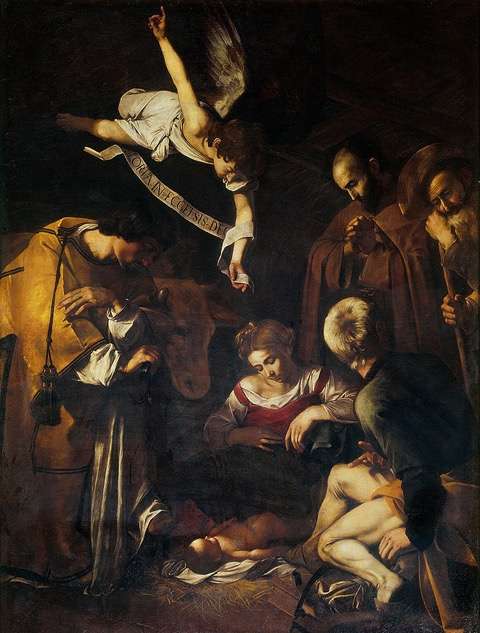
The Nativity, with Saint Francis & Saint Lawrence, painted in 1609, stolen from the Oratory of St Lawrence, Palermo, in 1969, still unrecovered.
Caravaggio (1571-1610)
CHRISTMAS 2025
The gods of the Greek and Roman pantheon were thought to assume human form from time to time and the deities of Hinduism are believed to make their presence felt by appearing outwardly as human beings. But Christmas celebrates not the appearance of God in a temporarily assumed and outwardly apparent human form, but the entry of the infinite, ineffable creator God into his own creation, as a genuinely and fully human being. Jesus of Nazareth, born of Mary, is both God, in the limitless vastness of his glory, and an individual, time-bound, man.
The whole of Christian faith is rooted in that assertion and without it, there would be no Christianity, and no hope. In the Word made flesh, the divine and the human are united and we are made one with God by his sharing of our human life and our sharing in his divine life. The human and divine are joined in the bond of friendship, the purpose for which the universe exists and for which we were created.
In becoming a human being, God accepted in Christ all the limitations and confinements of our nature. His birth was as dramatic and traumatic as ours, for both mother and child; his body was as frail and vulnerable as ours. He was born into a hopelessly convoluted and erratic political situation, just as convoluted and complex as ours. He suffered the pain of being “despised and rejected” and, finally, he entered the “shadow and darkness of death”, just as we will. But, on the third day, he rose from death, as in due course and by his grace we will.
His sharing of our humanity has transformed our nature, not only by revealing what it is to be truly and fully human, but by enabling us to become that which we are called to be for all eternity, namely friends of God. In and through him, divinity is now at the core of humanity and eternity at the core of time; and death, the final enemy, is now the path to “life everlasting”.
Jesus proved in his own life, death, and resurrection, that the simplest truth and the simplest act of goodness are stronger than the most sophisticated lie and the darkest evil; that love is infinitely more powerful than hatred and stronger even than death.
The difference this makes to the way we live our lives is manifold. We no longer need live permanently in defensive mode: we no longer need win every argument. Instead, liberated from aggressive ambition and fear-filled posturing, we can genuinely learn from one another. “Peace on earth” is a real if still difficult to achieve possibility, now that the self-perpetuating, infernal cycle of self-destruction, whereby victims become victimisers and the persecuted persecutors, has been finally broken by the one who forgave from the heart all who wished him dead.
At Christmas, we celebrate the appearance of God’s beauty and goodness in our world and in our lives, in the person of the Word made flesh, who has transformed the whole of our existence. His Word is a resounding ‘Yes’ to life. How could Christmas not evoke such deep and irrepressible delight?

Help us keep The Tablet’s voice independent, clear and far-reaching.
Founded in 1840, The Tablet is the leading independent English-language Catholic weekly, celebrated for great writing, astute analysis, brilliant arts and books reviews and trustworthy reporting from correspondents in Britain, Ireland, Rome and across the world.
Independent, high-quality journalism is at the heart of what we do. The Tablet does not have deep pockets and we are not funded by rich donors. If you appreciate our work please consider supporting The Tablet’s Development Fund. It only takes a moment and you can cancel at any time.
- Support with £5 per month
- Support with £10 per month
- Support with other amount.

MOST READ ARTICLES
-
1
Pope Leo diagnosed with lung cancer after operation
-
2
The Tablet Lecture 2026: Keeping the dream of peace alive
-
3
Battling confession fatigue
-
4
Vatican confirms Pope’s Latin America travel plans despite operation
-
5
Under endless skies
-
6
Nicaraguan bishops visit Rome as Ortega regime tightens grip
FROM THE EDITOR'S DESK


