The Cross is both the greatest evil and the greatest good


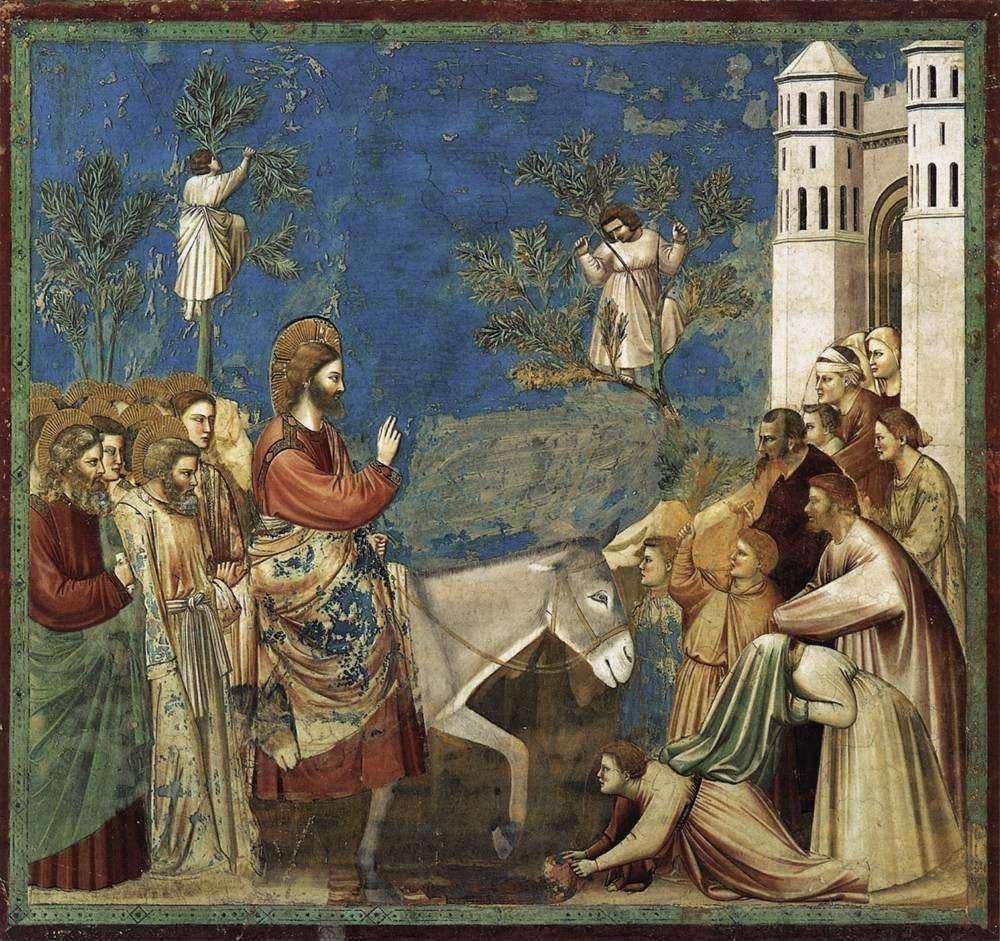
Entry into Jerusalem by Giotto di Bondone, circa 1303-1305.
PALM SUNDAY | 29 MARCH 2026
The crowd’s enthusiastic welcome as Jesus entered Jerusalem reinforced the Jewish authorities’ conclusion that a final solution to the problem he posed was a matter of urgency. The strategy they hatched was two-pronged: on the one hand, they had to convince the people that, as an irreligious blasphemer, he was their enemy not their friend; on the other, they had to convince Pilate, the Roman governor, that he was a political agitator, bent on revolution and thus deserving of crucifixion, the routine penalty for state subversion. The first of these objectives was helped immeasurably by his causing havoc among the money changers in the Temple, thereby seeming to call into question the very foundation of the Jewish nation’s identity. The second was achieved by the trumped-up charge of sedition, claiming that he had openly arrogated to himself the title “King of the Jews”.
Both charges were diametrically opposed to the truth. The only subversion of which Jesus was “guilty” was his refusal to collude with the paralysing legalism that had displaced the original, life enhancing purpose of the Law and his refusal to condemn those who found themselves socially and religiously outside the boundaries artificially constructed by the self-appointed guardians of the same Law.
The events of Holy Week are both unique and predictable: unique, because it is the Word made flesh who freely makes himself vulnerable to the worst that we inflict on each other; predictable, because they correspond to a well-worn pattern of corruption. The powerful are always super sensitive to anything and anyone that threatens their hold on political, financial, or emotional domination.
But the events of Holy Week were predictable in another sense. Jesus taught explicitly that crucifixion is the destiny of us all, if we dare to follow him faithfully. To die as Christ died, however, is to die into life. His death saves us not because of some arcane mechanism but because it was the direct consequence of his desire to convince us of his love: the price was vulnerability and his own death as a criminal. By dying, he achieved life for us, so that when we die, we die into life through him.
But we die into life with him here and now not by merely imitating him, but by adhering to and identifying with him in faith, hope and love: by living and loving, in other words, with his life, by grace, in other words, and dying with him in his death, which is what it is to die “in a state of grace”.
Living well and dying well are, of course, one and the same. How we die will depend on how we have lived. If we have lived our lives absorbed in ourselves, clinging at all costs to what is ours – every sin makes us more self-absorbed – the more difficult it will be to accept, let alone embrace, our death. But if we have lived generously and gratefully, our death will be our life’s culminating act of generous and grateful love.
The Passion of Christ is read in its entirety only twice each year, on Palm Sunday and Good Friday. Unlike all other readings of the gospel on Sundays throughout the year, it is not preceded or followed by the usual dialogue. Instead, it begins starkly: “The Passion of Our Lord Jesus Christ according to Matthew”; and it ends in silence. Nothing could be more fitting. The Passion of Christ is the “still point of the turning world” (Eliot), echoing the Carthusian motto, Crux stat, dum volvitur orbis: the Cross stands, while the world revolves.
On the Cross, which is “the dramatic manifestation of the sort of world we have made” (McCabe), Christ bore all our faults and shouldered all our sins, absorbing and expiating the worst that we have, will, or could ever do. As both the greatest evil and the greatest good, the Cross is the ultimate reassurance that out of all the folly, pain, and anguish of this world, God can, does, and will bring good, beyond all imagining.

Help us keep The Tablet’s voice independent, clear and far-reaching.
Founded in 1840, The Tablet is the leading independent English-language Catholic weekly, celebrated for great writing, astute analysis, brilliant arts and books reviews and trustworthy reporting from correspondents in Britain, Ireland, Rome and across the world.
Independent, high-quality journalism is at the heart of what we do. The Tablet does not have deep pockets and we are not funded by rich donors. If you appreciate our work please consider supporting The Tablet’s Development Fund. It only takes a moment and you can cancel at any time.
- Support with £5 per month
- Support with £10 per month
- Support with other amount.

MOST READ ARTICLES
-
1
Leo pleas for besieged Ukrainian town in call with Putin
-
2
Under endless skies
-
3
Battling confession fatigue
-
4
Restless statelessness
-
5
Pope Leo thanks staff at Mass in Gemelli Hospital
-
6
Study finds German dioceses failed to guard against spiritual abuse in lay groups
FROM THE EDITOR'S DESK


