Martha, Mary and how to interpret what Jesus said


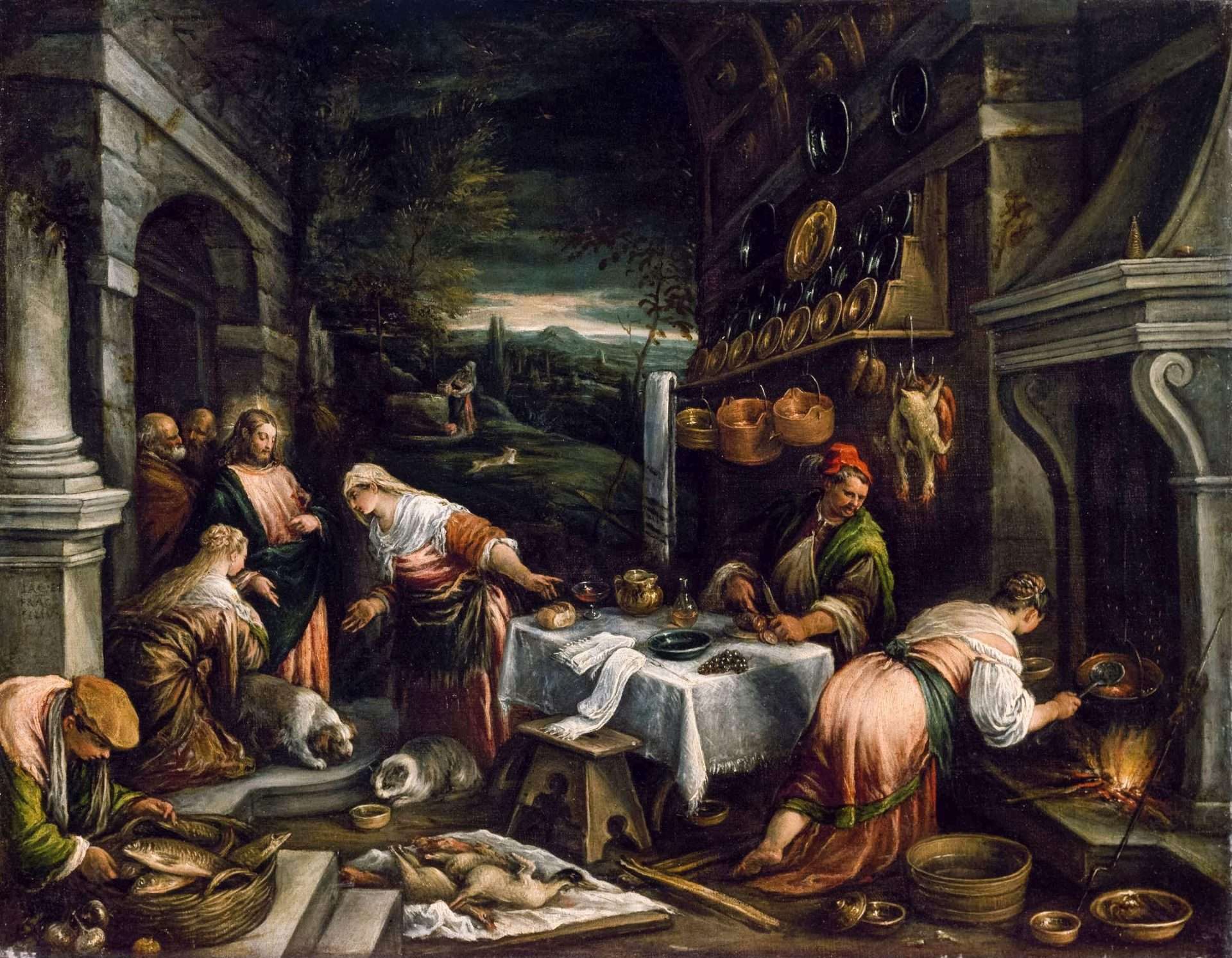
Christ in the House of Mary, Martha, and Lazarus, painting in oil on canvas by Jacopo Bassano, circa 1577
incamerastock via Alamy
C16 | 20 JULY 2025 | MARTHA AND MARY | LUKE 10:38-42
This account of a sisterly contretemps between Martha and Mary has been read differently at different times. It has been understood, for instance, as marking the superiority of the contemplative life, the life of monks and nuns, over the life of apostolic religious, such as friars; or as privileging the institutional religious life, as such, over the lives of Christians who do not belong to a religious order – the vast majority, in other words.
But it can also be read as continuing the theme of last week’s parable of the Good Samaritan, which immediately precedes it in Luke’s narrative, where Jesus sends out the clear and, to the Jewish authorities of the day, unacceptable message, that salvation is intended for all and virtue is just as likely to be found outside traditional and conventional boundaries.
Here, in the story of Martha and Mary, those boundaries are between male and female roles and expectations. The problem between Martha and her sister wasn’t just a question of workload – that may well have been distributed unfairly – but the fact that, in sitting at the feet of Jesus, “listening to his teaching”, Mary was assuming the privileges of men in that still starkly patriarchal society.
In that culture, and still in in strictly segregated societies, houses were divided into male “space” and female “space”. The public rooms of a house were reserved to men; the kitchen, and quarters unseen by outsiders, belonged to women. Men and women mixed only in very specific settings and mainly in open spaces outside the home, with the exception of the marital bedchamber.
By sitting with the men gathered round Jesus, Mary had crossed not only a very real boundary within the house, but also an equally strict boundary within society. So, when Martha complains to Jesus, she’s asking him to send her sister Mary back into the women’s quarters, where she belonged, and thus stopping her acting so shamelessly. And when Jesus responds by telling Martha that Mary has chosen “the better part”, he’s asserting, in yet another radical departure from convention, that women have an equal right to be in the inner circle of his followers – disciples, in other words.
But Jesus isn’t offering a proto-feminist critique by invoking abstract egalitarian principles. Rather, he’s affirming our common humanity and shared identity, rooted in the fact that we are all, without exception, made in the image and likeness of God. All differences pale in comparison with this fundamental communality. So, once again, Jesus is breaking through the boundaries we draw, often with good but mistaken intentions, that serve only to deprive others of their God-given humanity. Mary, in other words, stands for all who are unjustly excluded or disadvantaged or deprived of the dignity bestowed on them by our common Father.
But there’s another aspect to this homely story that introduces the next episode, which occurs in next week’s gospel, when the disciples ask Jesus to teach them how to pray. The story of Martha and Mary carries an important lesson about the nature of prayer, prayer understood not as a discrete activity in which we engage at given, distinct moments, but prayer as, first and foremost, a dispostion of the heart, an overarching attentiveness to the presence of God, in which our lives are spent: an attentiveness that shapes and characterises the whole of our lives, at all times and in all circumstances.
How else could St Paul say that we are to “pray constantly” and that prayer is not something that we ourselves do, but something that is done within us, by the Holy Spirit? “The Spirit Himself prays within us”, he says, “with sighs too deep for words”. Eliot echoes this: “prayer is more than the conscious occupation of the praying mind.” And in the earliest lives of St Francis of Assisi by Thomas of Celano, it is said of him that he did not so much pray, as himself became a prayer. We say our prayers, of course, but more fundamentally, our lives themselves are to be a prayer of praise, gratitude and love.
So, the story of Martha and Mary functions on two different but related levels. It breaks down the false and artificial boundaries that speciously segregate human beings from one another, by affirming that we all share a common nature and a common vocation. And it dissolves the dichotomy between prayer and activity. It isn’t Martha’s busy-ness that distracts her, but her pre-occupation with her own activity. Mary is just as busy, but her attentiveness is directed beyond herself to the Divine Presence, in which our lives are lived.
Martha might have found helpful these words from a much-read 17th century mystical tract, The Practice of the Presence of God, by an otherwise unknown Carmelite lay-brother, Brother Lawrence (1605-91):
The time of busyness does not with me differ from the time of prayer. In the noise and clutter of my kitchen, while several persons are at the same time calling for different things, I possess God in as much tranquillity as if I were on my knees before the Most Holy Sacrament.

Help us keep The Tablet’s voice independent, clear and far-reaching.
Founded in 1840, The Tablet is the leading independent English-language Catholic weekly, celebrated for great writing, astute analysis, brilliant arts and books reviews and trustworthy reporting from correspondents in Britain, Ireland, Rome and across the world.
Independent, high-quality journalism is at the heart of what we do. The Tablet does not have deep pockets and we are not funded by rich donors. If you appreciate our work please consider supporting The Tablet’s Development Fund. It only takes a moment and you can cancel at any time.
- Support with £5 per month
- Support with £10 per month
- Support with other amount.