‘I looked at him – Suddenly’


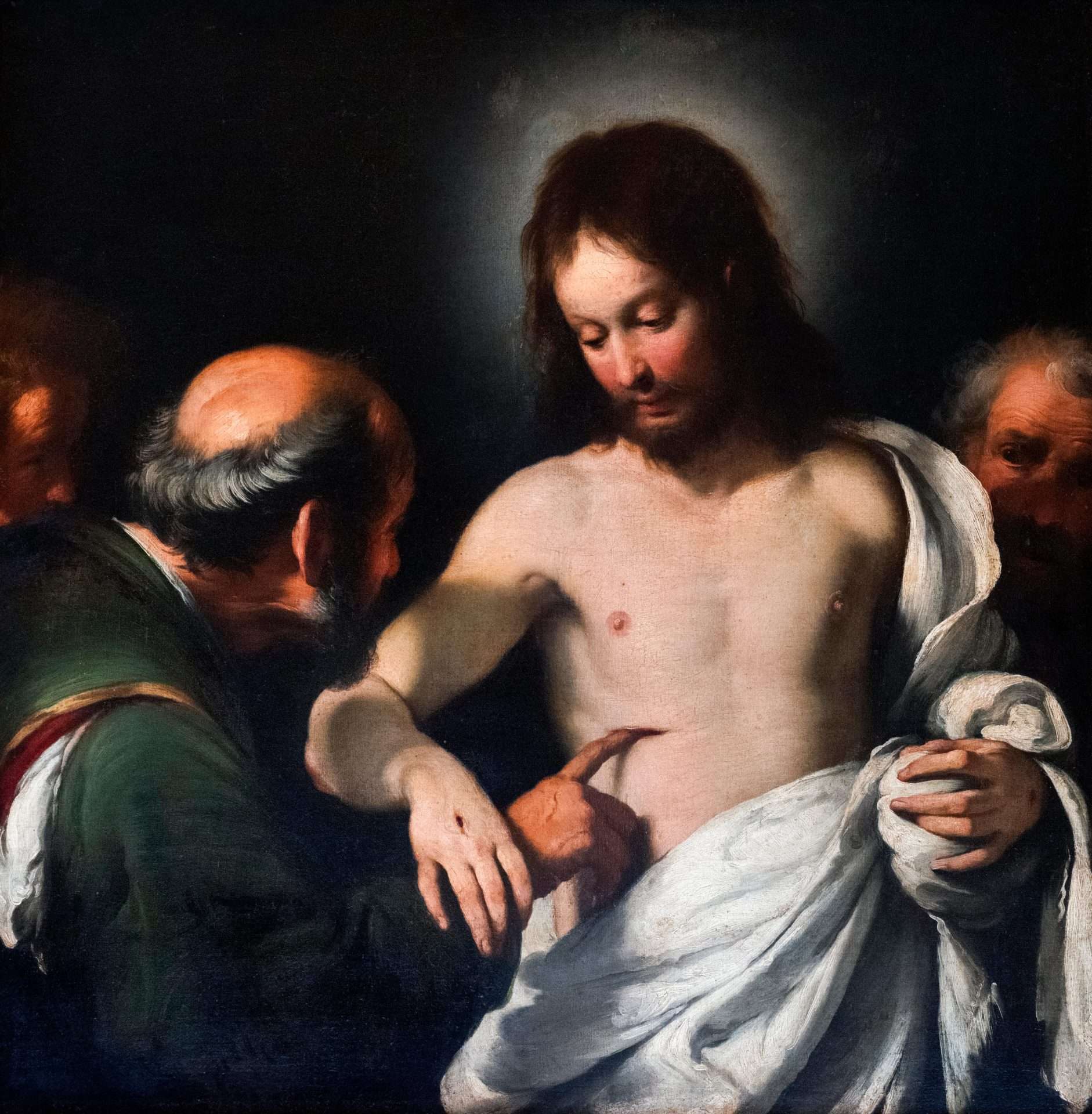
The Incredulity of St Thomas by Bernardo Strozzi (1582-1644), c.1620
: IanDagnall Computing / Alamy Stock Photo
EASTER 2C | BELIEVING THOMAS | 27 APRIL 2025 | JOHN 20:19-31
Thomas’s reluctance to believe, without the evidence of his own eyes, that Jesus had risen, has earned him the most misleading of all monikers. ‘Doubting Thomas’ is lodged in Christian consciousness as the archetypal sceptic. But this affecting episode at the end of John’s gospel isn’t about doubt, but faith. Or, better, it’s about the relationship between reasoning faith and reasonable doubt. So, far from being the petulant empiricist, Thomas speaks for all of us who, though we believe, are familiar with doubt. This encounter, coming as it does at the very end of what is thought to have been the original text of John’s gospel, was the climax of his narrative. Having begun his gospel with the majestic Prologue, “In the beginning was the Word and the Word was God”, John relates how Thomas was the first person to confess his belief that Jesus was God with his words, “My Lord and my God”.
With those words, the purpose of the gospel, “that you might believe that Jesus is the Messiah, the Son of God”, is seen to be fulfilled first in Thomas. Thomas, in other words, is the archetypal believer, not the archetypal doubter. The phrase, “he saw, and he believed”, used of many individuals in John’s gospel, applies prototypically to Thomas. Among other messages conveyed in this passage, it is clear that, as in all matters of truth, intelligent questioning is essential, not inimical to faith. Faith is not a crutch for the credulous, or a comfort blanket for the fearful. On the contrary, it requires courage to live in the presence of mystery: and faith points us in the direction of the ultimate mystery, which remains permanently beyond the reach of our intellects. Faith, however, does not so much empower us to reach out to the God, but rather renders us receptive to his reaching out to us.
Another lesson of this episode is that faith is not acquired by effort of will or through keenness of intellect. Neither is it the reward of virtue. On the contrary, faith is itself a virtue, an infused rather than an acquired virtue. But crucially, John shows in this episode that faith in the Risen Christ is not a private possession: it is given to us, not to me. It is given, that is, in the context and is therefore an attribute primarily of a community, namely, the Church. The Church has always known herself to be a living community of faith, the bearer, from generation to generation, of the faith, a tradition, a truth received and handed on. “That which I have received, I handed on to you”, says St Paul. (I Corinthians 15:3) That’s one reason why the papacy, presently vacant, is central to the life of the Church: it is the guarantor of identity, continuity, and unity, rooted in the apostolic tradition, the faith, that is, of the apostles, who knew Christ Himself. Of course, officially at least, modernity is impatient of tradition.
Enlightenment voices confidently predicted that reason would displace tradition as a matter of course, the two allegedly being mutually exclusive: Christianity would wither on the branch. That they were manifestly wrong hasn’t prevented their prediction seeping into the secular mind-set of the West, giving rise to the view that to engage in free enquiry, you must first be freed from the constraints of tradition. Tradition is often confused, of course, with traditionalism: but tradition is “the living faith of the dead; traditionalism is the dead faith of the living.” (Jaroslav Pelikan) But that sundering of reason and tradition was a departure not only from ancient wisdom but also from universal human experience, not just in matters of faith but in all questions of truth. Without tradition, learning of any kind is impossible. All ideas have a history. In all fields of culture and education, immersion in traditions of learning and living is indispensable for excellence and even a prerequisite of original thought.
All this is true, a fortiori, of Christian thought and understanding. To believe is, for a Christian, to be immersed in the apostolic tradition of faith, which has been safeguarded and transmitted by the living Church, “the Catholic faith, which comes to us from the Apostles”. That is one reason why the papacy, presently vacant, is central to the life of the Church: it is the guarantor of identity, continuity, and unity, rooted in the apostolic tradition, the faith, that is, of the apostles, who knew Jesus both before and after his resurrection. But there is a further, indispensable dimension of faith. Thomas’s profession, “My Lord and my God”, is as much a profession of love as of faith. Faith, like love, is a knowledge that draws us deeper into what or, better, who is known and loved. The gift of faith enables us not merely to know about God, but to know and love God Himself, and to know ourselves as known and loved by him. Both belief and knowledge of God are, as St Paul makes plain, sterile without love.
The post-resurrection appearances make it clear that faith is not so much cognition as recognition. It is not to see something that others don’t see – that’s the territory of the visionary and the seer – but rather to see everything differently, just as one who loves and is loved sees the beloved and everything and everybody with different eyes. Some of the early Church Fathers spoke of faith as seeing with the “spiritual senses”. The third century theologian, Origen (185-254), speaks of the “faculties of the heart” and the twentieth-century Jesuit theologian, Bernard Lonergan, speaks of faith as “knowledge born of religious love”. Thomas saw and touched the Risen Christ: but he believed because he had been seen and touched by his risen Lord. To believe is to be overwhelmed in and by the presence of Love Itself, as Thomas was, and as the irascible Welsh poet, R. S. Thomas (1913-2000), grasped:
I looked
at him, not with the eye
only, but with the whole
of my being, overflowing with
him, as a chalice would
with the sea.
Suddenly

Help us keep The Tablet’s voice independent, clear and far-reaching.
Founded in 1840, The Tablet is the leading independent English-language Catholic weekly, celebrated for great writing, astute analysis, brilliant arts and books reviews and trustworthy reporting from correspondents in Britain, Ireland, Rome and across the world.
Independent, high-quality journalism is at the heart of what we do. The Tablet does not have deep pockets and we are not funded by rich donors. If you appreciate our work please consider supporting The Tablet’s Development Fund. It only takes a moment and you can cancel at any time.
- Support with £5 per month
- Support with £10 per month
- Support with other amount.

MOST READ ARTICLES
-
1
Pope Leo diagnosed with lung cancer after operation
-
2
The Tablet Lecture 2026: Keeping the dream of peace alive
-
3
Battling confession fatigue
-
4
Vatican confirms Pope’s Latin America travel plans despite operation
-
5
Archbishop bars Catholics from firing squad for US military execution
-
6
Under endless skies
FROM THE EDITOR'S DESK


