Hypocrisy is practically the only thing Jesus railed against in the gospels


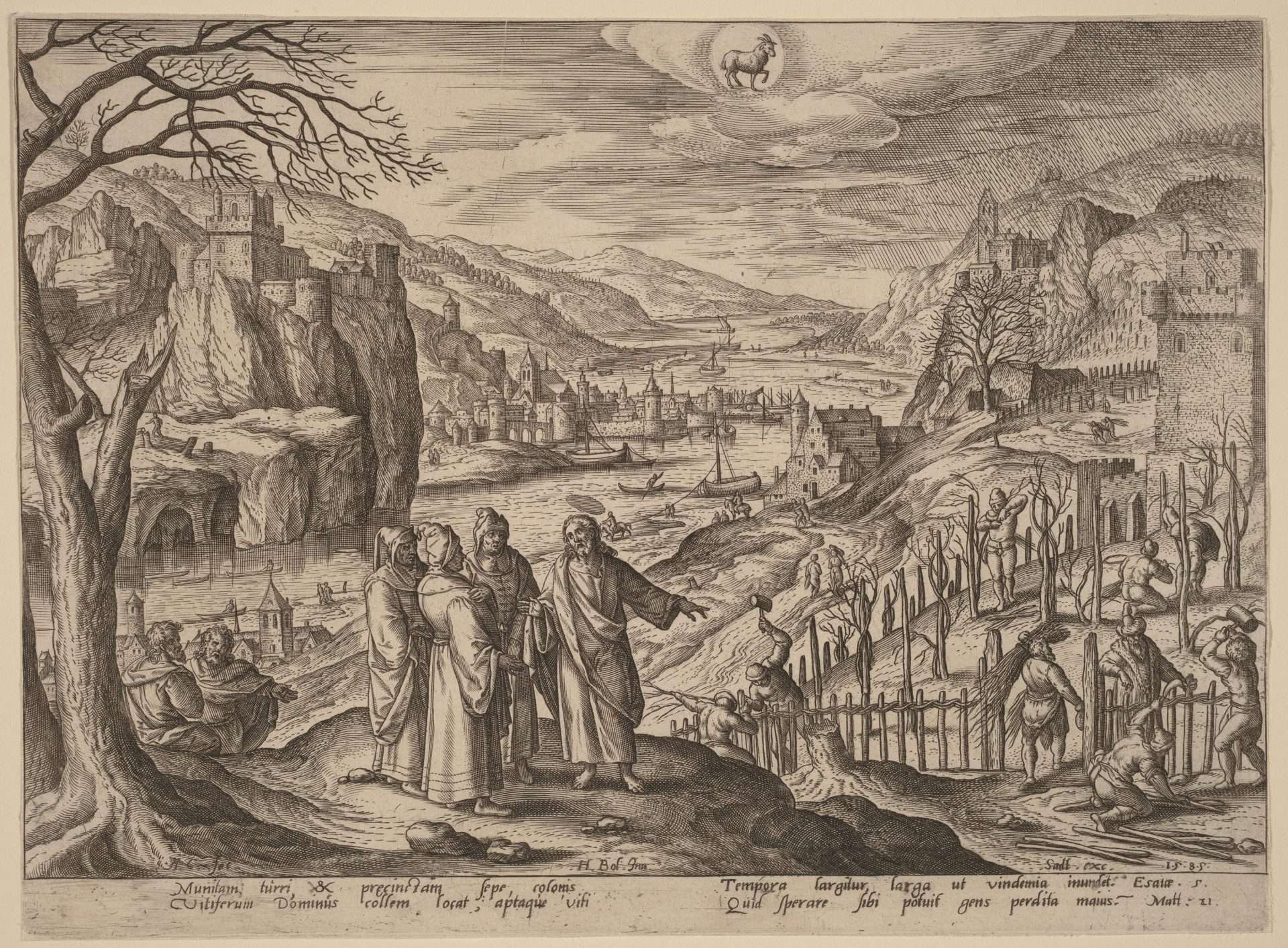
The Parable of the Two Sons and the Unjust Husbandmen by Adriaen Collaert (1585)
A26 | 27 SEPTEMBER 2026 | THE PARABLE OF THE TWO SONS MATT 21:28-32
From the first moment of his arrival in Jerusalem, Jesus had incensed the religious establishment by allowing himself to be hailed as “Messiah”. He then proceeded to cause further scandal by angrily driving the buyers and sellers from the Temple and overturning the moneychangers’ tables. The scandal was not the havoc caused but the fact that, in doing this, he was, in effect, calling into question the whole sacrificial system that was so central to Judaism at the time. Without the moneychangers, the temple cult couldn’t function: it was they who changed Roman currency, with its blasphemous image of “divine” Caesar, into temple shekels with which to buy small animals for sacrifice.
No wonder, then, that when he returned to the Temple a day or so later, the chief priests and elders cornered him and demanded to know by what authority he was doing all this. The parable in this gospel, told to the highest authorities of the Jewish religion, in its holiest of places, and in the last week of his life, undoubtedly set in train the events that would lead to Jesus’ death.
He had already tied his accusers in knots by answering their question about his authority with a question of his own about the authority of John the Baptist, a question which they, for fear of the people, who had revered the Baptist, dared not answer; any answer would have incriminated them. And so, unable either to affirm or deny the authority of the Baptist, they were hoist by their own petard.
His telling of this parable of the two sons was his answer to them. But to leave them in no doubt about its meaning, he tells the chief priests and elders to their face that tax-collectors and prostitutes – in their view, the despised unjust and unchaste – would stroll into heaven ahead of them, because they, unlike the Chief Priests and Elders, had heeded the Baptist’s prophetic voice.
The tax-collectors and prostitutes are represented in the parable by the son who initially says, ‘No’, but thinks better of it and, in the end, does what his father asks of him. The chief priests and elders, on the other hand, are represented by the goody-two shoes son who says, ‘Yes’, but doesn’t deliver.
Jesus was telling them, in effect, that they were the ‘Yes Men’, who had said all the right things, believed all the right things and stood up for all the right things but, when push came to shove, had put their status, power and reputation before everything else, even before God. And now, though they claimed a divinely-derived authority, in truth they were paying empty lip-service to God. They stood convicted of hypocrisy.
Hypocrisy, and especially institutionalised hypocrisy, is practically the only thing Jesus railed against in the gospels, and in Matthew’s gospel, at least, it appears to be the only thing that raised his ire. But hypocrisy is an uncomfortable topic. Who can honestly say that they have never acted or spoken hypocritically?
Hypocrisy, of course, is not the same as pretentiousness. Pretentiousness, often born of insecurity, is a weakness. It has been said that we all possess three kinds of character traits: those we have, those we think we have, and those we pretend we have. Pretentiousness is forgivable because, however convincing we may think we are, it is so easily seen through – by others, at least. Pretentiousness, which deceives only ourselves, is something we can grow out of, an immaturity arising from the inevitable discrepancy, this side of the grave, between life as we’d like it to be, and life as it is.
Hypocrisy, on the other hand, is a vice that seeks to deceive everybody else but ourselves. Its deception is particularly corrosive because, while integrity can sometimes co-exist alongside many vices of character, hypocrisy always undermines integrity. Think of the countless Graham Greene figures who, when the heat is on, emerge from beneath the mire of their myriad mistakes as genuinely good people. Their sins and failings usually turn out to be what Dorothy L. Sayers called the ‘warm hearted’ sins, the ones that can never masquerade as anything but sin; as opposed, that is, to what she called the ‘cold-hearted’ sins, that so easily masquerade as virtues. According to the book of Proverbs, it is far better to be known as a sinner than a hypocrite.
Hypocrisy, of course, is not the preserve of the powerful, though they are especially susceptible: power really does tend to corrupt. Ironically, hypocrisy is nowhere more likely than in the arena of religion. “When you see a great deal of religion displayed in a man’s shop window”, the 19th century Baptist preacher, Charles Spurgeon, s once said, “you may depend on it, that he keeps a very small stock within”.
Hypocrisy is, in some ways, the deepest form of untruth, the truth being, of course, as much what we do as what we say. Silence is as important as speech in the pursuit of truth: saying nothing is often the only truthful course, even at the cost of being thought dull or boring. We are not always obliged to speak, but we are always obliged to be speak truthfully.
The truth matters: anyone who says it doesn’t, proves the point. Without the truth, we are cut off from reality, and whatever cuts us off from reality, cuts us off from the source of reality, namely God. That was the charge Jesus laid at the feet of the religious establishment of his day: they had set between themselves and God a gulf so great that when God came into their midst, when the Messiah foretold in their scriptures finally arrived, they either couldn’t or wouldn’t acknowledge him. If it was the case that they couldn’t, they stood convicted of blindness; if it was the case that they wouldn’t, they stood convicted of hypocrisy.
The virtue that enables us to close the gap between what we are and what we claim to be, is simplicity, a harmony between head, heart, and hand, which transparently and serenely ensures that we say and do only what we mean, and always mean what we say and do.

Help us keep The Tablet’s voice independent, clear and far-reaching.
Founded in 1840, The Tablet is the leading independent English-language Catholic weekly, celebrated for great writing, astute analysis, brilliant arts and books reviews and trustworthy reporting from correspondents in Britain, Ireland, Rome and across the world.
Independent, high-quality journalism is at the heart of what we do. The Tablet does not have deep pockets and we are not funded by rich donors. If you appreciate our work please consider supporting The Tablet’s Development Fund. It only takes a moment and you can cancel at any time.
- Support with £5 per month
- Support with £10 per month
- Support with other amount.

MOST READ ARTICLES
-
1
German bishops commit to global Synod process despite delay to reforms
-
2
The Tablet poem
-
3
Battling confession fatigue
-
4
Bangladesh Christians ask president to help ease missionary visa restrictions
-
5
Catholic Social Teaching and universities
-
6
Nigerian first lady suffered death threat for practising Christian faith
FROM THE EDITOR'S DESK


