Fasting and penance are nothing if they do not lead us to an increase in charity


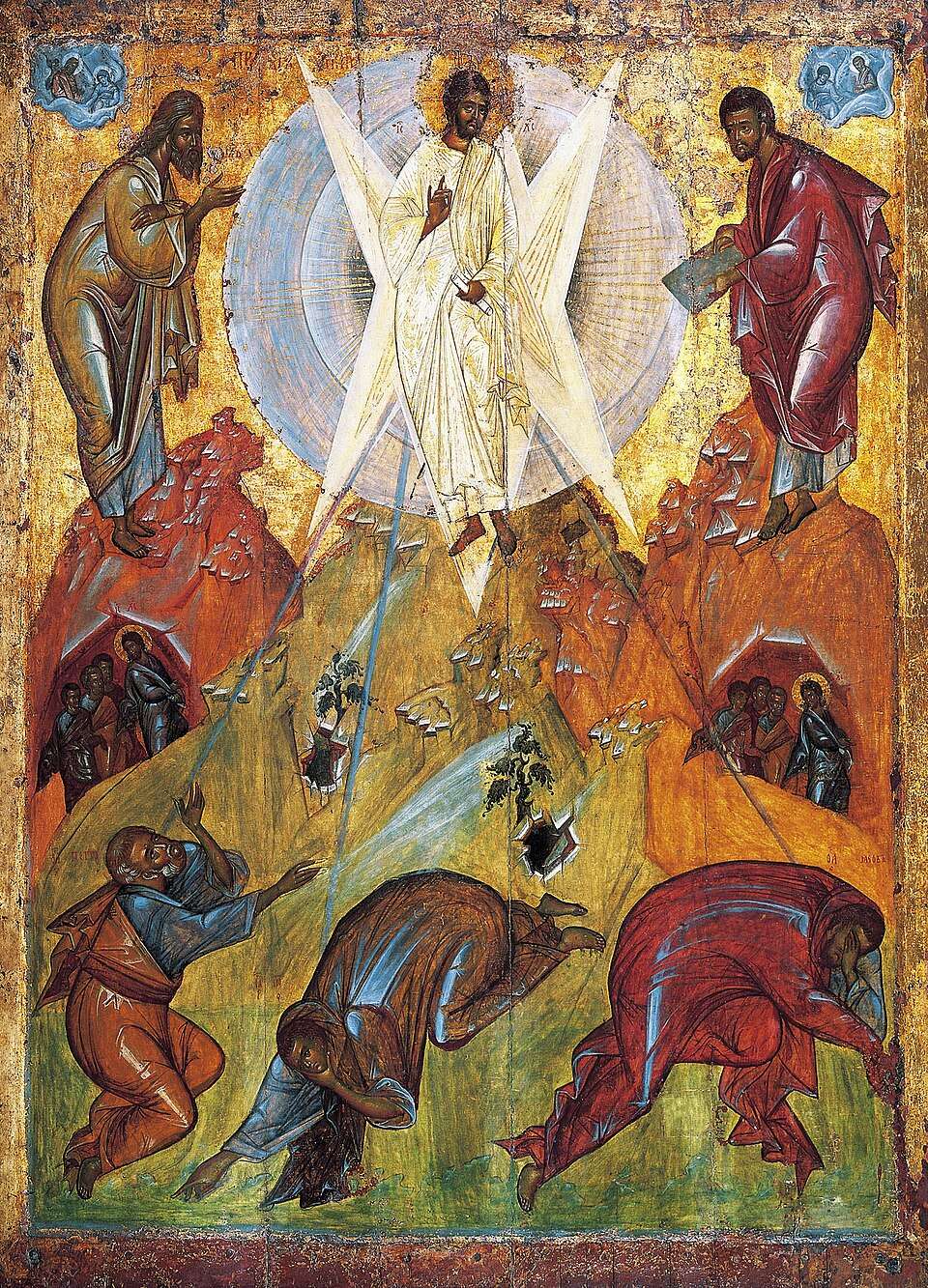
Transfiguration icon by Theophanes the Greek, 15th century
LENT 2A | 1 MARCH 2026 | MATTHEW 17:1-9
The image of the wilderness has frequently been employed to describe the experience and purpose of Lent. Reflecting on the account of Jesus’ temptations there, early Christian writers spoke of the wilderness within, into which we enter during these forty days of preparation for Easter. The Desert Fathers, the earliest monks, solitaries who removed themselves into the actual wilderness, often spoke of the wilderness as both a privileged place of encounter with God and a place of testing, where we encounter and confront not only God but our real selves, and face both our real needs and deepest desires.
This is not to be confused with the soul-stirring introspection so beloved of our therapeutic society. The ascetical practices of Lent having nothing whatever to do with self-improvement or human perfectibility. We are not indulging in spiritual navel-gazing or spring cleaning, as if we could somehow make ourselves presentable to God by tidying up what we find.
On the contrary, God already sees us as we are and knows us infinitely better than we can ever know ourselves; and he loves us not despite, but because of what he knows. What we come to see in ourselves we offer, warts, wounds and all, humbly and trustingly, to the healing power of his grace. We ask for grace in Lent to know our need of God by owning our waywardness.
This is, of course, easier said than done. There is a moment in Graham Greene’s The Power and the Glory when the flawed ‘whisky priest’, at risk to his own life at a time of violent persecution of Catholics in Mexico during the 1920s and 30s, is secretly and hurriedly hearing whispered confessions. He says to one old woman penitent: “Remember your real sins.” To which she replies indignantly, “But Father, I’m a good woman.” “Then what are you doing here”, he says to her, “keeping away the bad people?”
We can all say, “I’m a sinner” but it is quite another thing to mean it. When it is not pious rhetoric, this is the most uncomfortable thing we can ever say: and if we don’t feel deep discomfort, we’re not remembering our real sins. And yet, owning our sinfulness is the absolute precondition of genuinely acknowledging not only our need of God but also the sheer gratuitousness of his love. Why? Because he meets us precisely where we most need him, in the confusion and chaos of our real lives, in our weakness and hopelessness and desolation and temptation and failure. But he meets us there precisely to effect those changes that we ourselves are powerless to make.
Our fasting, or whatever we choose to do or not to do, during Lent is a token, an expression of our desire to be changed by Him. Outer fasting will contribute nothing but corrupting self-satisfaction, unless accompanied by inner fasting. And inner fasting is in the heart. We fast, first and foremost, from all that does not have love and compassion as its motive. Many things move us, but we pray in Lent that love alone might be the mover of all we do. Fasting and penance are nothing if they do not lead us to an increase in charity.
Love is the “form”, the meaning, the soul, the life of every virtue, made possible only by the gift of the Holy Spirit. Our journey in this life is a return journey, a return to the source of life and love, a return to God. We are called not to some cold, detached ideal of self-perfection, but to the perfection of love, in communion with God and one another.
To arrive at the wholeness for which we were made, we must strip away all that conceals our true humanity. The glory of God is revealed at the Transfiguration in Jesus’ humanity, but that revelation will be completed in his suffering humanity. In his death, Jesus reveals the transcendent power of God shining through human weakness and failure. In this fragile vessel which is our body, and in the failures and chaos of our lives, God’s glory is still radiantly visible: not on the far away mountain top, on in the clouds, or in a distant scene, but in his gift of life itself and his call to share his own life in love for all eternity.
When St Antony the Great (251-356), the first of the Desert Fathers, went out into the wilderness, he was immediately confronted by all the demons he carried within him: lust, avarice, anger, vanity, pride, despair. If we, in our own wilderness, uncover similar things, we should thank God that we are, by his grace, on the path of truth; and of our need for Him, we will be in no doubt.

Help us keep The Tablet’s voice independent, clear and far-reaching.
Founded in 1840, The Tablet is the leading independent English-language Catholic weekly, celebrated for great writing, astute analysis, brilliant arts and books reviews and trustworthy reporting from correspondents in Britain, Ireland, Rome and across the world.
Independent, high-quality journalism is at the heart of what we do. The Tablet does not have deep pockets and we are not funded by rich donors. If you appreciate our work please consider supporting The Tablet’s Development Fund. It only takes a moment and you can cancel at any time.
- Support with £5 per month
- Support with £10 per month
- Support with other amount.



