Easter Sunday: the tomb is empty and women are the first to see the Risen Jesus


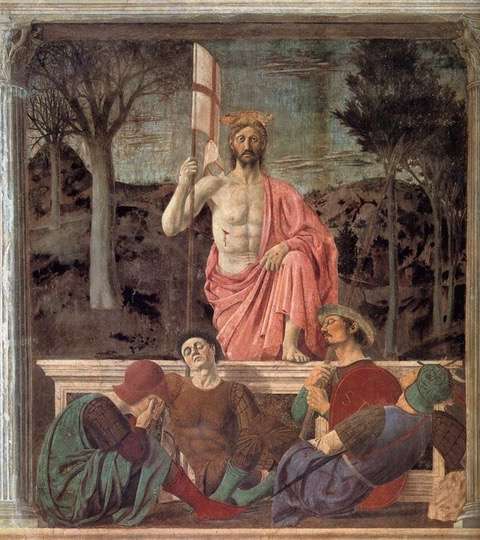
Resurrection by Piero della Francesca
Wikimedia Commons
In all four of the gospel accounts, women are the first to discover the empty tomb and in three of them, including Matthew’s today, they are the first to see Jesus risen from death. Significantly, Mary of Magdala figures prominently in each account.
That women were the first witnesses is significant. The testimony of women at that time and in that culture counted, in law at least, for nothing: so had the account of Jesus’ resurrection been a fabrication, as was alleged by the authorities, it would have been naïve to suggest that women were the first witnesses. That the gospel writers did not cavel at the fact can only attest to the authenticity of their accounts.
But it is significant for another reason. Speaking of the resurrection, St Thomas Aquinas remarks that since the women showed greater love for Jesus by returning to the tomb, while the men, having fled, now cowered in fear, “they were therefore first to see him in his risen glory.” Equally, he says, their greater love will be rewarded by greater glory in the Beatific Vision.
The reason for Mary of Magdala’s prominence becomes clearer when it’s recalled that she is said to have had much forgiven her because she had loved much. Among the men, it is John, “the disciple whom Jesus loved”, who reaches the tomb first, and who, seeing with the insight of love, believes. Speaking of John’s getting to the tomb ahead of Peter, and shedding light on the nature of faith, the Franciscan, St Bonaventure, Aquinas’s exact contemporary, says that “Love outruns knowledge, for where the intellect cannot go, the heart enters with ease.”
What all this suggests is that while the resurrection is the defeat of death, the victory belongs to love. Jesus let go of his life in this world, allowing himself to be done to death, out of love for us and the resurrection is his love’s fulfilment. It is also the vindication of love itself, the conclusive proof that nothing else in this world matters more: our relationships are our real treasure and fullest flourishing. Love is the meaning and raison d’être of all creation, that “moves the sun and the other stars”. The resurrection affirms that God is Love.
As such, the Resurrection rescues us from the fear that nothing makes ultimate sense. It is both the only point from which we can grasp the origin and final outcome of our lives, and the reassurance that can banish from our lives all the pettiness, prejudice and pretension that distorts our vision and the jealousy, cynicism and hubris that skews our relationships, individually and across the nations. In other words, it re-configures and reorientates our whole existence, proving that kindness, humility, tenderness, patience and long-suffering love are the key to a life lived well and the only authentic hallmark of the risen life here and now.
Finally, the first words of the risen Christ to the women anchor us in the peace only he can give: “Do not be afraid.” Though we too must endure death, as he did, God will never let go of us, for
One short sleep past, we wake eternally
And death shall be no more; Death, thou shalt die.
John Donne (1572-1631), Holy Sonnet X

Help us keep The Tablet’s voice independent, clear and far-reaching.
Founded in 1840, The Tablet is the leading independent English-language Catholic weekly, celebrated for great writing, astute analysis, brilliant arts and books reviews and trustworthy reporting from correspondents in Britain, Ireland, Rome and across the world.
Independent, high-quality journalism is at the heart of what we do. The Tablet does not have deep pockets and we are not funded by rich donors. If you appreciate our work please consider supporting The Tablet’s Development Fund. It only takes a moment and you can cancel at any time.
- Support with £5 per month
- Support with £10 per month
- Support with other amount.

MOST READ ARTICLES
-
1
Leo pleas for besieged Ukrainian town in call with Putin
-
2
Under endless skies
-
3
Battling confession fatigue
-
4
Restless statelessness
-
5
Pope Leo thanks staff at Mass in Gemelli Hospital
-
6
Study finds German dioceses failed to guard against spiritual abuse in lay groups
FROM THE EDITOR'S DESK


