A hard gospel: what does it mean to hate your mother?


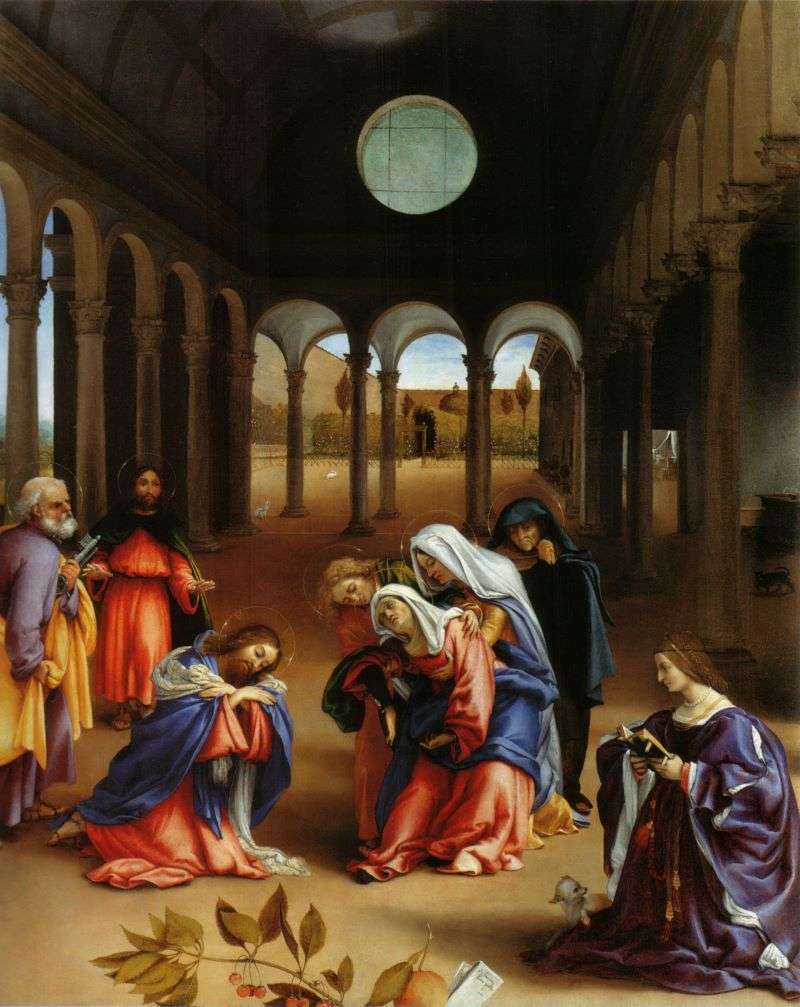
Christ taking leave of his mother by Lorenzo Lotto, c. 1521
Creative Commons Licenses 4.0
23C | 7 SEPTEMBER 2025 | LUKE 14 25-33
This gospel is fraught with difficulty for the modern mind. What are we to make of being told that we must hate our families, put up no resistance to those who would unjustly kill us, and renounce all our material possessions?
Some interpreters have seen these draconian demands as an extreme example of Semitic hyperbole: on this reading, ‘hating’
one’s family, for instance, is to be understood as never preferring or prioritising them over the demands of the gospel. That’s still quite difficult to take on board. Little wonder that Matthew, in his gospel, plays safe and avoids the idiom – if that’s what it is – altogether.
Others have seen this and other so-called ‘hard sayings’ as deliberately imitating the stark tone of much of the Old Testament’s Wisdom literature, which was intended to be hard- hitting, uncompromising, and provocative. On this reading, we’re meant to feel perplexed, uncomfortable, and thereby challenged.
Yet other, more recent scholars have seen in this and similar passages of the gospels traces of the teaching methods of the
Cynics, a philosophical movement that was deliberately and openly shocking and unconventional. They earned their name
from the Greek for ‘dog’, (kunos), because of their deliberately dog-like (kunikos) – and sometimes even worse – behaviour in public. On this reading, we are meant to be scandalised and shocked.
As a final resort, some have sought to render these words more palatable by applying what has cynically – in the English sense of that word – been called the ‘saltwater treatment’: first you water it down and then you add a pinch of salt.
To grasp the point of this passage, we need to remember that it comes straight after the parable in which the guests invited to a great banquet all make their different excuses for not attending: one had some new property to inspect; another had to tend to some new livestock; yet another was newly-married – the text is faintly ironic in seeming to suggest that this was the nearest thing to a real excuse. Each of the invitees had given priority to something (or someone) else, in other words.
In today’s gospel immediately following that parable, Jesus is drawing out its meaning. The parable and now the explanation
are about the nature and cost of what is conventionally called ‘discipleship’; except that being a disciple of Jesus turns out to be unlike any conventional notion of discipleship. Normally, discipleship involves hierarchy and submission: great tyrants have
devoted disciples (often even more bloodthirsty than their masters); great teachers have them, too, some creative, others slavishly imitative.
But Jesus rules out our being his disciples in any of these senses by saying explicitly that we are related to Him not primarily as
disciples to a master, but as friends. To be a ‘disciple’ of Jesus is to share his life, as friends share their lives; and that sharing of his life in friendship is the inexpressible mystery we refer to when we speak of the life of grace. (Herbert McCabe inimitably expressed it: “We are fortunate…to be personal friends of God – this good luck is what [is called] grace.” 1)
Sharing the life of another person is, of course, always a grace and a gift, in the case of friendship, a mutual gift. But it is never
without cost. That’s what ‘taking up your cross’ means: to ‘take up your cross’ is to accept the consequences of the free choices we make, principally, our choice about the kind of person we want to be or become.
Jesus accepted the consequences of his free choice to be a fully human being in a hopelessly inhuman world. And he accepted
those consequences out of love for us, in that he became human, so that we might be restored to the friendship for which we were created.
To take up our cross, then, is to accept the consequences of being true to that friendship. And, given that a friend, according to Aristotle and Aquinas, is ‘another self’, being true to our friendship with God is the same as being true to ourselves – and
vice-versa. Nothing less secures our integrity and thereby our salvation.
Both Aristotle and Aquinas also remind us that we can only be real friends with our equals. So, in offering us his friendship, God, in a way that transcends our understanding, makes us his equal, by taking us into his own life. That’s what many of the early Christian Fathers, especially the Greek Fathers of the Church, mean by ‘divinisation’. And the Sacraments, none more explicitly than the Mass, are the dawning of that divinisation even now. But the only authentic visible mark of that divinisation in our own lives, is the selflessness that was manifest in the life and saving death of Jesus himself.
These sayings, then, are not so much draconian as dramatic. They remind us that our relationship with God embraces and is the foundation of all our relationships. All love, in other words, is God’s gift.
That’s why loving God above all else is not to be understood simplistically, that is, as making God a ‘priority’ over all other
considerations. Strictly speaking, God can never be a priority, as such, as if He were one consideration, albeit the first and most important, among the many others we have to juggle. To think in this way is to misunderstand and misuse the word ‘God’; to act in this way is to demean our relationship with God.
The meaning of loving God above all else is to be found in the frequent exclamation of St Francis of Assisi, now the motto of the Franciscan Order: Deus meus et omnia: My God and My All. God, in other words, is at the heart of all that we love: he is not competing for our love or wanting us to love him more than anything or anybody else. How could he? He is himself the source of all those whom we love and the love with which we love them. Which is why we love aright and prize most fully all whom we love in this life, only when we love them in him, and love God in them.
1 Faith Within Reason, ed Brian Davies, Continuum 2007, p. 96.

Help us keep The Tablet’s voice independent, clear and far-reaching.
Founded in 1840, The Tablet is the leading independent English-language Catholic weekly, celebrated for great writing, astute analysis, brilliant arts and books reviews and trustworthy reporting from correspondents in Britain, Ireland, Rome and across the world.
Independent, high-quality journalism is at the heart of what we do. The Tablet does not have deep pockets and we are not funded by rich donors. If you appreciate our work please consider supporting The Tablet’s Development Fund. It only takes a moment and you can cancel at any time.
- Support with £5 per month
- Support with £10 per month
- Support with other amount.



